
AI penetration testing is the use of AI models and agents to plan and run security tests and try to exploit what they find. In 2026 it is strong at speed, breadth and repetition, but weaker at business logic, cross-account access and judgement. Trust only findings that come with replayable proof.
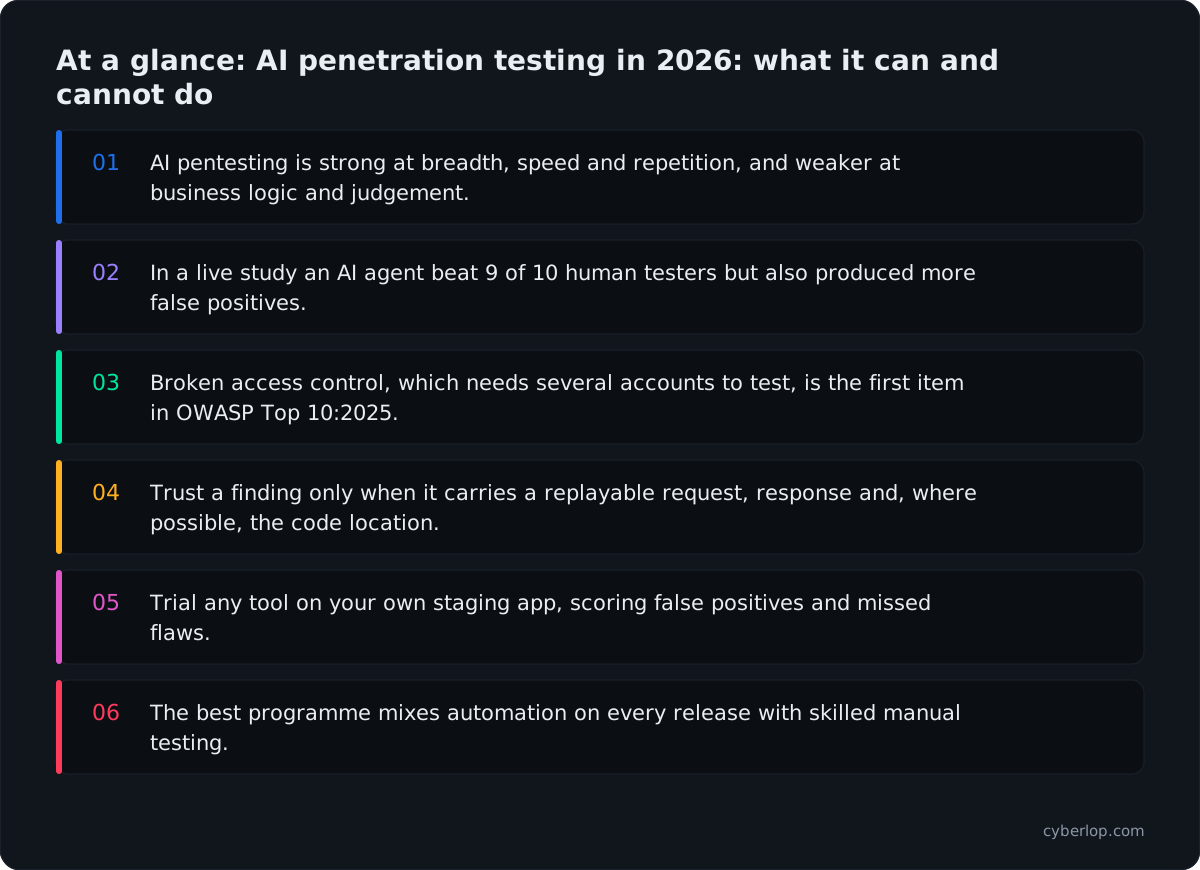
- AI pentesting is strong at breadth, speed and repetition, and weaker at business logic and judgement.
- In a live study an AI agent beat 9 of 10 human testers but also produced more false positives.
- Broken access control, which needs several accounts to test, is the first item in OWASP Top 10:2025.
- Trust a finding only when it carries a replayable request, response and, where possible, the code location.
- Trial any tool on your own staging app, scoring false positives and missed flaws.
- The best programme mixes automation on every release with skilled manual testing.
AI penetration testing is the use of AI models and software agents to plan and run security tests against an application, find vulnerabilities and try to exploit them. In 2026 it is good at fast, wide, repeatable work: mapping an app, trying known weakness patterns and drafting reports. It is weaker at business context, multi-step judgement and knowing when its own finding is wrong, so the findings you act on still need proof.
What is AI penetration testing?
AI penetration testing means a penetration test where an AI system does part or all of the work a human tester would do: reading the target, choosing what to try next, running tools, interpreting responses and writing up results. The term covers very different products, so the first job is to separate them.
A scanner with an AI summary on top is not the same thing as an agent that chooses its own next request. A human tester using an AI assistant is not the same thing as a tool that runs unattended. Vendors use one label for all three, and buyers compare them as if they were equal.
Three things people mean by "AI pentesting"
Table 1. Three products sold as "AI pentesting"
| Type | What the AI does | Where a human sits | Typical limit |
|---|---|---|---|
| AI-assisted tester | Helps a person write payloads, read code, summarise output and draft the report | Drives the whole test | Only as fast as the person using it |
| AI-enhanced scanner | Adds model-written triage, descriptions or fix advice to a rule-based DAST or SAST engine | Reviews the results | Still limited by the underlying rules |
| Autonomous agent | Plans, runs tools, adapts to responses and proposes findings with little supervision | Sets scope, approves risky steps, validates findings | Can be confidently wrong and can miss what needs context |
Most of what is written about AI in security testing is really about the third row. This guide is mainly about that row, because it is where the claims are biggest and the evidence is thinnest.
What can AI penetration testing do well in 2026?
AI penetration testing does well at breadth, speed and consistency: it can work through a large target quickly, repeat the same checks every day and keep going without tiring. Published evidence now shows it matching skilled people on some tasks, as long as the target suits it.
Evidence from research and bug bounty
The ARTEMIS study
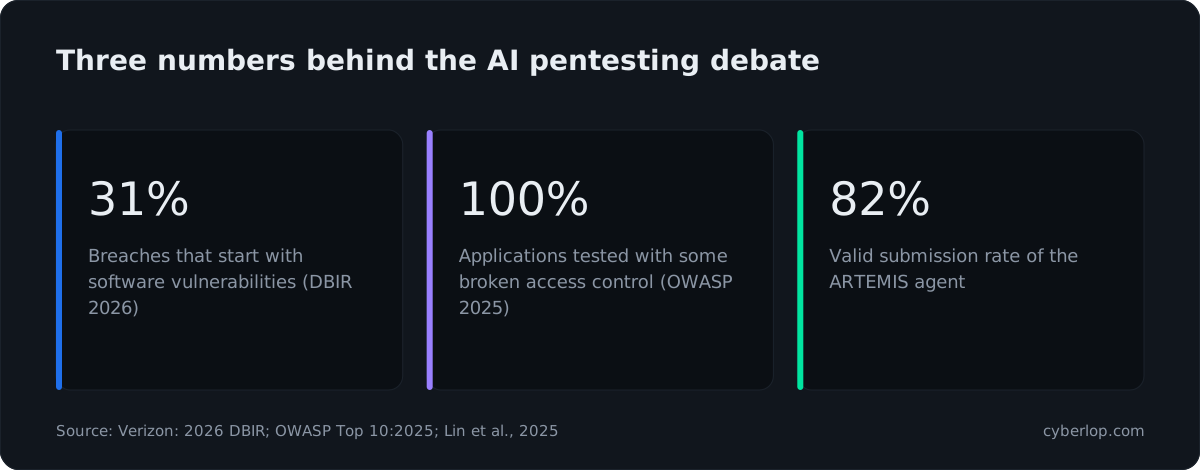
In a study by researchers from Stanford and Carnegie Mellon, an AI agent called ARTEMIS was run on a live university network of about 8,000 hosts alongside ten human security professionals. The paper reports that ARTEMIS found 9 valid vulnerabilities with an 82% valid submission rate and outperformed 9 of the 10 human participants.
The same paper is clear about the weak points. The agent produced more false positives than the humans and struggled with tasks that needed a graphical interface. One example: it reported default credentials as working after receiving "200 OK" responses that were really redirects to the login page. A person looking at the screen spots that at once.
XBOW on HackerOne
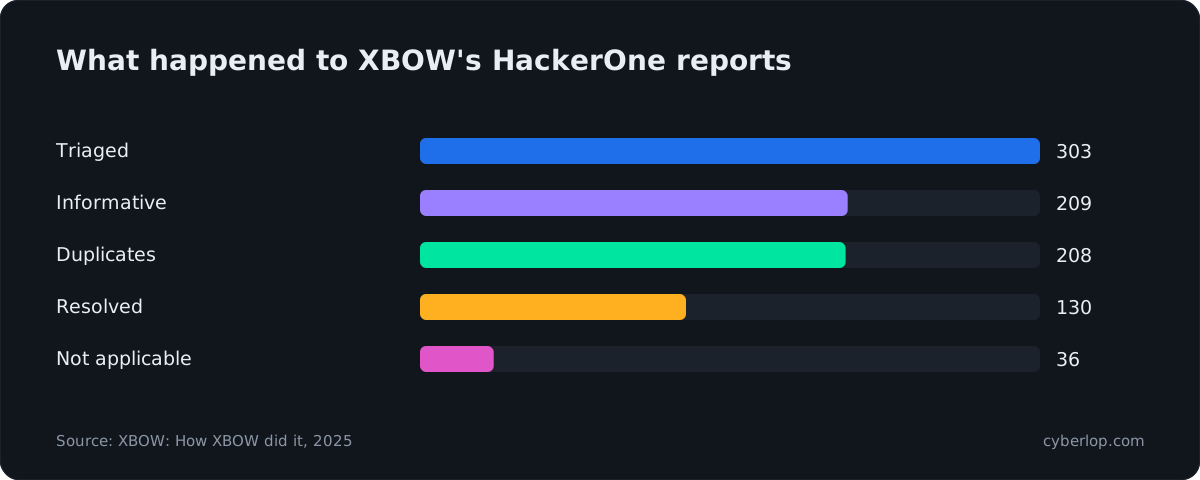
In June 2025, XBOW wrote that its autonomous tester had reached the top of HackerOne's US leaderboard. By its own account it had submitted nearly 1,060 vulnerabilities, reviewed by its security team before submission to comply with HackerOne's policy on automated tools. The same post lists the outcomes: 130 resolved, 303 triaged, 208 duplicates, 209 informative and 36 not applicable, with the rest new or pending.
That is real signal mixed with noise. Volume is easy for a machine. Reports that a programme owner accepts, fixes and has not already seen are harder to produce: 208 duplicates and 209 informative outcomes, out of nearly 1,060 submissions, means roughly two in five reports added little.
Where AI already helps most
- Reconnaissance and mapping. Crawling routes, reading API specifications, spotting forgotten endpoints and listing the technology stack.
- Known patterns at scale. Injection points, missing headers, exposed files, outdated components and common misconfigurations.
- Code reading. Following data from a request to a database call across many files, which suits white-box testing.
- Structured methodology. Walking the test cases in the OWASP Web Security Testing Guide (stable version 4.2) category by category.
- Repetition. Re-running the same checks on every release, which is what continuous pentesting needs.
- Writing. Turning raw output into readable reproduction steps and fix guidance.
What can't AI penetration testing do?
AI penetration testing cannot reliably judge what a flaw means for your business, and it often misses flaws that only exist because of how your product is supposed to work. It also cannot take responsibility for scope, safety or risk acceptance. Those stay with people.
Business logic and cross-account flaws
A business-logic flaw is a case where every request is valid and the outcome is still wrong: a coupon used twice, a refund larger than the payment, a step skipped in a checkout. No signature exists for it, because the rule being broken is yours. The tester has to learn the rule first.
The same applies to cross-account access. To see whether one customer's account can read another's invoice, a tool needs two real accounts, knowledge of which records belong to whom and a way to tell a correct refusal from a silent leak. OWASP's 2025 Top 10 puts Broken Access Control first and says 100% of the applications tested had some form of it. A tester that cannot reason about ownership will pass over the most common serious flaw on the list. Our article on why a scanner with one login misses this covers the mechanics.
Judgement under uncertainty
Prioritising and pivoting
In the ARTEMIS study, humans tended to deepen a foothold after finding a weakness, while the agent tended to submit a finding straight away. Turning one small issue into a serious chain is where experienced testers earn their fee, and where today's agents are less dependable. See chained vulnerabilities.
Graphical, human and physical steps
Anything that needs a mouse, a phone call or a badge is a poor fit. The ARTEMIS paper notes the agent struggled with graphical interfaces.
Owning the risk
A model cannot sign an attestation, decide that a risk is acceptable or answer an auditor's questions. Risk acceptance is a business decision with a named owner.
Table 2. Who is better at what in 2026 (a general guide, not a benchmark)
| Task | AI today | Human today |
|---|---|---|
| Mapping routes and APIs | Strong, fast | Slower, deeper on odd cases |
| Known vulnerability patterns | Strong at scale | Good, limited by time |
| Business-logic flaws | Weak unless taught the rules | Strong with product context |
| Cross-account access | Possible with multiple accounts and ownership knowledge | Strong with a clear access plan |
| Chaining small issues | Inconsistent | Core skill |
| Telling a real finding from noise | Needs proof built in | Strong, but slow at volume |
| Accepting risk and signing off | Cannot | Required |
Is AI penetration testing accurate?
It is accurate only to the extent that each finding carries proof. A model can describe a vulnerability convincingly whether or not it exists, so a report is worth the evidence attached to each claim and nothing more.
False positives and false negatives
A false positive wastes developer time and teaches a team to ignore the tool. A false negative is quieter and worse: the flaw is there and nobody knows. Ask about both. Vendors usually quote the first and never the second, because the second needs a known set of seeded flaws to measure.
What proof looks like
A finding is proven when someone can replay it. For a web application that means the exact request, the response that shows the problem, a screenshot where a person can see it, and, where code is available, the file and line. Compare these with "suspected" findings, which our post on exploited, not suspected argues against. Our guide to reading a finding shows what a complete one contains.
Also keep severity and confidence apart. A critical-severity finding with low confidence needs checking before it needs fixing.
Will AI replace human penetration testers?
Not in 2026. The better question is which parts of a test a machine should do and which a person should. The ARTEMIS agent was strong at breadth and weak at context, and that split points to using both.
Let automation do the broad, repeatable work on every release. Save scarce expert hours for logic, abuse cases and chained issues. Our guide to continuous penetration testing explains how to run both together, and DAST vs SAST vs IAST shows where each older technique still fits.
Why is AI penetration testing getting attention now?
Attackers are moving faster, and software flaws now start more breaches than stolen passwords do. Testing has to keep up.
Verizon's 2026 Data Breach Investigations Report says 31% of breaches now start with software vulnerabilities, which "beat stolen passwords as the top way attackers get in". The UK National Cyber Security Centre assessed in May 2025 that "the time between disclosure and exploitation has shrunk to days", and that AI will almost certainly shrink it further.
One annual test cannot answer that. A test that runs when the code changes can, and so can proof that a fix worked. See exploitability and vulnerability management for the basics.
How do you evaluate an AI penetration testing tool?
Judge it on proof, on whether it covers the flaws your app is likely to have, on safety controls, and on what happens after a finding. Ask for a trial on one of your own applications, with flaws you already know about, rather than a demo against a deliberately vulnerable app.
Questions to ask
Table 3. Twelve questions for any AI pentesting vendor
| Area | Ask this | A good answer |
|---|---|---|
| Proof | What evidence comes with each finding? | Request, response, screenshot and code location, replayable |
| Proof | Is anything reported that was not exploited? | Clearly separated from confirmed findings, or not reported |
| Coverage | Does it test with more than one signed-in account? | Yes, with ownership checks across accounts |
| Coverage | How does it handle business rules? | You can state the rules; it tests them |
| Coverage | Does it read source code? | Offers black-box, grey-box and white-box modes |
| Accuracy | Can you measure false negatives? | Yes, against flaws you seed or already know |
| Safety | What stops it damaging production? | Scope limits, rate limits, no destructive actions, approval gates |
| Data | Where do your code and traffic go? | Stays in your network, or the path is documented |
| Control | Can you see what it did? | Full log of every request |
| Fixes | How is a fix verified? | The same exploit is re-run, not a new scan |
| Fit | Does it work in CI/CD? | Schedules, triggers and can gate a build |
| People | Who validates and signs off? | A named person, with the limits in writing |
Red flags
No answer on missed flaws
A vendor that quotes finding counts and never mentions what it missed is selling volume. Ask what it did not find on a known test app.
Claims of replacing all testers
The research does not support it, and your auditor may not accept it. Our page on what we will and will not claim shows the standard we hold ourselves to.
Unbounded scope
If the tool cannot be restricted to named hosts, paths and methods, do not point it at production. See pentest scope and rules of engagement.
How do you run a fair trial of an AI pentest?
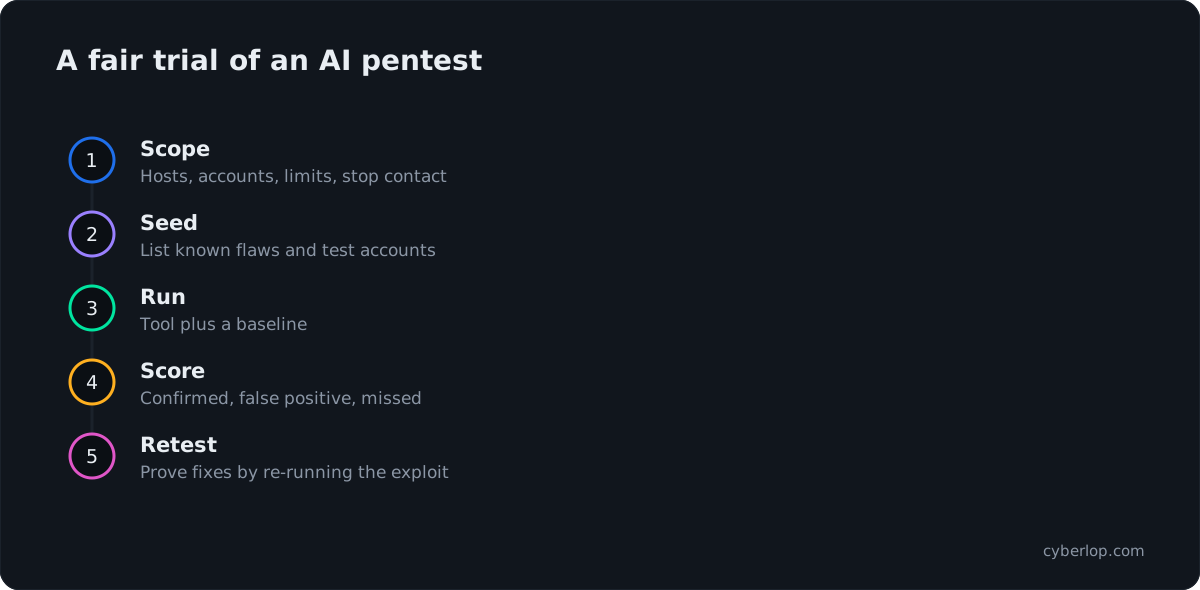
Run it on a staging copy of a real application, with known flaws, two or more test accounts and a written scope. Then score the output against what you know. The steps below take a week or two, not a quarter.
- Write the scope. Hosts, paths, accounts, forbidden actions, time window and a contact who can stop the test.
- Prepare the environment. Use staging with realistic but fake data. Create at least two accounts in different organisations, plus an admin.
- Seed or list known flaws. Include a cross-account read, a broken rule such as a reused coupon, an injection point and a harmless secret in client code.
- Run the tool and a baseline. Also run your current scanner or last human report for comparison.
- Score every finding. Mark each as confirmed, false positive or duplicate, using the evidence supplied.
- Score the misses. Count known flaws it did not report. This is the number vendors rarely give you.
- Fix and retest. Fix two findings, then check how the tool proves they are closed. See closed-loop retest.
- Decide where it fits. Per release, per month or before launch, and which parts still need a person.
Is it safe to let AI test your application?
It is safe when scope, permission and limits are fixed before it runs. Test only systems you own or have written permission to test, and treat the tool like any other powerful account.
- Written authorisation. From the system owner, naming targets and dates. Cloud and hosting providers have their own testing rules.
- Staging first. Production only after the tool has behaved well, with rate limits and no destructive actions.
- Least privilege. Give it throwaway accounts and short-lived keys, per the principle of least privilege.
- Where data goes. If code or traffic is sent to a hosted model, know where, for how long and under what terms. Our page on private scanning describes running inside your network.
- Prompt injection. A tool that reads untrusted content can be steered by it. The OWASP Top 10 for LLM Applications 2025 lists prompt injection first and excessive agency sixth.
Does an AI pentest satisfy compliance requirements?
That depends on the wording of the framework and your auditor, not on the technology. Standards generally ask for a qualified, independent test with a report and evidence of fixes, so ask before you buy.
NIST SP 800-115 gives practical recommendations for designing, implementing and maintaining technical security test processes, which means a plan, a method and a record, not only a tool run. For specifics see our guides to SOC 2, PCI DSS and ISO 27001 testing. Whatever you choose, keep the scope, request logs, findings and retest evidence, as evidence of exploitation.
How is AI pentesting different from a scanner or a manual test?
A scanner matches known patterns. A manual test applies human judgement over a few days. An AI pentest tries to bring machine speed to some of that judgement, and none of the three replaces the others.
Side-by-side comparison
Table 4. Four ways to find vulnerabilities
| Approach | Strength | Weakness | Best used |
|---|---|---|---|
| Scanner / DAST | Cheap, repeatable, wide | Pattern-bound; many false positives; one login | Every build, as a baseline |
| Manual pentest | Judgement, chaining, context | Slow, periodic, depends on the tester | Before launch and for high-risk features |
| AI-driven pentest | Speed and breadth with adaptive choices | Needs proof, context and human validation | Between manual tests and on every release |
| SAST | Finds code issues early | Cannot see runtime behaviour | In pull requests |
What a programme looks like
A practical programme runs SAST and dependency checks on every pull request, an automated pentest on each release, and a skilled manual test once or twice a year or after major changes. Findings from all of them go into one list with one owner, as in our guide to the vulnerability remediation process. If you are choosing a provider, start with how to choose a penetration testing company, and if your app was largely written by a model, read vibe coding security. Testing AI features themselves is a different job, covered in AI agent security testing.
What to keep human
Keep scope decisions, approval of risky steps, review of anything marked critical and the final risk-acceptance call with a person. Write that into the engagement terms, so nobody finds the gap during an incident.
What should you check before you buy? A short checklist
Before you trust an AI pentest
- Every finding has a replayable request and response.
- It tests with at least two accounts and reports cross-account results.
- You know its false negative rate on a set you control.
- Scope, rate limits and stop controls are written down.
- You know where your code and traffic go.
- A named person validates and signs off.
- A fix is checked by re-running the exploit.
- Your auditor has agreed it counts.
How does Cyberlop approach this?
Cyberlop finds vulnerabilities in web apps and their APIs with black-box, grey-box and white-box pentesting. Its rule is the one this guide recommends: if we did not exploit it, we do not report it. Each finding carries the request, the response, a screenshot where a person can see it and, in white-box mode, the line of code.
It also checks business-logic flaws and cross-account access, keeps severity and confidence apart, and proves a fix by re-running the exact exploit against the new code. It can run inside your network, on a schedule or in CI/CD. See how it works and what evidence looks like. The limits of any automated test are on our honest page.
Questions people ask
Ai penetration testing: FAQs
What is AI penetration testing?
AI penetration testing uses AI models and software agents to plan and run security tests, find vulnerabilities and try to exploit them. It ranges from a human using an AI assistant to an agent that runs largely unattended. The findings still need proof and human validation.
Can AI replace a human penetration tester?
Not in 2026. In a Stanford and Carnegie Mellon study, the ARTEMIS agent outperformed 9 of 10 human professionals on a live network, yet it produced more false positives and struggled with graphical interfaces. Use AI for breadth and repetition, and people for logic, chaining and sign-off.
How accurate is AI penetration testing?
Accuracy depends on evidence per finding. In the ARTEMIS paper 82% of submissions were valid, so roughly one in five was not. Ask any vendor for replayable proof and for results on flaws you already know about, including the ones it missed.
What can AI penetration testing not find?
It struggles with business-logic flaws that depend on your own rules, and with cross-account access that needs several accounts and knowledge of who owns what. It also struggles with steps that need a graphical interface, a person or a physical presence.
Is AI penetration testing safe to run on production?
Start on staging with written authorisation, a defined scope, rate limits and a way to stop it. Move to production only after it has behaved well. Know where your code and traffic go if a hosted model is involved.
Is an AI pentest accepted for SOC 2, PCI DSS or ISO 27001?
It depends on the wording of the framework and your auditor. They generally want a qualified test, a report, and evidence that findings were fixed. Ask your auditor before buying, and keep the scope, logs, findings and retest evidence.
How is AI pentesting different from a vulnerability scanner?
A scanner matches known signatures. An AI pentest chooses what to try next based on responses, so it can follow a path a scanner would not. Neither is proof on its own: the useful difference is whether each finding was actually exploited and shown.
How do I evaluate an AI penetration testing tool?
Run it on a staging copy of a real app with known flaws and at least two accounts. Score confirmed findings, false positives and missed flaws, and check how fixes are verified. The twelve questions in this guide make a good starting list.
Sources
Where the facts come from
- arXiv: Comparing AI Agents to Cybersecurity Professionals in Real-World Penetration Testing (Lin et al., 2025)
- XBOW: The road to Top 1: How XBOW did it (2025)
- Verizon: 2026 Data Breach Investigations Report
- NCSC (UK): Impact of AI on cyber threat from now to 2027
- OWASP: Top 10:2025 A01 Broken Access Control
- OWASP: Top 10 for LLM Applications 2025
- OWASP: Web Security Testing Guide
- NIST: SP 800-115 Technical Guide to Information Security Testing and Assessment
Keep reading
Related articles
AI agent security testing: a 2026 test plan for LLM apps and agents
AI agent security testing in 2026: a test plan for prompt injection, excessive agency, data leakage and cross-account access, mapped to OWASP.
Continuous penetration testing: how to run it alongside your annual pentest
What continuous penetration testing really means, how it compares with annual pentests, DAST and PTaaS, and how to run both in your pipeline.
DAST vs SAST vs IAST vs SCA: what each finds, what each misses, and how to combine them
DAST vs SAST vs IAST vs SCA compared: what each finds and misses, a comparison table, and the order to adopt them in a 2026 security programme.

Want proof, not just findings?
Cyberlop reports only what it exploited, with the request, the response, a screenshot and the line of code, and proves a fix by re-running the exact exploit. Ask us to run it on one of your applications.
Or start with a $199 pilot on one application: thirty days, success criteria agreed before day one, credited against the annual if you convert.