
Home / Blog / Continuous penetration testing
Buyer guides
Continuous penetration testing: how to run it alongside your annual pentest
Continuous penetration testing tests what you ship, when you ship it, and proves each fix. Here is how it differs from an annual pentest, a scanner and PTaaS, and how to combine them.
Cyberlop Labs · Updated · 15 min read
Continuous penetration testing is penetration testing tied to change instead of the calendar. Tests run when you release, add an endpoint or a role, or a new exploit appears; every finding is proven, and every fix is checked by re-running the exploit. It sits beside, not instead of, a yearly independent report.
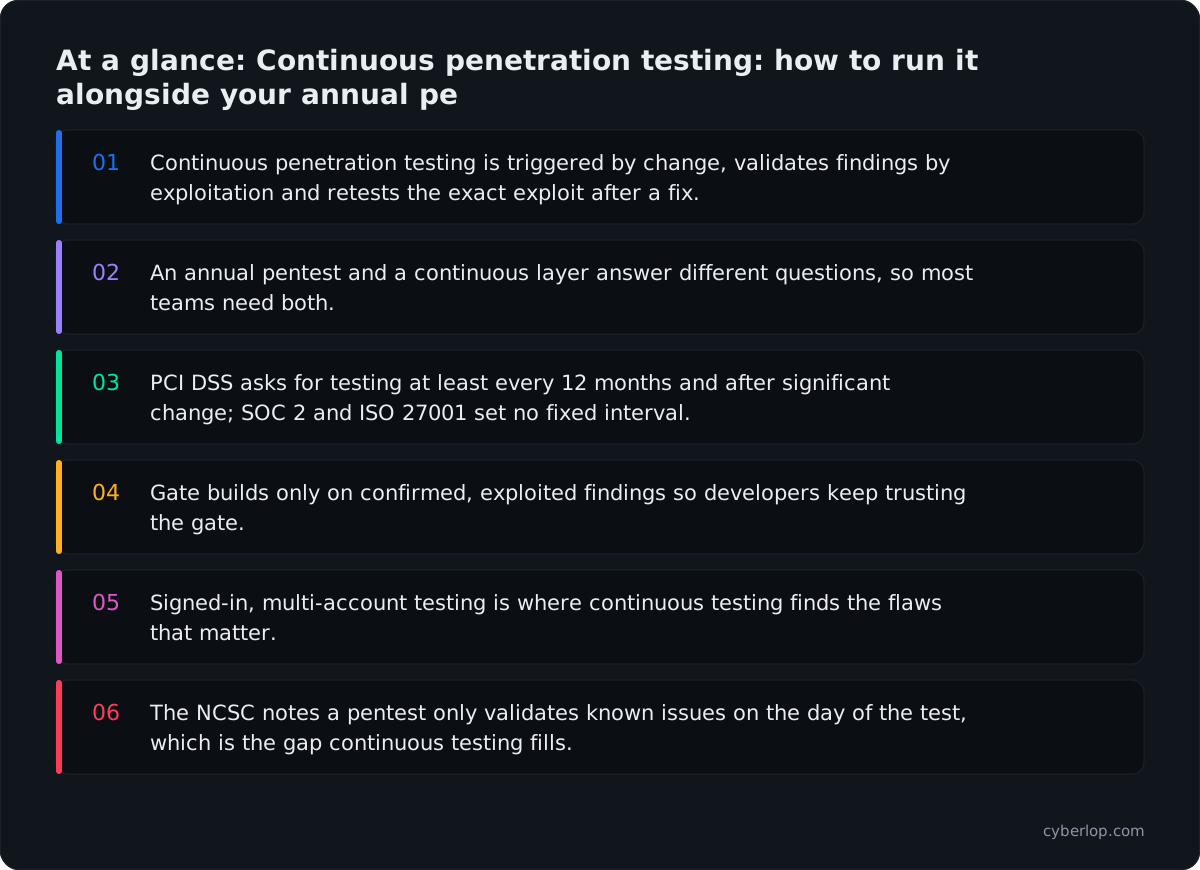
- Continuous penetration testing is triggered by change, validates findings by exploitation and retests the exact exploit after a fix.
- An annual pentest and a continuous layer answer different questions, so most teams need both.
- PCI DSS asks for testing at least every 12 months and after significant change; SOC 2 and ISO 27001 set no fixed interval.
- Gate builds only on confirmed, exploited findings so developers keep trusting the gate.
- Signed-in, multi-account testing is where continuous testing finds the flaws that matter.
- The NCSC notes a pentest only validates known issues on the day of the test, which is the gap continuous testing fills.
Continuous penetration testing means your application is tested for exploitable vulnerabilities on an ongoing basis, tied to the way you ship, rather than once a year. It does not mean a person is probing your app round the clock. In practice it is a mix of automated checks on every build, deeper authenticated testing when something important changes, and a person reviewing the results.
The honest answer to "annual or continuous?" is usually "both, doing different jobs". The annual test gives you a dated report an auditor accepts. The continuous layer catches the flaw you shipped on a Tuesday, long before the next report is due. This guide explains the difference, what the standards actually require, and how to run the two together.
What does continuous penetration testing actually mean?
The phrase is used loosely; the Knowledge Hub gives the short definition of continuous pentesting. Vendors apply it to scheduled scans, to subscription pentests, to platforms that deliver findings in a dashboard, and to automated tools that re-test after each deployment. These are different things, and a buyer who treats them as one will buy the wrong thing.
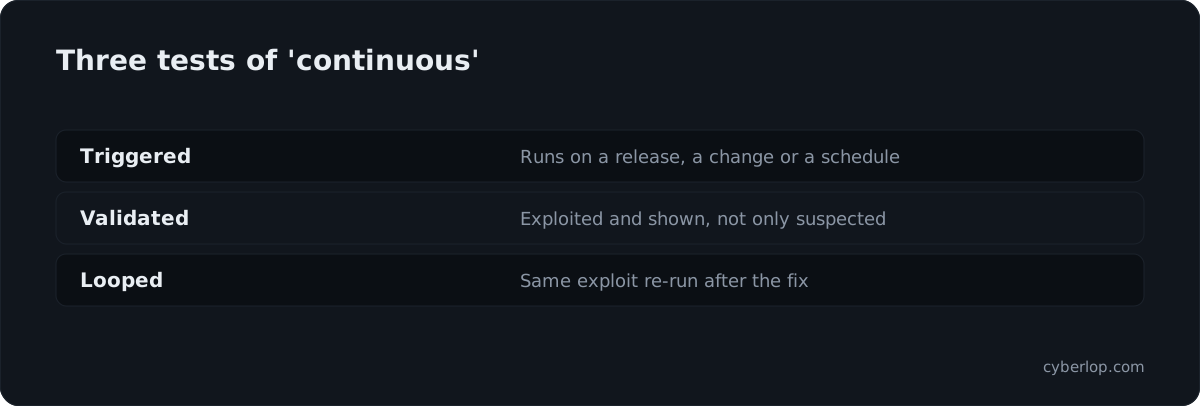
A useful working definition has three parts. Testing is triggered by change (a release, a new endpoint, a new role, a dependency bump) or runs on a fixed schedule. Findings are validated, meaning someone or something has shown the issue can be exploited rather than only suspected. And there is a loop back to the fix: when a developer ships a patch, the exact same exploit is run again to confirm it no longer works.
If one of those three is missing, you have something useful but not continuous pentesting. A scheduled scan with no validation is vulnerability scanning. A yearly engagement with unlimited emails afterwards is a normal penetration test. Both are worth having. Neither is continuous.
The idea borrows from a wider security habit. NIST SP 800-137 describes information security continuous monitoring as maintaining ongoing awareness of vulnerabilities and threats so that risk decisions rest on current information. Continuous pentesting applies the same instinct to a narrower question: can someone actually get through right now?
Why is an annual pentest not enough on its own?
A pentest report is a photograph. It describes the application on the days the testers were working on it, against the scope that was agreed. It cannot describe code that did not exist yet.
For a team that deploys weekly or daily, the gap is easy to picture. Suppose the test ends in March. In April you add a bulk-export endpoint, in May you change how invoices are shared between organisations, and in June you add a new admin role. None of those changes were tested by a person. Each of them touches the kinds of code where serious flaws live: ownership checks, role checks, and money.
The problem is not that annual tests are bad. A good one finds things automation will not, and the report is a clean record for customers and auditors. The problem is that a single yearly date creates a long stretch in which new code is untested by anything that behaves like an attacker. That stretch is the exposure continuous testing is meant to shrink.
What the evidence says about the gap
The UK NCSC is blunt about the limit: a penetration test checks only for known issues, and only on the day it is run, and it is "not uncommon for a year or more to elapse between penetration tests". The threat data points the same way. The Verizon 2026 Data Breach Investigations Report, covering 1 November 2024 to 31 October 2025, says 31% of breaches now start with software vulnerabilities, beating stolen passwords as the top way in.
The pace outside is quick too. When we read the CISA Known Exploited Vulnerabilities catalogue on 7 October 2026 it listed 1,734 entries, and some of the newest carried a due date only three days after they were added. These numbers do not say your app is weak. They say that waiting twelve months to look is a long time.
Three failure patterns that repeat
- The regression nobody re-tests. A finding is fixed in February, a refactor in July quietly removes the fix. Nothing in the pipeline notices because no check exists for that specific exploit. See regression.
- The new feature outside the scope. The report lists the endpoints that existed at kick-off. The endpoints added afterwards are, strictly speaking, untested.
- The fix that was never proven. The ticket says "closed", but nobody ran the original exploit again. The scanner no longer flags it, which is not the same thing as the exploit failing.
How does continuous pentesting differ from an annual pentest, DAST and PTaaS?
These four terms overlap, and search results blur them. The table separates them by what they do rather than by what the brochure calls them. For a deeper look at the scanner side, read our guide on DAST, SAST and IAST.
| Question | Annual pentest | Scheduled DAST scan | PTaaS subscription | Continuous pentesting |
|---|---|---|---|---|
| When does it run? | Once or twice a year | On a schedule or per build | Booked engagements through a platform | On change, on a schedule, or both |
| Who does the work? | Human testers | A tool | Humans, with a platform | Automation plus human review |
| Are findings proven? | Usually yes | Often not; many are suspicions | Usually yes | Yes, if it reports only what was exploited |
| Business-logic and cross-account flaws | Yes, where testers have time | Rarely | Depends on the engagement | Possible when accounts and code are available |
| Catches new code between reports | No | Yes, for what scanners can see | Only if you book another test | Yes, that is the point |
| Retest after the fix | One retest, usually within a window | Re-scan, not the same exploit | Usually offered | Same exploit re-run against the new code |
| Audit-ready report | Yes | Not on its own | Yes | Depends on how it is produced; confirm with your auditor |
The comparison shows why "continuous versus annual" is the wrong framing. They answer different questions. Annual testing answers "has a skilled person looked hard at this system lately?". Continuous testing answers "is what we shipped this week exploitable?". The Knowledge Hub entry on pentest as a service gives the short version.
What do PCI DSS, SOC 2 and ISO 27001 actually require?
Only PCI DSS puts a penetration-testing interval in writing, and none of the three asks for "continuous" testing in those words. Continuous testing helps with the "after significant change" part and keeps evidence fresh, but it does not replace the periodic report an auditor expects.
PCI DSS v4.0.1
Requirement 11.4 covers penetration testing. It asks for a defined methodology, testing at least once every 12 months and after any significant infrastructure or application change, coverage of internal and external networks and the application layer, and a repeat test to confirm corrections. The standard sits in the PCI Security Standards Council document library; see PCI DSS 11.4 and our guide to PCI DSS penetration testing requirements.
SOC 2 and ISO 27001
Neither sets a testing frequency the way PCI DSS does. SOC 2 rests on the AICPA Trust Services Criteria, and ISO/IEC 27001:2022 includes controls on technical vulnerability management and on security testing in development and acceptance. Your auditor decides what evidence is enough, so ask early and write the answer into your testing policy. Our posts on SOC 2 penetration testing and ISO 27001 penetration testing cover what to bring. Customer questionnaires usually ask for the date and scope of your last independent test, so keep one clean, dated summary even if most of your testing is continuous.
What should you automate, and what still needs a person?
Frequent tests give human judgement something current to look at; they do not replace it. Whatever the cadence, follow a published method such as the OWASP Web Security Testing Guide (stable release 4.2) or NIST SP 800-115, so frequent tests stay easy to defend.
Good candidates for continuous automation
- Known exploit paths you have already found. Once a flaw is fixed, keep the exploit as a permanent check. This is the cheapest regression insurance there is.
- Authentication and session behaviour. Login, logout, token expiry, password reset and multi-factor flows change often and break in predictable ways.
- Access control on high-value endpoints. Checking what each signed-in account can reach that it should not is repeatable once the accounts and test data are set up.
- Injection and input handling on new parameters. New fields and new endpoints are where injection appears first.
- Configuration drift. Missing headers, debug modes left on, exposed staging hosts. OWASP moved Security Misconfiguration from fifth place in 2021 to second in its Top 10:2025.
What still benefits from a human tester
- Chained attacks. Joining three low-severity quirks into one serious path takes imagination.
- Novel business logic. A workflow your company invented has no pattern library. Someone has to read it and ask what a customer could do that you never intended.
- Judgement on impact. Whether an issue matters commercially depends on your data, contracts and customers.
- Scoping and rules of engagement. Deciding what is safe to test in production is a human decision.
The balance is moving as tools improve, and we cover what automated and AI-assisted testing can and cannot do in AI penetration testing. For now, treat any claim that a tool fully replaces a skilled tester with caution, and ask to see the evidence behind its findings. Our own limits are written down on the honest page.
How do you add continuous pentesting to CI/CD without breaking the build?
Tying tests to the pipeline is the most practical form of continuous testing, and the easiest to get wrong. A scan that takes 90 minutes and fails builds for unclear reasons will be switched off within a month.
The OWASP DevSecOps Guideline places DAST alongside SAST, IAST and dependency checks as stages you add to the pipeline progressively, tuned to your own delivery process. That advice holds up. Start small and add stages as the team trusts the signal.
A sensible staged approach
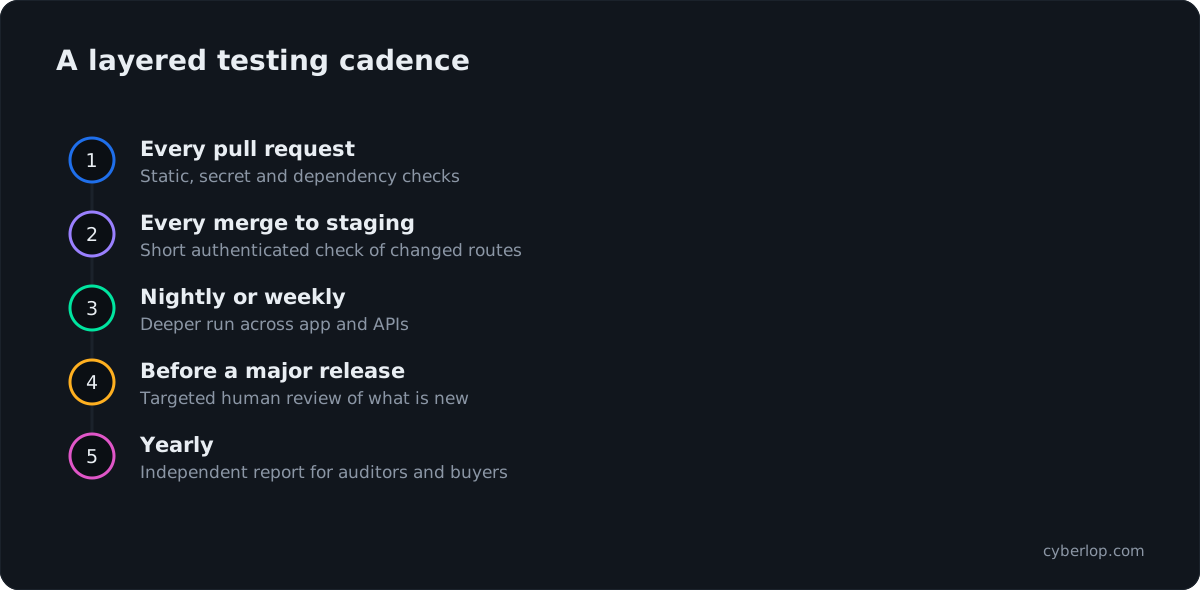
- On every pull request: fast static checks, secret scanning and dependency checks. These take minutes and give the author immediate feedback.
- On every merge to a test environment: a short dynamic check against the running build, covering login, session handling and the endpoints that changed.
- Nightly or weekly: a deeper authenticated run across the full application, with seeded accounts and test data.
- Before a major release: a targeted manual review of whatever is new and risky, by a person.
- Once a year (or as the framework requires): the independent pentest that produces the formal report.
Each layer is cheap where it is fast and expensive where it is thorough. That is the whole design. You do not need the heavy test on every commit, and you do not want to rely on the light test alone.
What should fail a build?
A build gate should block only on something the team will accept as real. If it fails on suspicions, developers learn to override it. Agree the rule in advance and write it down. The table is a starting policy; set your own thresholds.
| Finding state | Build action | Who acts |
|---|---|---|
| Exploited, high severity, high confidence | Block the release | Feature team, same day |
| Exploited, medium severity | Warn, with a ticket and due date | Feature team, per your SLA |
| Suspected, not proven | Never blocks; goes to triage | Security owner |
| Accepted risk | Pass, with an expiry date | Named approver |
Keep severity and confidence apart
Severity says how bad the outcome would be; confidence says how sure you are the flaw is real. A gate that reads both blocks fewer builds and keeps its credibility, and it keeps the false positive rate low enough to survive a deadline. The same thinking drives the vulnerability remediation process, where severity sets the clock.
Start in report-only mode
Run the gate in report-only mode for a few weeks, then switch on blocking once the team trusts the signal. Put an expiry on every exception.
ZAP, the open-source web scanner, documents packaged Docker scans, a GitHub Action and an Automation Framework (ZAP automation documentation). Whatever you choose, check that it can run against an environment with realistic data and several signed-in accounts, because that is where the interesting flaws live.
Why does signed-in depth decide whether it is worth it?
A scheduled scan that only sees the public pages tests the least interesting part of your product. The flaws that cost companies customers sit behind login: one organisation reading another's invoices, a support role approving its own refund, a trial account using a paid feature.
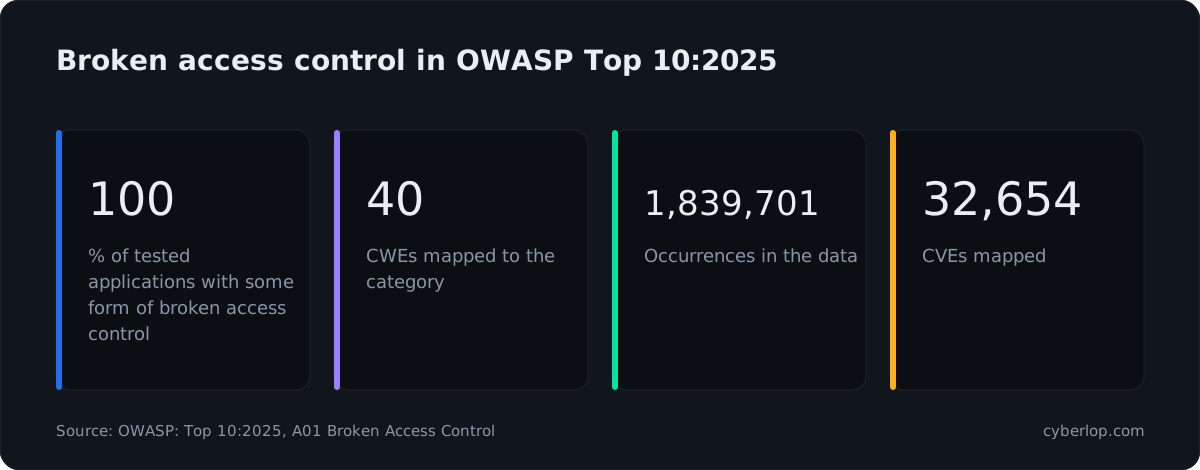
Continuous testing earns its keep when it is configured with several test accounts of different types and checks what each can reach that it should not. That is authenticated testing aimed at broken object-level authorization and business-logic flaws. Generic scanners struggle here because they do not know what the data means. The OWASP Top 10:2025 found some form of broken access control in 100% of the applications tested, and it stays at number one. Our post on why a scanner with one login misses the real problems goes into the detail.
Setting this up is real work: seeded accounts, stable test data and rules about what is safe to touch. It is the same setup a good annual tester will ask for, so it pays back twice.
How do black-box, grey-box and white-box fit a continuous programme?
The testing mode changes what continuous testing can see.
- Black-box testing sees only what an outsider sees. It is the right check on the exposed surface and on whatever is internet-facing, and it needs no access to your code.
- Grey-box testing adds signed-in accounts and some knowledge of how the application is built. It is the usual sweet spot for business logic and access control.
- White-box testing adds the source code. A finding can then point at the file and line responsible, which shortens the fix and makes a retest more precise.
A mature programme often uses all three. Black-box runs against production-like environments on a schedule, grey-box runs in staging after each significant change, and white-box runs where the team is willing to share code. For a fuller treatment, see the black-box, grey-box and white-box comparison. If your code cannot leave your network, private scanning runs the testing inside it.
How do you close the loop after a fix?
The single most valuable habit in continuous testing is also the least common. When a developer ships a fix, run the original exploit again against the new code. If it fails, the fix is proven. If it succeeds, the ticket was closed too early.
A fresh scan is not the same test. A scanner may stop flagging an issue because the page layout changed, the error message changed or a parameter was renamed, while the underlying flaw remains. Re-running the identical request, with the identical account, answers the real question. This is a closed-loop retest.
Keep every proven exploit
Once an exploit has been proven and fixed, turn it into a permanent regression check in the pipeline. Over a year, that library guards against the same mistake returning. For the evidence side, our post on what belongs in a finding sets out the four parts a proven finding carries, and exploited, not suspected explains why unproven results get left out.
How do you run annual and continuous testing together?
This pattern fits most software companies with a small security function or none.
A two-layer programme
- Layer one, continuous: automated and validated testing wired to your releases, with a nightly or weekly authenticated run and a gate on confirmed high-severity findings.
- Layer two, periodic: an independent human-led pentest once a year, or after a major redesign, producing the formal report your customers and auditors ask for.
- The link between them: share findings, accounts and the exploit library with the annual testers so they start from your known weak spots instead of rediscovering them.
- One owner: a named person per finding, with a deadline set by severity.
- One record: every finding, fix and retest in a single dated history.
Define "significant change" in writing
Many frameworks ask for testing after significant change, so decide what that means before an auditor asks. The table gives one workable starting list; adjust it to your product.
| Trigger | Why it matters | Test that follows |
|---|---|---|
| New authentication or session method | Small edits can reopen old holes | Full login, reset and session checks |
| New role, tenant rule or sharing feature | Ownership checks sit here | Cross-account checks on the new surface |
| New payment, export or public API | Money and bulk data raise the stakes | Business-logic and abuse-case tests |
| Framework upgrade or hosting move | Defaults change quietly | Configuration and regression run |
| Newly exploited flaw in a dependency you use | Public exploits spread fast | Check whether it is reachable in your app |
Write down who signs it off
For each trigger, name the test that runs, the person who reviews the result and where the record is kept. That record is what an auditor will later read.
What should you ask a provider before you buy?
Because the term is applied so loosely, the buying conversation matters more than the product name. These questions separate continuous testing from relabelled scanning.
- What triggers a test: a schedule, a deployment, an API call, or only a person booking one?
- Does every finding include the request, the response and evidence of exploitation, or are suspicions mixed in?
- Are severity and confidence reported separately?
- Can it test with several signed-in accounts and check cross-account access?
- When we fix something, is the original exploit re-run, or is a scan repeated?
- Can it run inside our network if our code or data must not leave it?
- Can it block a build, and can we set the threshold?
- What does it say it cannot do?
The last question is a test of honesty: a provider that answers "nothing" is selling, not informing. For a longer checklist see how to choose a penetration testing company, and for the cost drivers behind a quote read penetration testing cost.
What mistakes do teams make when they move to continuous testing?
- Starting with the gate. Blocking builds before the signal is trusted trains the team to bypass it.
- Testing only the front page. Without accounts and data, the run misses most of the risk.
- Counting findings, not fixes. Track time from discovery to proven fix; see mean time to remediate.
- Dropping the annual test. Unless your auditor and customers agree otherwise, keep the independent report.
- No owner. A finding with no named owner and no date will still be open next quarter.
How do you start in four weeks?
You do not need a large project. A small team can move from annual-only to a working continuous layer in a month.
- Week one: scope and accounts. List your most valuable flows (sign-up, payments, data sharing, admin actions). Create test accounts of each type and a resettable test environment.
- Week two: first run, report only. Run authenticated testing against staging. Review every finding with an engineer and discard anything that cannot be reproduced.
- Week three: fix and retest. Fix the confirmed items, then re-run the exact exploits. Keep each one as a regression check.
- Week four: wire it in. Add the quick checks to the pipeline, schedule the deep run, and agree the gate threshold and the owner for each severity.
After that, review the results monthly. The thing to watch is not how many issues were found but how quickly each one was fixed and proven closed. See how Cyberlop works and the integrations page for how this fits a pipeline, and what a finding looks like for the proof each one carries.
Summary
Continuous penetration testing keeps the annual report true between dates; it does not replace the report. Test on change, validate what you find, prove each fix by re-running the exploit, and keep the independent test for the record. Do that, and "when were we last tested?" has a short and recent answer.
Questions people ask
Continuous penetration testing: FAQs
Is continuous penetration testing better than an annual pentest?
Neither is better on its own, because they answer different questions. An annual test gives a skilled, independent review and a dated report auditors recognise. Continuous testing checks what you ship between those dates. Most teams are best served by running both.
Is continuous pentesting the same as PTaaS?
Not necessarily. Pentest as a service describes a delivery model: a platform, a subscription and findings shown online. It can still mean tests that are booked a few times a year. Continuous testing is defined by what triggers it and whether fixes are retested, not by the platform.
How often should you penetration test a web application?
At least once a year and after significant change is the common baseline, and PCI DSS requires it for in-scope systems. Teams that release often add automated authenticated testing on each significant change or on a weekly schedule, with a human-led test for major redesigns.
Does continuous testing satisfy PCI DSS, SOC 2 or ISO 27001?
It can support them, but confirm with your assessor. PCI DSS asks for penetration testing at least every 12 months and after significant change, with a defined methodology. SOC 2 and ISO 27001 do not set a fixed interval. Keep a dated, readable report as evidence either way.
Can continuous penetration testing run in CI/CD?
Yes. Quick checks can run on each pull request or merge, with a deeper authenticated run nightly or weekly. Gate the build only on findings that were exploited and confirmed at an agreed severity, so the gate stays trusted.
Is continuous penetration testing safe to run against production?
It can be, with limits. Agree rules of engagement, avoid destructive actions, use synthetic test accounts and data, and prefer a staging environment that mirrors production for deep runs. Run lighter, non-destructive checks against production only where you have approved them.
How is continuous pentesting different from a vulnerability scanner?
A scanner reports what might be wrong, often without proof. Continuous pentesting validates findings by exploiting them, covers signed-in behaviour and business logic where it can, and re-runs the exploit after a fix. Scanners are still a useful cheap layer inside it.
What should I ask a continuous pentesting provider?
Ask what triggers a test, whether each finding includes the request, response and evidence of exploitation, how fixes are retested, whether it works with several signed-in accounts, and what the tool cannot do. Our buyer questions above give a full list.
Sources
Where the facts come from
- NCSC: Penetration testing
- Verizon: 2026 Data Breach Investigations Report
- CISA: Known Exploited Vulnerabilities Catalog
- OWASP: Top 10:2025, A01 Broken Access Control
- OWASP: Top 10:2025 Introduction
- PCI Security Standards Council: Document Library (PCI DSS v4.0.1)
- NIST: SP 800-137, Information Security Continuous Monitoring (ISCM)
- NIST: SP 800-115, Technical Guide to Information Security Testing and Assessment
- OWASP: Web Security Testing Guide
- OWASP: DevSecOps Guideline
- ZAP: Automation documentation
Keep reading
Related articles
AI penetration testing in 2026: what it can and cannot do
AI penetration testing in 2026: what it does well, where it fails, how accurate it is, and questions to ask before you trust a tool.
Black box vs white box penetration testing: which to choose
Black, grey and white box penetration testing compared: what each finds and misses, how effort differs, when to choose each and how to combine them.
DAST vs SAST vs IAST vs SCA: what each finds, what each misses, and how to combine them
DAST vs SAST vs IAST vs SCA compared: what each finds and misses, a comparison table, and the order to adopt them in a 2026 security programme.

Test what you shipped this week
Cyberlop runs black-box, grey-box and white-box testing on a schedule or in CI/CD, reports only what it exploited, and proves each fix by re-running the exact exploit. Ask us to run it on one of your applications.
Or start with a $199 pilot on one application: thirty days, success criteria agreed before day one, credited against the annual if you convert.