
Buyer guides
DAST vs SAST vs IAST vs SCA: what each finds, what each misses, and how to combine them
DAST tests the running app, SAST reads the code, IAST watches from inside and SCA checks your packages. Here is what each finds, where it stops, and the order to adopt them in.
Cyberlop Labs · Updated · 12 min read
DAST vs SAST: SAST reads source code without running it, DAST tests the running application from outside, IAST monitors code from inside while it runs, and SCA checks open-source dependencies. Each finds different flaws. Use SAST, SCA and DAST as a baseline, and add a penetration test for access control and business logic.
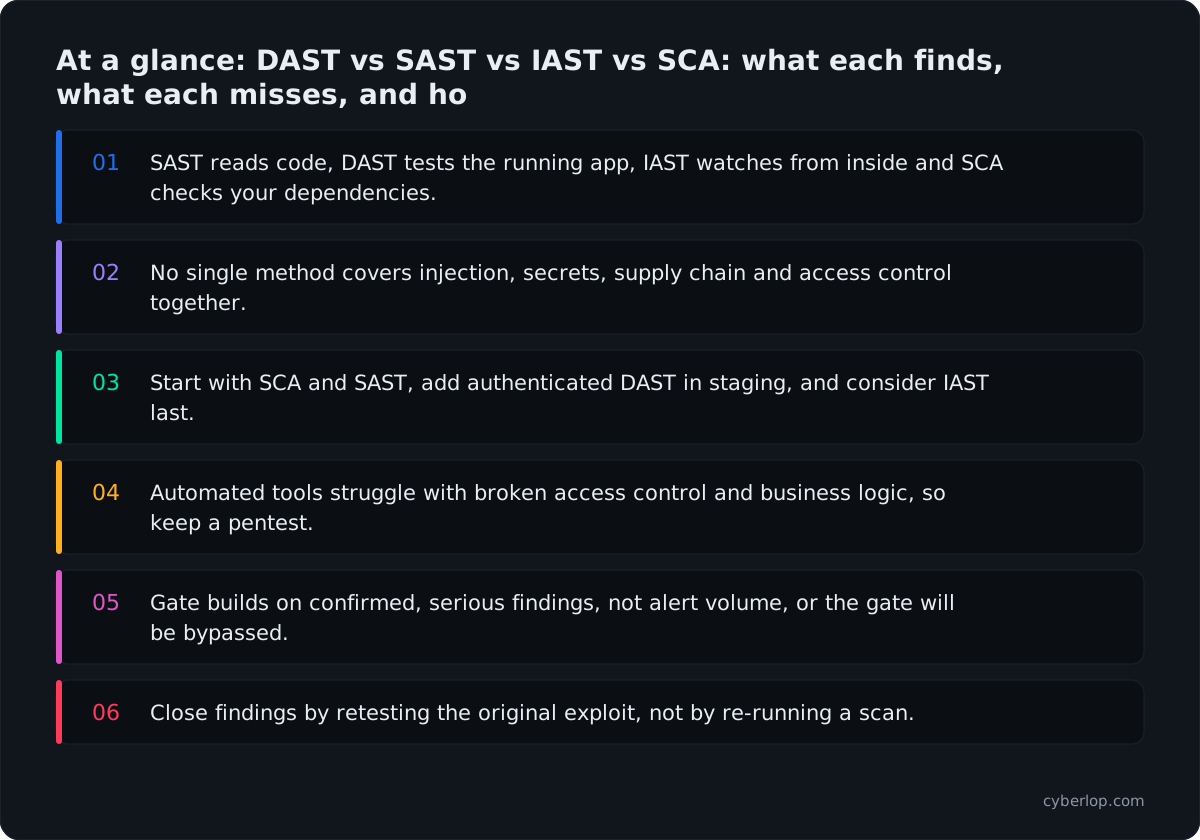
- SAST reads code, DAST tests the running app, IAST watches from inside and SCA checks your dependencies.
- No single method covers injection, secrets, supply chain and access control together.
- Start with SCA and SAST, add authenticated DAST in staging, and consider IAST last.
- Automated tools struggle with broken access control and business logic, so keep a pentest.
- Gate builds on confirmed, serious findings, not alert volume, or the gate will be bypassed.
- Close findings by retesting the original exploit, not by re-running a scan.
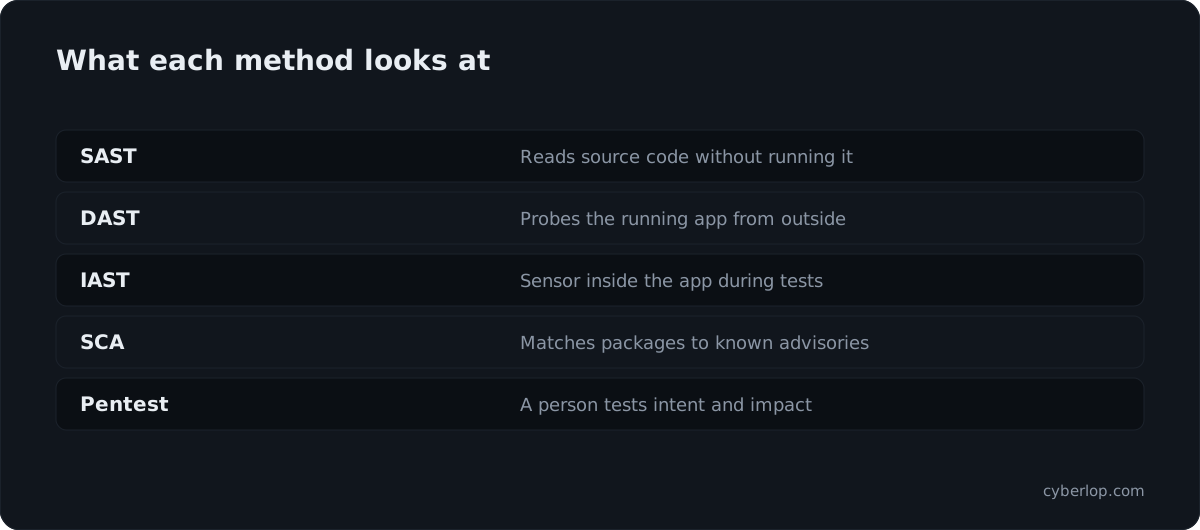
DAST vs SAST is a question of vantage point. SAST reads your source code without running it, DAST probes the running application from outside, IAST watches the code from inside while it is exercised, and SCA checks the open-source packages you ship. Each finds a different class of flaw, so most teams need SAST, SCA and DAST together, plus a human-led penetration test for logic and access-control flaws.
What is the difference between DAST and SAST?
SAST (static application security testing) analyses source code, bytecode or binaries without executing them. DAST (dynamic application security testing) sends requests to a running application and judges the responses, with no need for the code. The difference is what each can see: SAST sees every line but not how the app behaves when deployed; DAST sees real behaviour but not the code behind it.
Two more terms complete the usual list. IAST (interactive application security testing) places a sensor inside the running app and reports issues as tests or users exercise it. SCA (software composition analysis) inventories your third-party components and matches them against known vulnerabilities. Neither is a replacement for the other two; they answer different questions.
DAST, SAST, IAST and SCA side by side
| Method | What it examines | When it runs | Finds well | Typically misses | Needs |
|---|---|---|---|---|---|
| SAST | Source code, bytecode, binaries | Editor, pull request, build | Injection patterns, hardcoded secrets, unsafe functions, coding-standard breaks | Deployment settings, access-control intent, flaws that need a running state | Code access and a supported language |
| DAST | The running app or API from outside | Staging or a test environment, nightly or per release | Input handling, server configuration, authentication problems, exposed endpoints | Code that no request reaches, intent-dependent logic flaws | A reachable app and test accounts |
| IAST | Code paths inside the running app | During automated tests or manual use | Issues with exact code location, taint flows that tests actually trigger | Anything your tests never exercise; unsupported runtimes | An agent in the app and good test coverage |
| SCA | Third-party packages and their dependencies | Build, scheduled, on new advisories | Known-vulnerable libraries, licence issues, SBOM data | Flaws in your own code; whether the vulnerable function is reachable | A lockfile or manifest |
| Manual pentest | Everything a person can reach and reason about | Per release or on a cycle | Logic flaws, cross-account access, chained issues, proof of impact | Breadth at speed; it is a point-in-time exercise | Scope, accounts and time |
OWASP describes the three dynamic and static families in its DevSecOps Guideline. It calls DAST a black-box approach that finds flaws in a running application without source access, and notes that SAST is usually part of a code review, which is a white-box method (OWASP DAST, OWASP SAST). Our guide to black box, grey box and white box testing explains how those labels map to pentests.
How does each method work in practice?
Knowing the definition is not enough to choose. This section walks through what each method does on an ordinary web application and API, what you can expect from it and where it stops.
SAST: reading the code
A SAST tool parses your code into a model and looks for patterns that match known weaknesses, such as user input reaching a database query without parameters. It runs early, often on every pull request, so a developer sees the problem next to the line that caused it. OWASP lists this as a core strength: SAST tools "highlight the problematic code, by filename, location, line number" (OWASP Source Code Analysis Tools).
What SAST finds well
Look to SAST for classic code-level mistakes: SQL injection sinks, command injection, weak hashing calls, unsafe deserialisation, hardcoded secrets and banned functions. It scales across large repositories and can be rerun cheaply.
What SAST misses
The same OWASP page is frank about the limits. It lists authentication problems, access-control issues and insecure use of cryptography as areas where tools struggle, adds that SAST often cannot find configuration issues "since they are not represented in the code", and warns that it is hard to "prove" a flagged issue is a real vulnerability. Expect a false-positive rate you must manage.
DAST: testing the running app
A DAST tool crawls the application or reads its API description, sends crafted requests and watches the responses for signs of a flaw. OWASP characterises it as injecting malicious payloads to find issues such as SQL injection and cross-site scripting, with little interaction once configured. Because it does not need the code, you can point it at a staging site in an afternoon and it works whatever the language.
What DAST finds well
DAST suits input and output handling, server and header configuration, exposed admin paths, authenticated scans of pages behind a login, and anything that only appears at runtime. It confirms a flaw by producing the response that proves it, which is why developers trust its findings more.
What DAST misses
DAST can only report what a request reveals. It cannot tell you which line to change, it may never reach screens that need a particular state, and a scanner does not know that account A should not read account B's invoice. Those flaws need intent, which is why tools alone leave a gap (see the section on what a penetration test adds).
IAST: testing from inside
OWASP defines IAST as testing the application "while the app is run by an automated test, human tester, or any activity interacting with the application functionality", using embedded sensors that can see code, data flow and configuration (OWASP IAST). It combines runtime context with code location, which cuts guesswork.
What IAST finds well
When your test suite is strong, IAST can report a flaw with the stack trace and the file, with fewer false alarms than static analysis. It fits teams with solid integration tests on a supported language and framework.
What IAST misses
Its visibility equals your coverage: a route no test or user touches is invisible to it. It also needs an agent in the application, which means a deployment change, a performance check and a supported runtime. For many small teams that cost outweighs the benefit, so treat IAST as an add-on rather than a starting point.
SCA: checking what you depend on
Modern applications are mostly other people's code. SCA lists your direct and transitive dependencies, matches them to advisories such as the National Vulnerability Database, and often produces an SBOM. OWASP's Top 10 for 2025 recommends exactly this: continuously monitor CVE and NVD sources for the components you use, and let SCA or SBOM tooling automate the work (OWASP A03:2025).
What SCA finds well
It finds known-vulnerable libraries, outdated packages and licence risk fast and with few false positives, because it matches versions rather than guessing at behaviour.
What SCA misses
SCA says nothing about the code you wrote. A listed CVE may sit in a function your app never calls, so triage by reachability and by whether the flaw is on the known-exploited list. Malicious or typosquatted packages need extra checks beyond version matching.
Why is one tool never enough?
One tool is never enough because the main ways applications are breached sit in different layers: unpatched components, missing authorisation, and exploitable running code. Public data from 2025 and 2026 backs this up.
- Vulnerability exploitation is a leading entry route. The Verizon 2026 Data Breach Investigations Report page states that 31% of breaches now start with software vulnerabilities.
- Access control fails almost everywhere. In the data behind OWASP's Top 10:2025, 100% of applications tested had some form of broken access control, with an average incidence rate of 3.74% and 1,839,701 recorded occurrences.
- Supply chain failures are now a Top 10 category in their own right. OWASP A03:2025, Software Supply Chain Failures, reports an average incidence rate of 5.72%.
- Known-exploited flaws keep accumulating. The CISA Known Exploited Vulnerabilities catalogue listed 1,734 entries when we opened it on 7 October 2026.
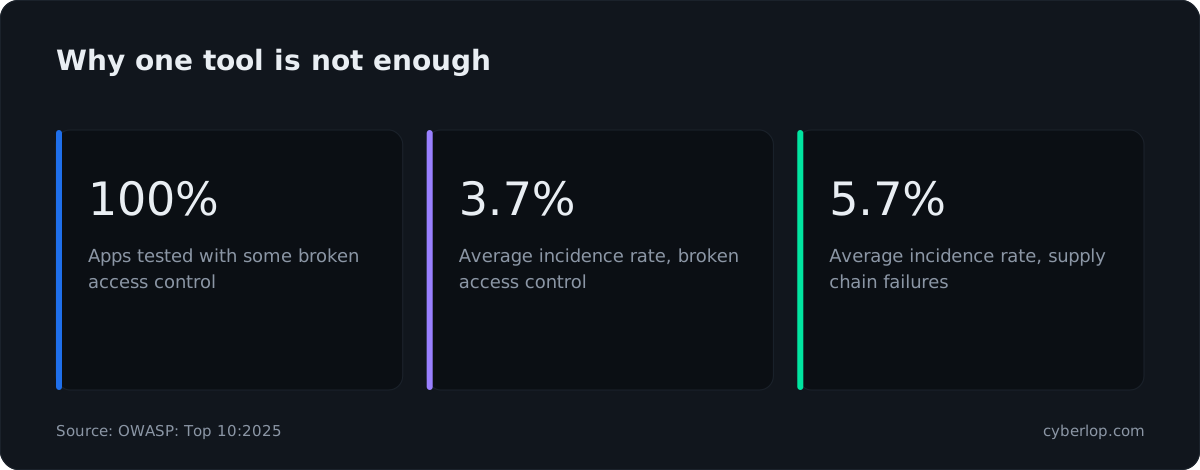
The mix matters. Supply chain issues are an SCA job. Injection and secrets suit SAST. Exposed behaviour suits DAST. Access control, the most widespread of the four, is the weak spot for all automated scanners, and the next section shows why.
What does a penetration test add to DAST and SAST?
A penetration test adds judgement: a tester decides what the application is meant to allow, then checks whether it really does. That is how flaws in business logic and cross-account access are found, and why they usually escape scanners. A scanner has no model of who should see which invoice.
The same OWASP data shows the stakes. Since all of the applications tested had some form of broken access control, and SAST tools struggle with it by OWASP's own account, the gap is not a corner case. It is the main one. Our guides on access control testing and broken object level authorization show what testing it looks like.
Which flaw is best caught by which method?
The table below is a practical guide, not a guarantee. "Good" means the method is a primary detector; "Partly" means it catches some cases or hints at the problem; "Weak" means do not rely on it.
| Weakness | SAST | DAST | IAST | SCA | Pentest |
|---|---|---|---|---|---|
| Injection (SQL, command) | Good | Good | Good | Weak | Good |
| Hardcoded secrets | Good | Weak | Partly | Weak | Partly |
| Known-vulnerable library | Partly | Partly | Partly | Good | Partly |
| Server and header misconfiguration | Weak | Good | Partly | Weak | Good |
| Authentication weaknesses | Partly | Partly | Partly | Weak | Good |
| Broken access control (IDOR, BOLA) | Weak | Partly | Partly | Weak | Good |
| Business logic abuse (coupons, limits) | Weak | Weak | Weak | Weak | Good |
| Race conditions | Weak | Partly | Weak | Weak | Good |
| Chained issues and proof of impact | Weak | Weak | Weak | Weak | Good |
Reading the gaps
The bottom four rows are where automated checks thin out. They are also the rows that most often turn into customer-visible incidents, because they involve real data and real money rather than a missing header. Pair automation for breadth with a pentest for these.
What a pentest report should prove
A pentest finding should show a request, a response and the effect. That is the difference between "suspected" and "exploited". We cover why in exploited, not suspected and how to read the result in how to read a finding.
How do you build an application security testing programme?
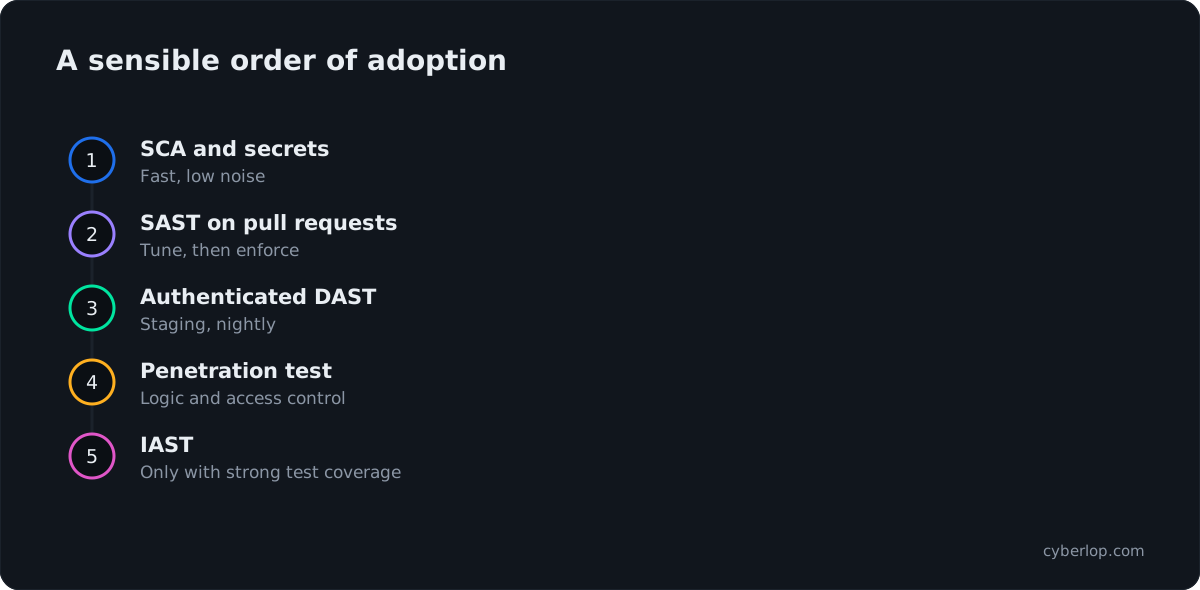
Build the programme in layers, cheapest and fastest first, and add the next layer only when the previous one is producing fixes rather than a backlog. NIST's Secure Software Development Framework (SP 800-218) frames this as practices to integrate into any development lifecycle model to reduce vulnerabilities in released software (NIST SP 800-218), and NIST SP 800-115 treats testing as one planned technique among several (NIST SP 800-115). A sensible order for a software company in 2026:
- Start with SCA and secret scanning. They are quick to add, low-noise, and cover the supply chain and leaked credentials. See secret scanning.
- Add SAST on pull requests. Begin in report-only mode, tune the rules, then enforce on a short list of high-confidence rules.
- Add DAST against staging. Give it authenticated sessions so it reaches the screens behind login, and run it nightly or on release.
- Schedule a penetration test. Run one before major launches and after large changes, with test accounts for each role you ship.
- Consider IAST later. Only if your test coverage is strong and the runtime is supported.
- Connect findings to one tracker. Assign owners and deadlines using your vulnerability remediation process.
Which approach fits your stage?
| Company stage | Start with | Add next | Keep for later |
|---|---|---|---|
| Pre-launch startup | SCA, secret scanning, one pentest | SAST on pull requests | IAST |
| Growing product team | SCA, SAST, authenticated DAST in staging | Annual or per-release pentest | IAST on critical services |
| Regulated or enterprise-facing | All of the above, with evidence kept | Scheduled retesting and gates in CI | Wider red-team work |
| Pentest agency or MSSP | Repeatable testing under your own brand | Client reporting and retests | Per-client automation |
How do you reduce false positives and tool noise?
Reduce noise by tuning rules, deduplicating findings and demanding proof before a ticket is raised. Noise is the main reason teams abandon scanners, and OWASP lists "high numbers of false positives" among the weaknesses of SAST. A finding nobody trusts is worse than none, since it trains developers to ignore the next one.
Four habits that work
- Start narrow. Switch on rules for injection and secrets first; add more as the queue empties.
- Group by root cause. Twenty alerts from one unsafe helper are one fix.
- Keep severity and confidence apart. A critical finding with low confidence needs checking before it is escalated.
- Prefer proof. A request, response and effect settles an argument faster than a rule name.
How do you add DAST, SAST and SCA to CI/CD?
Put fast checks where developers already work and slow checks where they do not block anyone. In practice that means SAST, SCA and secret scanning on pull requests, DAST on a staging deployment after the build, and a pentest on a calendar. For background, see CI/CD and DevSecOps.
| Pipeline stage | Check | Typical time cost | Blocks the build? |
|---|---|---|---|
| Pre-commit | Secret scanning | Seconds | Yes, for live credentials |
| Pull request | SAST, SCA | Minutes | Only high-confidence, high-severity rules |
| Build | SBOM generation, container image scan | Minutes | On known-exploited components |
| Staging deploy | Authenticated DAST, API tests | Minutes to hours | On confirmed critical findings |
| Release or schedule | Penetration test and retest | Days | Release sign-off |
A rule for gating
Gate on confidence, not volume. A build that fails on every medium alert gets bypassed within a month. A security gate that fails only on confirmed, serious findings keeps its authority.
What about AI-generated code and vibe-coded apps?
AI-assisted code needs the same layers, with more weight on SCA and runtime testing. Generated code can look correct and still omit an ownership check or pull in a package the team never reviewed. Static rules help with the patterns; only a running test shows whether one account can read another's data. We cover this in vibe coding security, and the question of AI doing the testing itself in AI penetration testing.
Where does Cyberlop fit?
Cyberlop is a pentesting platform, so it sits in the human-style testing layer rather than replacing your scanners. It finds vulnerabilities in web apps and their APIs with black-box, grey-box and white-box pentesting. In white-box mode it reads your code while testing the running app, so a finding can point to the file and line.
It reports what it actually exploited, with the request, the response, a screenshot where a person can see it, and the line of code. If we did not break it, we do not report it. It keeps severity and confidence apart, adds CWE and OWASP references, and checks business-logic flaws and cross-account access. A fix is proven by re-running the exact exploit against the new code. See how it works and evidence examples.
It can also run inside your own network, so your code does not leave it (private scanning), and it can run on a schedule or in CI/CD and gate a build (integrations). Keep your SAST, SCA and DAST tools. Use Cyberlop for the findings they cannot prove.
How do you choose between tools?
Choose by the questions below rather than by feature lists. Ask each vendor, and ask yourself, in this order.
Seven questions to ask before you buy
1. Which languages, frameworks and API styles are supported?
Coverage gaps hide the most important services. Check REST, GraphQL and any gRPC you run.
2. Can it test behind a login?
If the tool cannot hold a session, it tests your marketing site rather than your product. Look for support for multiple test accounts.
3. How does it show a finding is real?
Look for request and response evidence, or a code location with a data-flow trace. Ask for a sample report.
4. How does it behave in CI/CD?
Ask about run time, incremental scans, and whether you control which findings fail a build.
5. Where does your code or data go?
Some teams need analysis inside their own network. Ask about self-hosted options and data handling, and read the vendor's security page.
6. How are fixes verified?
A re-scan that no longer lists a rule is weaker than a retest of the original exploit. See closed-loop retest.
7. What does it not cover?
A trustworthy vendor can say. Our own limits are on the honest page.
What are the most common mistakes?
- Treating a clean scan as a clean bill of health. A scan passes what it can test, not what it cannot see. A missed flaw leaves no trace in the report.
- Buying every category at once. Four tools with no owners create four backlogs.
- Scanning only unauthenticated pages. Most risk sits behind login.
- Skipping retests. A merged pull request is not proof the exploit stopped working.
- Ignoring access control. It tops the OWASP Top 10:2025 for a reason. Start with the access control testing checklist.
For the wider picture of continuous coverage, see continuous penetration testing, and for budgeting see penetration testing cost. For background, the Knowledge Hub explains vulnerability scanning, the OWASP Top 10, white-box testing and secure code review.
Questions people ask
Dast vs sast: FAQs
Which is better, DAST or SAST?
Neither is better; they find different things. SAST suits code-level mistakes such as injection patterns and hardcoded secrets, and DAST suits runtime behaviour such as configuration and input handling. Most teams run both, with SCA alongside.
Do I need both SAST and DAST?
For most software companies, yes. SAST gives early, code-level feedback and DAST confirms what is exposed on the running app. If you must start with one, pair SAST with SCA, then add DAST once you have a stable staging environment.
Is IAST better than DAST?
IAST gives more precise findings, including code location, but only for code paths your tests exercise, and it needs an agent in the app. DAST needs no agent and works on any stack. They complement each other more than they compete.
What is SCA and how is it different from SAST?
SCA checks the open-source components you use against known vulnerability records. SAST checks the code you wrote. A library can be vulnerable while your code is clean, and the reverse, so you need both.
Can SAST or DAST replace a penetration test?
No. OWASP lists access-control issues among the areas where SAST tools struggle, and scanners lack knowledge of who should see what. A penetration test checks intent, business logic and cross-account access, and shows proof of impact.
Is SAST white box and DAST black box?
Broadly yes. OWASP describes DAST as a black-box approach and SAST as usually part of a white-box code review. IAST and grey-box pentests sit between the two because they combine some inside knowledge with a running app.
Where do SAST and DAST fit in a CI/CD pipeline?
Run SAST, SCA and secret scanning on pull requests, because they are fast and give feedback near the code. Run DAST against a staging deployment after the build, and gate only on confirmed, serious findings.
How do I reduce false positives from SAST?
Start with a short rule set, group duplicate alerts by root cause, tune or suppress rules with a recorded reason, and keep severity separate from confidence. Ask for proof, such as a data-flow trace or a working request, before raising a ticket.
Sources
Where the facts come from
- OWASP DevSecOps Guideline: Static Application Security Testing
- OWASP DevSecOps Guideline: Dynamic Application Security Testing
- OWASP DevSecOps Guideline: Interactive Application Security Testing
- OWASP: Source Code Analysis Tools
- OWASP: Top 10:2025 A01 Broken Access Control
- OWASP: Top 10:2025 A03 Software Supply Chain Failures
- OWASP: Top 10:2025
- Verizon: 2026 Data Breach Investigations Report
- CISA: Known Exploited Vulnerabilities Catalog
- NIST: SP 800-218 Secure Software Development Framework
- NIST: SP 800-115 Technical Guide to Information Security Testing and Assessment
Keep reading
Related articles
Black box vs white box penetration testing: which to choose
Black, grey and white box penetration testing compared: what each finds and misses, how effort differs, when to choose each and how to combine them.
Access control testing checklist: sideways, upward and across tenants.
A step-by-step access control testing checklist for web apps and APIs: account planning, sideways, upward and cross-tenant checks, evidence and retests.
Broken object level authorization (BOLA): examples, testing and fixes
Broken object level authorization (BOLA) explained: examples, BOLA vs IDOR, a two-account test, the ownership-check fix and code review questions.

Prove what your scanners only suspect
Cyberlop finds vulnerabilities with black-box, grey-box and white-box pentesting, reports only what it actually exploited, and proves each fix by re-running the exact exploit. Ask us to run it on one of your applications.
Or start with a $199 pilot on one application: thirty days, success criteria agreed before day one, credited against the annual if you convert.