
Home / Blog / Cert-in empanelled vapt
Compliance
CERT-In empanelled VAPT: who needs it, and how to check one
Empanelment is a filter on who may sign your report, not a seal on your app. Here is who is asked for it, where that is written, and how to verify an auditor.
Cyberlop Labs · Updated · 15 min read
A CERT-In empanelled VAPT is a penetration test done by an auditing organisation on CERT-In's official empanelled list. You need one only when a regulator, tender or contract names it. CERT-In's 2025 guidelines expect at least one audit a year and a signed, evidenced report with CVSS, EPSS and CWE mapping.
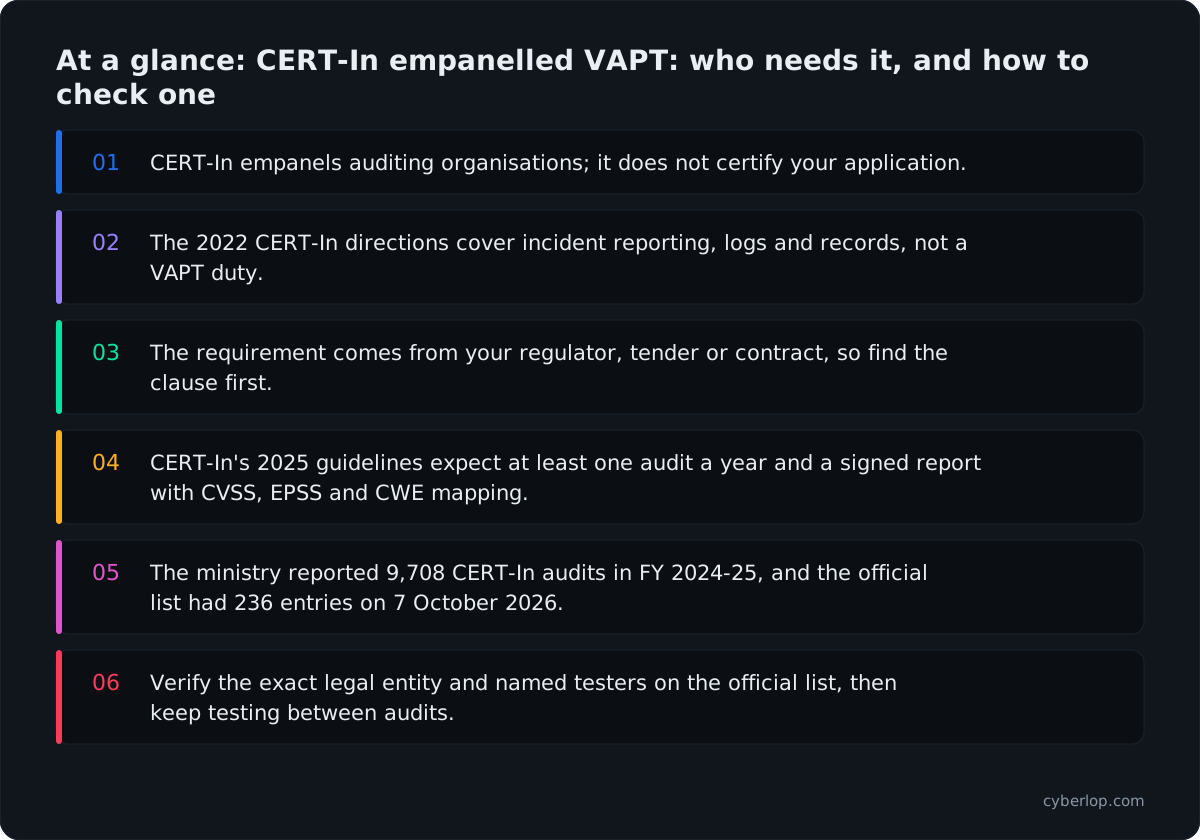
- CERT-In empanels auditing organisations; it does not certify your application.
- The 2022 CERT-In directions cover incident reporting, logs and records, not a VAPT duty.
- The requirement comes from your regulator, tender or contract, so find the clause first.
- CERT-In's 2025 guidelines expect at least one audit a year and a signed report with CVSS, EPSS and CWE mapping.
- The ministry reported 9,708 CERT-In audits in FY 2024-25, and the official list had 236 entries on 7 October 2026.
- Verify the exact legal entity and named testers on the official list, then keep testing between audits.
A CERT-In empanelled VAPT is a vulnerability assessment and penetration test run by a firm on the official list of auditing organisations empanelled by CERT-In, India's national cyber security agency. You need one when a regulator, a government buyer or a signed contract asks for it by name. The 2022 CERT-In directions do not, on their own, require one.
Below: what empanelment is, who asks for it (each claim sourced), how to check an auditor, and what CERT-In's July 2025 audit guidelines expect from both sides. It ends with how an empanelled audit fits the rest of your VAPT work. Still choosing a provider? Read how to choose a penetration testing company. This is not legal advice.
What is a CERT-In empanelled VAPT?
It is a penetration test plus a vulnerability assessment, done by an organisation that CERT-In has evaluated and listed. CERT-In (the Indian Computer Emergency Response Team) empanels Information Security Auditing Organisations. They audit the systems, networks and applications of government bodies and other sectors, including through vulnerability assessments and penetration testing (CERT-In audit guidelines, 2025). The guidelines define penetration testing as testing in which components or the whole application are "actively tested to identify and exploit potential vulnerabilities".
Empanelled, not certified
CERT-In empanels organisations. It does not certify your application, and it does not stamp a report as "CERT-In approved". If someone asks for a "CERT-In certificate", what you can actually get is a report, often with an audit certificate, signed by an empanelled auditor. Its weight comes from who signed it.
The guidelines set a signature chain. The auditors who did the work sign first, and they must be people the firm declared to CERT-In. A separate reviewer signs next, and the head of the auditing organisation signs last. CERT-In must not be made or projected to be a party to your contract with the auditor. You hire and pay the firm directly (CERT-In, 2025).
Buyers also search for a "safe to host certificate". The guidelines use the term audit certificate, and we found no "safe to host" wording in them. Ask the party that wants one which exact document they will accept.
How big is the panel, and how much work does it do?
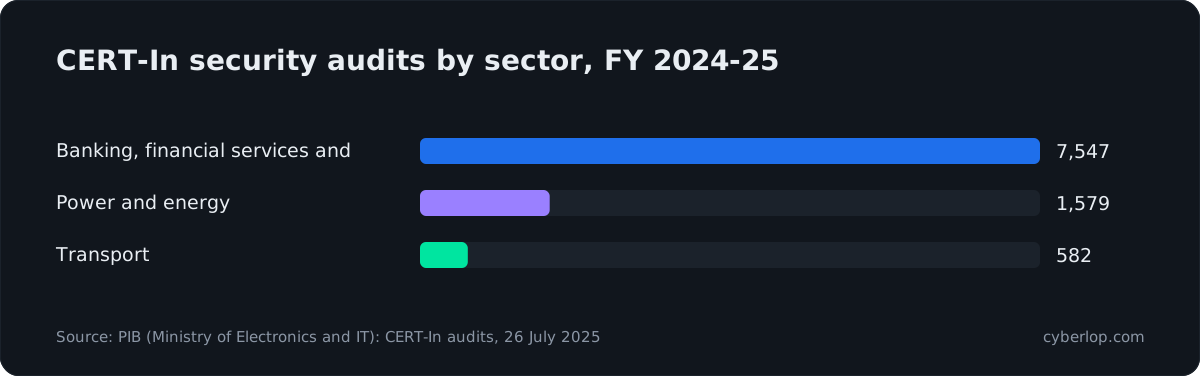
A 26 July 2025 release from the Ministry of Electronics and IT said CERT-In had empanelled 200 cybersecurity organisations. It also said CERT-In security audits in FY 2024-25 totalled 9,708 across power, transport and banking, financial services and insurance (PIB, 2025). The official list we opened on 7 October 2026 had 236 numbered entries, so the panel has grown past the 200 in that release.
Who needs a CERT-In empanelled VAPT auditor?
Only organisations whose regulator, buyer or contract names empanelled auditors. The duty comes from that document, not from CERT-In's own directions. The table lists the sources we opened and read on 7 October 2026. Rules change, so confirm the current text before you sign a statement of work.
Where empanelled auditors are named in official text
| Situation | What the official text says | What to do |
|---|---|---|
| Securities market (SEBI-regulated entities) | SEBI's CSCRF FAQs say that for commercial off-the-shelf or in-house developed software, regulated entities shall ensure DAST or SAST tests or audits are done by a CERT-In empanelled IS auditing organisation (SEBI CSCRF FAQs). | Treat the auditor as fixed. Ask which CSCRF category you fall in. If you build software for brokers, expect them to pass this down to you. |
| Prepaid payment instrument issuers (RBI) | A December 2016 RBI notification asked issuers and banks to carry out a special audit by CERT-In empanelled auditors on a priority basis (RBI, 9 December 2016). | Read the current RBI direction for your licence, not only the 2016 notice. |
| RBI-regulated entities (IT governance) | The RBI Master Direction of 7 November 2023 asks for vulnerability assessment at least every six months and penetration testing at least every 12 months for critical information systems and customer-facing systems in the DMZ, by "appropriately trained and independent information security experts/ auditors" (paragraph 26). Those paragraphs do not name CERT-In empanelment (RBI Master Direction). | Check your entity category and your bank partners' vendor rules for stricter wording. |
| Government and public-sector projects | CERT-In says it empanels auditors to audit systems of "various organizations of the Government and of other sectors" (CERT-In, 2025). | Read the tender for the exact wording and the proof of empanelment it wants. |
| Enterprise customer contracts | No public rule. A buyer's security schedule may name empanelled auditors. | Ask for the exact clause and which parts of the report they will read. |
Capital markets and SEBI
SEBI is the clearest case we found. The CSCRF circular is SEBI/HO/ITD-1/ITD_CSC_EXT/P/CIR/2024/113 of 20 August 2024. Answer 53 in the FAQs sends the DAST or SAST of in-house or off-the-shelf software to a CERT-In empanelled organisation. The FAQs also set timing. Qualified Stock Brokers run VAPT and cyber audit half-yearly, and must close vulnerabilities found in a VAPT within three months of submitting the VAPT report (SEBI CSCRF FAQs).
What the SEBI FAQs do not say
For forensic audits, the same FAQs say regulated entities select auditors "after due diligence"; they are not told to use only empanelled firms. Empanelment is not a blanket rule even inside one regulator's document, so read each clause.
Payments, banking and insurance
RBI has named CERT-In empanelled auditors before, as the 2016 notification shows. Newer RBI, IRDAI and payment-system directions may repeat or change that wording. We could not open every current text, so we do not list them as fact. Ask your compliance lead for the clause number.
Data protection law
The DPDP Act and its 2025 Rules ask Data Fiduciaries for reasonable security safeguards. The government's explainer says the highest penalty tier applies to failing to maintain them. It also says Significant Data Fiduciaries must conduct independent audits (PIB: DPDP Rules, 2025). It does not say those audits must come from a CERT-In empanelled firm. An empanelled report can still be good evidence. See our DPDP Act security guide.
If your buyers are global
SOC 2 and ISO 27001 buyers usually ask for an independent tester with a clear method and a retest, not an empanelled one. See SOC 2 penetration testing and ISO 27001 penetration testing. If you serve both kinds of buyer, run one empanelled audit for the regulated deals and test between audits for everyone.
Do the 2022 CERT-In directions require a VAPT?
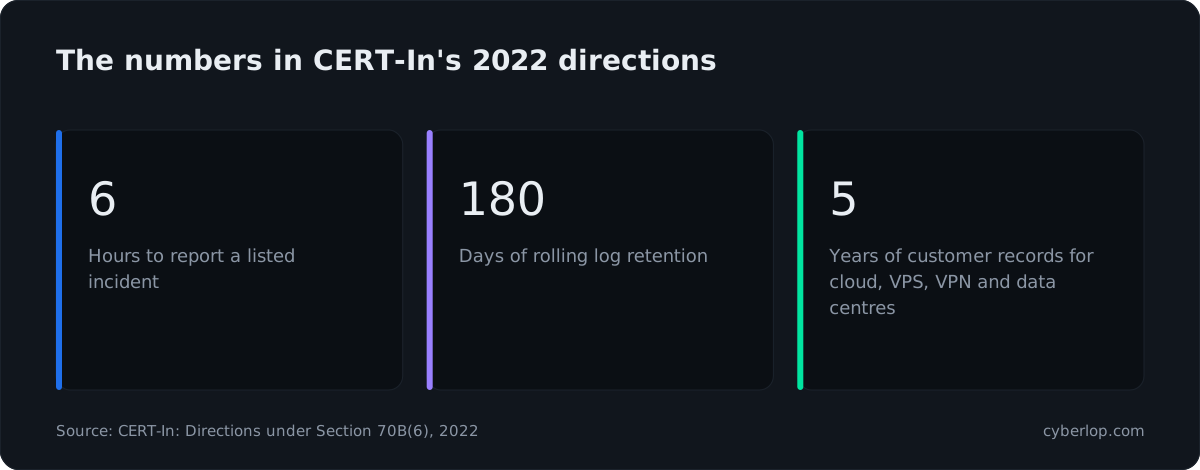
No. CERT-In is the national agency under Section 70B of the Information Technology Act, 2000. Its six directions of 28 April 2022 were issued under Section 70B(6). They cover clock synchronisation, six-hour incident reporting, a point of contact and log retention. They also cover subscriber records for data centres, VPS, cloud and VPN providers, and records for virtual asset service providers (CERT-In Directions, 2022). None is a penetration-testing duty, and none mentions empanelled auditors. The mistake is quoting "CERT-In compliance" as if it meant "buy an empanelled VAPT".
What the 2022 directions actually ask for
| Direction | Requirement | Relevance to testing |
|---|---|---|
| Time sync | Synchronise ICT system clocks to NIC or NPL time servers, or sources traceable to them. | Makes log timestamps usable as evidence. |
| Incident reporting | Report listed cyber incidents to CERT-In within 6 hours of noticing them. | Your incident process must exist before a test finds something serious. |
| Point of contact | Designate a point of contact for CERT-In. | Reuse the same person as audit point of contact. |
| Logs | Enable logs of all ICT systems and keep them securely for a rolling 180 days, within Indian jurisdiction. | Needed to see what a tester, or anyone else, touched. See log retention. |
| Providers' records | Data centres, VPS, cloud and VPN providers keep validated customer details for 5 years. | Applies to the provider, not to your app team. |
The directions say non-compliance may invite punitive action under Section 70B(7). CERT-In's FAQs on the directions quote that provision as imprisonment of up to one year, a fine, or both. That sits on reporting and records, not on whether you ran a VAPT.
What do CERT-In's 2025 audit guidelines expect?
CERT-In published its Comprehensive Cyber Security Audit Policy Guidelines, version 1.0, on 25 July 2025. They call themselves binding on empanelled auditing organisations and on auditee entities "covered under the relevant provisions". They are written for public and private organisations that are required to evaluate their security, or want to (CERT-In, 2025).
Rules for the organisation being audited
Auditee expectations in the guidelines
| Topic | What the guidelines say |
|---|---|
| Frequency | An audit at least once a year; sectoral regulators may ask for more. Audits should also follow every major change to infrastructure or application, based on criticality. |
| Scope | A comprehensive scope that includes testing, UAT, development and production assets, with follow-up audits written into the scope of work. |
| Secure development first | Applications built without secure design and development practices should not be assessed. The auditor tells the auditee in writing, with a copy to CERT-In. |
| Environment | If only staging was audited, the report must say production was not. |
| Closure | Patching is the auditee's responsibility. The final report is issued after vulnerabilities are closed and a follow-up audit on production is complete. |
| Risk acceptance | Retaining, avoiding, transferring or reducing a reported risk must be authorised by the head of the auditee organisation. See risk acceptance. |
| After the certificate | Avoid code changes to the audited application, and capture hash values, versions and timestamps so the audited build can be traced. |
| Contract length | Critical or high-reach applications should get contracts of 2 to 3 years so audits happen at a defined frequency. |
| Ownership | Responsibility for security "rests with the auditee organization, not the auditor". |
Rules for the auditor
Independence and payment
Payments must not depend on the audit outcome or on approval of closure reports. A firm that both implements controls and audits them has a conflict of interest, and it must disclose it. If a quote ties fees to a clean report, it breaks the guidelines.
Method and tooling
The guidelines discourage solely tool-based testing, because tools may miss manual components. They also say short lists such as the OWASP Top 10 and SANS Top 25 should not be the audit standard. They point to fuller references such as OWASP's Web Security Testing Guide and the Application Security Verification Standard. A report that only says "tested against OWASP Top 10" is thin by CERT-In's own measure.
Scoring, evidence and the report
Auditors grade findings with CVSS, add the Exploit Prediction Scoring System (EPSS), and map each finding to a CWE and, where one exists, a CVE. The report lists every in-scope asset, the duration, methods, tools, sampling decisions, manpower and limitations. It carries an executive summary that turns findings into business risk, and it states closure timelines by severity. Evidence must be accurate, relevant, sufficient and appended. The lead auditor and the head of the firm sign the audit certificate.
Findings during the test
The auditor tells you about critical and high findings as they turn up, not in the final report. High-risk items, such as a discovered breach or a flaw with a known high exploitation rate, need an immediate report with a practical fix.
People and process
Auditors use only staff declared to CERT-In. Freelancers, trainees, moonlighters, outside consultants and anyone serving notice are out. A separate checker reviews the work. Audit metadata goes to CERT-In within five days of completion, and the auditor must tell you this before work starts. CERT-In says the data submitted is kept confidential.
How do you verify a CERT-In empanelled auditor?
Check the firm against CERT-In's own list, never its website badge. The list calls itself the "up-to-date valid list" and says it is updated "as soon as there is any change" (CERT-In list, linked from the empanelment page).
- Find the firm on the official list. Open the list yourself, not through a link the vendor sends. Match the exact legal name and address, not the brand, and note the date you checked.
- Check how it describes itself. The guidelines allow one sentence: "This Organization is empaneled by CERT-In for providing information Security Auditing Service". Firms may not use other wording or the CERT-In logo without written permission. A logo on a sales deck is already outside the rules.
- Confirm the signing entity. A group company, reseller or partner may not be the empanelled entity. The contract and report must name the one on the list.
- Ask for the named testers. The firm may deploy only people declared in its snapshot information. The guidelines invite you to interview the proposed testers and check their credentials and identity cards.
- Match domain experience. The snapshot shows skills, audit categories, sector-wise audits in the last 12 months, tools and manpower. Each profile also says whether the firm outsources work. Match it to your web, mobile, cloud or network scope.
- Read a sample report. Look for CVSS and EPSS, CWE and CVE mapping, the environment tested, attached evidence and the signature chain. See how to read a penetration test report.
- Keep an exit. If the auditor's credibility is unclear, the guidelines say the contract should let you stop and move to another organisation. Add "no subcontracting without written consent" too.
Red flags worth walking away from
Claims that do not check out
"CERT-In certified" or "approved by CERT-In" wording. A firm missing from the list, or a different legal entity from the one quoting. A logo but no name on the list.
Terms that break the guidelines
Fees tied to passing. A promise to "clear" a report. No named testers until after signing. A raw scanner export as the report. A staging-only test sold as a production certificate.
How does CERT-In empanel an auditor?
CERT-In runs a four-stage evaluation: documentation review, an offline practical skill test, a practical skill test in vulnerability assessment and penetration testing, and a personal interaction session at CERT-In (CERT-In empanelment page). New applications were open from 1 July 2026 until 5:30 PM on 30 September 2026, so the list can change. Check the current version every time.
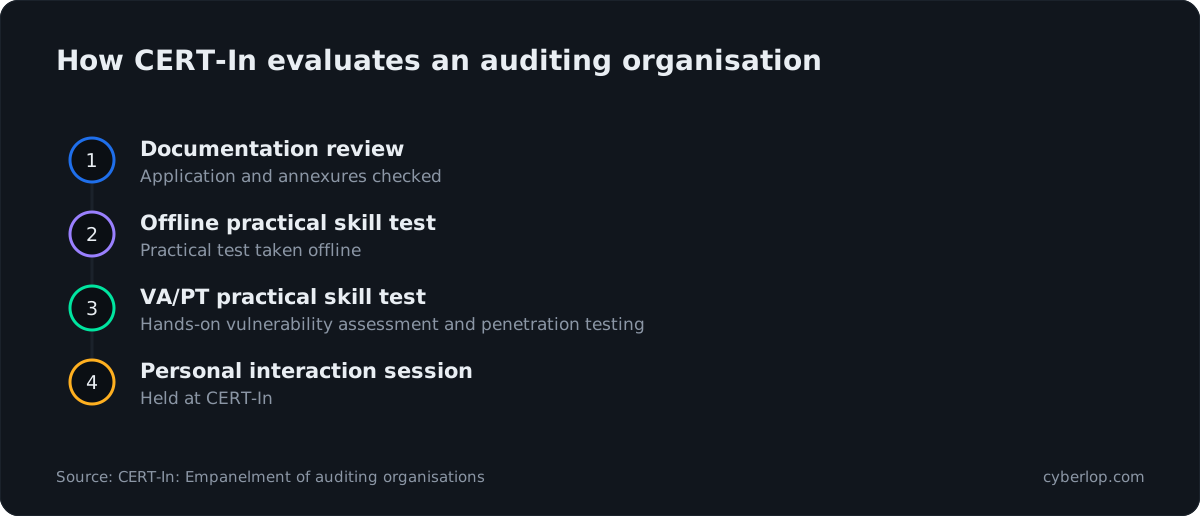
Passing is a filter on who may do the work, not a rating of any single test.
What happens to auditors who break the rules?
For poor audits or breaches of the terms, the guidelines list graded actions: a watch list with a written warning, suspension, debarment, de-empanelment, and penal and legal action. Triggers include inadequate closure of non-compliances and repeated gaps in audit coverage. Sub-letting or outsourcing an assignment is a named breach.
What does CERT-In empanelment not guarantee?
It does not guarantee a secure application or a deep test. Treat it as one signal among several.
What empanelment tells you, and what it does not
| It tells you | It does not tell you |
|---|---|
| The firm passed CERT-In's evaluation and is on the list. | That your application has no serious flaws today. |
| The firm accepts CERT-In's terms, including sharing audit metadata within five days. | That your testers know your stack or your business logic. |
| Reports follow a set structure and signature chain. | That the scope was chosen well. A narrow scope gives a clean certificate for a small area. |
| Regulators and tenders that name empanelment will accept the report. | That a buyer who did not name it will care. |
A test is a snapshot. The pentest report describes the build tested, which is why the guidelines want hashes and versions in it. An annual audit says nothing about next week's release, which is why they also ask for audits after every major change.
How do you prepare for an empanelled audit?
Prepare scope, environment, accounts and an owner for fixes before day one. The guidelines expect a pre-audit discussion on scope and a technical point of contact on your side. Our VAPT checklist has the long form.
Preparation checklist
| Item | Why it matters |
|---|---|
| Written scope listing every URL, API and environment | All in-scope assets must appear in the report. Write the pentest scope before kickoff. |
| A stable build with a version and hash | The report records them. A moving target makes findings hard to reproduce. |
| Test accounts for each kind of user, with realistic data, and more than one tenant if you are multi-tenant | Access flaws only show when the tester holds separate accounts and compares what each one can reach. |
| A named owner for fixes and a retest slot booked | Closure needs a follow-up audit, so book it with the engagement. |
| Logging switched on | The 2022 directions ask for 180 days of logs, and logs separate test traffic from real traffic. |
| Rules of engagement agreed | Test windows, rate limits and data handling. See rules of engagement. |
Eight things to get in writing
Contract, people and report
- The exact clause in your tender, circular or contract that requires empanelment.
- The firm's legal name matched to the official list, with the date you checked.
- Names of the testers and the reviewer, all declared to CERT-In.
- How many test accounts and user types the testers will use, and who creates them.
- Whether code review is included, and how much source they will read.
- The report format: CVSS, EPSS, CWE and CVE mapping, environment tested.
- A follow-up audit in the price and timeline, and data kept in India and deleted afterwards.
- No subcontracting without written consent, and a right to stop if quality slips.
Compare quotes on these items; our penetration testing cost guide explains what drives differences.
What mistakes do teams make with CERT-In empanelled VAPT?
- Buying it because a vendor said it was mandatory. Ask for the clause first.
- Testing staging only. If staging differs from production, the certificate is weaker, and the report must say so.
- Treating the certificate as the end. Code shipped later is not covered.
- Skipping the follow-up audit. A report with open high findings is a to-do list, not evidence. Run a remediation process with owners and dates.
- Giving the tester one account. Authorisation flaws such as broken object level authorization need several accounts of different types to find.
Why does an annual audit still leave a gap?
Attackers do not follow your audit calendar. Verizon's 2026 Data Breach Investigations Report says 31% of breaches now start with software vulnerabilities, beating stolen passwords as the top way in (Verizon DBIR, 2026). IBM's 2026 Cost of a Data Breach report calls the global average cost a record, up 12% on last year (IBM, 2026). IBM India reports a 15.9% rise in India, with financial services and technology the two costliest sectors (IBM India, 2026). The lesson is to fix flaws between audits as well. It does not argue against the yearly audit.
How do you run an empanelled audit alongside continuous testing?
Use the empanelled audit for the signed, regulator-facing report, and continuous testing to keep the application clean between audits. The audit shows that an empanelled outside party looked; continuous testing catches what each release introduces. Our guide to continuous penetration testing covers the split.
Where Cyberlop fits
Cyberlop finds vulnerabilities in web apps and their APIs with black-box, grey-box and white-box pentesting. It reports what it actually exploited, with the request, the response, a screenshot where a person can see it, and, in white-box mode, the line of code. A fix is proven by re-running the exact exploit against the new code, the closed-loop retest. It can run on a schedule or in CI/CD, or inside your own network with private scanning.
Run it before an audit and the auditor spends time on harder issues. Run it after, and each fix is proven before the follow-up audit. It does not replace the signed report a regulator names. See regulated teams, our evidence page and where we draw our own limits.
A simple yearly rhythm
- Quarter 1: confirm the requirement, fix last year's backlog and prove each fix with a retest.
- Quarters 2 and 3: run scheduled tests on each release and gate builds on critical findings.
- Quarter 4: freeze scope, brief the empanelled auditor and audit a stable build.
- After the audit: close findings, complete the follow-up audit and archive the signed report with the build hash and version.
Do you need an empanelled auditor?
- A regulator, tender or contract names CERT-In empanelled auditors: yes. Get the clause in writing.
- A customer asks for "a pentest report": ask what they will accept before paying for empanelment.
- You are an agency or MSSP serving regulated clients: the client contract decides. You may need your own empanelment, a partner that holds one, or neither.
- You want a better product, not a signed paper: pick on skill and evidence.
Questions people ask
Cert-in empanelled vapt: FAQs
Is CERT-In empanelled VAPT mandatory in India?
Not by itself. The 2022 CERT-In directions do not require a VAPT. It becomes mandatory when a regulator, tender or contract names empanelled auditors. Answer 53 in SEBI's CSCRF FAQs does that for DAST or SAST of some software.
What is the difference between CERT-In certified and CERT-In empanelled?
CERT-In empanels auditing organisations after an evaluation. It does not certify applications or companies. A report or audit certificate gets its weight from an empanelled auditor signing it.
How do I check if a VAPT company is CERT-In empanelled?
Find its exact legal name on CERT-In's published List of Empanelled Information Security Auditing Organisations. Then confirm that the entity signing your contract and report is the one listed.
How often should an empanelled VAPT be done?
CERT-In's 2025 guidelines say at least once a year, and after every major change to infrastructure or application, based on criticality. Regulators can ask for more: SEBI's FAQs set half-yearly VAPT for Qualified Stock Brokers.
Can a startup use a non-empanelled pentest firm?
Yes, if no regulator, tender or customer contract names empanelled auditors. Check your contracts first, because a single enterprise customer clause can change the answer.
Do empanelled auditors have to share my audit with CERT-In?
Yes, within 5 days of completion and in the format CERT-In prescribes. The auditor must tell you before the audit starts. CERT-In says it keeps the data confidential.
What should a CERT-In empanelled VAPT report contain?
Under the 2025 guidelines: every in-scope asset, the methods, tools and limitations, and findings graded with CVSS, EPSS, CWE and CVE mapping. Add an executive summary in business terms and closure timelines. The declared testers, a separate reviewer and the head of the firm sign it. The final report follows the follow-up audit.
Is a safe to host certificate the same as a CERT-In audit certificate?
The 2025 CERT-In guidelines speak of an audit certificate and we found no "safe to host" wording in them. Ask the party that wants the document what exact wording and signer it will accept.
Sources
Where the facts come from
- CERT-In: Directions under Section 70B(6), 28 April 2022
- CERT-In: Comprehensive Cyber Security Audit Policy Guidelines, v1.0, 2025
- CERT-In: FAQs on the Cyber Security Directions, May 2022
- CERT-In: Empanelment of information security auditing organisations
- CERT-In: List of Empanelled Information Security Auditing Organisations
- PIB (Ministry of Electronics and IT): CERT-In audits in 2024-25, 26 July 2025
- SEBI: FAQs on Cybersecurity and Cyber Resilience Framework (CSCRF), 2025
- SEBI: CSCRF circular, 20 August 2024
- RBI: Master Direction on IT Governance, Risk, Controls and Assurance Practices
- RBI: Technical audit of Prepaid Payment Instrument issuers, 2016
- Verizon: Data Breach Investigations Report, 2026
- IBM: Cost of a Data Breach Report, 2026
- IBM India: Cost of a Data Breach, India, 2026
- PIB: DPDP Rules, 2025 notified
Keep reading
Related articles
Continuous penetration testing: how to run it alongside your annual pentest
What continuous penetration testing really means, how it compares with annual pentests, DAST and PTaaS, and how to run both in your pipeline.
DPDP Act security requirements: what Rule 6 and Rule 7 mean for app teams
DPDP Act security requirements in plain English: the Rule 6 safeguards, the 72-hour breach notice, the penalties and the evidence an app team should keep.
How to choose a penetration testing company: 20 questions, red flags and a report check
20 questions to ask, red flags, how to review a sample report, and what CREST, OSCP and CERT-In empanelment do and do not tell you.

Find flaws before the auditor does
Cyberlop finds vulnerabilities in web apps and their APIs, reports only what it actually exploited, and proves each fix with a closed-loop retest. Run it between audits so your empanelled engagement starts clean. Book a pilot on one app.
Or start with a $199 pilot on one application: thirty days, success criteria agreed before day one, credited against the annual if you convert.