
Home / Blog / Hackerone vs bugcrowd
Compare
HackerOne vs Bugcrowd in 2026: bounty, pentest or automated testing?
HackerOne and Bugcrowd both run bug bounty, disclosure and pentest programmes. Here is how each describes itself, and how to choose between a bounty, a pentest and automation.
Cyberlop Labs · Updated · 13 min read

HackerOne vs Bugcrowd is a choice between two similar crowdsourced platforms that both sell bug bounty, vulnerability disclosure and pentest services. Choose a pentest for a dated report, a bounty for ongoing discovery and automated testing for every release. Run the same small trial with both and score the evidence, noise and retest.
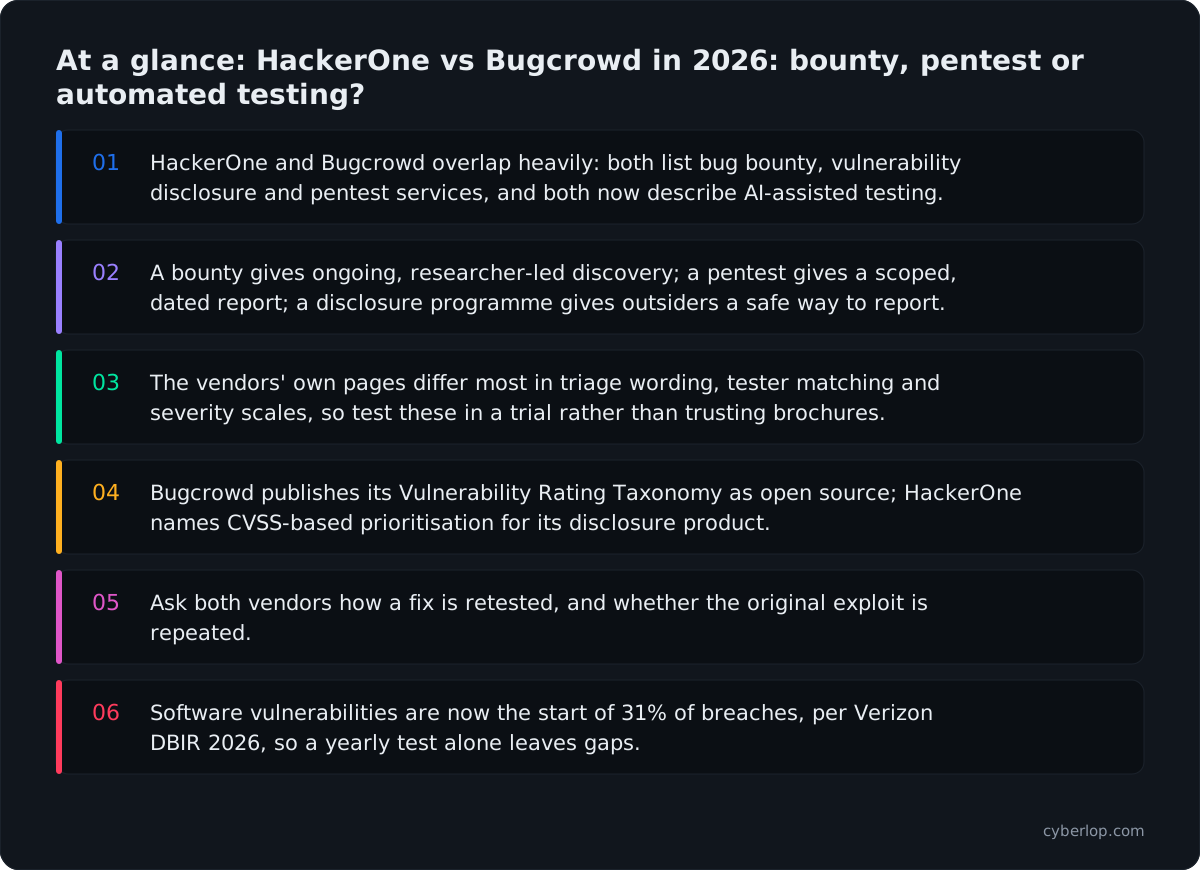
- HackerOne and Bugcrowd overlap heavily: both list bug bounty, vulnerability disclosure and pentest services, and both now describe AI-assisted testing.
- A bounty gives ongoing, researcher-led discovery; a pentest gives a scoped, dated report; a disclosure programme gives outsiders a safe way to report.
- The vendors' own pages differ most in triage wording, tester matching and severity scales, so test these in a trial rather than trusting brochures.
- Bugcrowd publishes its Vulnerability Rating Taxonomy as open source; HackerOne names CVSS-based prioritisation for its disclosure product.
- Ask both vendors how a fix is retested, and whether the original exploit is repeated.
- Software vulnerabilities are now the start of 31% of breaches, per Verizon DBIR 2026, so a yearly test alone leaves gaps.
HackerOne vs Bugcrowd comes down to what you want from a crowd of security researchers, not which logo is bigger. Both are platforms that connect companies with vetted researchers for bug bounty programmes, vulnerability disclosure and pentest as a service. Each now also sells AI-assisted testing. Pick a bounty when you want open-ended discovery over time, a pentest when you need a scoped report by a date, and automated testing when you need a check on every release. This guide uses each vendor's own pages, read on 7 and 8 October 2026.
What is the difference between HackerOne and Bugcrowd?
HackerOne and Bugcrowd are both crowdsourced security platforms. Their product ranges overlap heavily: each offers bug bounty, vulnerability disclosure and penetration testing delivered through a platform. The real differences sit in how each describes its triage, its tester matching and its newer AI products.
HackerOne's home page describes its H1 Platform as eliminating "exploitable risk with continuous discovery, validation, prioritization, and remediation at AI scale." It lists H1 Bounty, H1 Agentic Pentest, H1 Continuous Testing, H1 Validation, H1 Remediation, H1 Code, H1 AI Red Teaming and H1 Response. (HackerOne home page.)
Bugcrowd's home page lists Bug Bounty, Vulnerability Disclosure, Penetration Testing as a Service, Red Team as a Service and Attack Surface Management. It also names Savant Pathseeker, described as "agentic pentesting on the Bugcrowd Platform". (Bugcrowd home page.)
So the choice is rarely about missing features. It is about which delivery style, triage model and reporting you prefer, and whether a crowd is the right tool for your problem at all.
What is the difference between a bug bounty, a pentest and a disclosure programme?
A bug bounty pays outside researchers for valid findings, a penetration test is a time-boxed, scoped engagement that ends in a report, and a disclosure programme is a front door for anyone who finds a flaw. Teams often buy the wrong one because the names sound alike.
Bug bounty: open-ended and paid per result
A bug bounty is an ongoing invitation. Researchers choose what to test inside your published scope and are paid for findings you accept. Researchers pick what to test, so coverage follows their interests. That suits creative, unexpected bugs. It does not guarantee anyone looked at a dull feature.
HackerOne says its bounty programmes "complement penetration testing" rather than replace it. (HackerOne: bug bounty.) Bugcrowd's own line is to "continuously hunt for hidden, unknown vulnerabilities and only pay for results." (Bugcrowd home page.)
Penetration test: scoped, dated and reported
A penetration test is a defined piece of work: a scope, a window, named testers and a final report. Auditors and customers ask for it because it has a start, an end and a document. Coverage is planned against a methodology, which is why it suits compliance evidence.
Vulnerability disclosure: a safe front door
A vulnerability disclosure programme tells outsiders how to report a flaw and promises not to pursue them for good-faith research. It usually has no reward. HackerOne describes H1 Response as "a trusted way for third parties to report vulnerabilities", and says Response is an intake channel for outsiders to self-report, while Bounty recruits researchers to hunt for issues. (HackerOne: H1 Response.)
Bugcrowd draws the same line: a disclosure programme provides "a safe harbor for disclosure", while a bounty is for active, incentivised testing. (Bugcrowd: Vulnerability Disclosure.)
The three models side by side. Descriptions summarise the vendors' own pages and the CISA directive cited below.
| Model | Who tests | Output | Best for |
|---|---|---|---|
| Bug bounty | Researchers who choose your programme | Individual reports, as found | Ongoing discovery of unexpected issues |
| Penetration test | Assigned testers, scoped and dated | One final report with findings and guidance | Compliance evidence and release gates |
| Disclosure programme | Anyone who happens to find a flaw | Inbound reports to triage | A safe, public way to report |
What does HackerOne offer?
HackerOne offers bounty, pentest, continuous testing, code security and disclosure products under one platform, with an AI orchestrator called Hai. Here is how its own pages describe the parts that matter for this comparison.
HackerOne products in plain terms
H1 Bounty
HackerOne describes H1 Bounty as "elite researchers find your most critical vulnerabilities." HackerOne says organisations can use ID verification, background checks and NDAs, and restrict participation "by skill or location". Programmes can be private or public. (HackerOne: bug bounty.)
For triage, the page says the platform uses AI and expert review to "filter out duplicates and noise, so only validated, actionable reports reach your team." It also offers in-house analysts and tracks payments through its "global payments infrastructure".
H1 Pentest and H1 Agentic Pentest
HackerOne's pentest page presents "Pentest as a Service (PTaaS)" that combines "top-tier talent with AI-driven insights", with "real-time findings" during the engagement. Testers come from "a vetted pool of elite pentesters" matched to your asset type and technology stack. (HackerOne: pentest.)
After fixes, testers "revisit the vulnerabilities and validate that all patches are successful", a service the page calls validation. Reports include "proofs of concept and recommendations for fixes". The page lists frameworks it addresses, among them SOC 2, ISO 27001, GDPR, CREST, NIST CSF 2.0 and DORA. When AI agents help, human pentesters "review all agent findings for quality, accuracy, and relevance."
On the home page, H1 Agentic Pentest is summed up as "AI agents and human experts, scaling with your attack surface."
H1 Response
H1 Response is HackerOne's disclosure product. You can host reports on HackerOne's site, take them by email or use a custom domain. Teams get custom inboxes, automated filters and CVSS-based prioritisation, and the page says in-house analysts "validate and prioritize all incoming vulnerability reports". (HackerOne: H1 Response.)
What does Bugcrowd offer?
Bugcrowd sells managed bug bounty, disclosure, pen testing as a service, red teaming and attack surface management, plus AI products branded Savant. Its pages stress triage, tester matching and taxonomy.
Bugcrowd products in plain terms
Managed Bug Bounty
Bugcrowd says its Managed Bug Bounty uses CrowdMatch, an AI system that curates hackers based on "skills, track record, and impact". It describes triage as a core competency, combining an in-house global team with specialised AI models. Bugcrowd is also a CVE Numbering Authority, so it can request CVE IDs. Pre-built connectors cover Jira, GitHub, Slack and Qualys. (Bugcrowd: Bug Bounty.)
Penetration Testing as a Service
Bugcrowd ties its pen testing to external attack surface management (EASM) and stresses transparency. Its pen test page promises a view of the estimated timeline, including launch and final report dates, before work starts. Customers can then watch testers move through a methodology checklist. (Bugcrowd: Pen Testing.)
The final report is written for auditors: a findings summary, details, the methodology used and an executive summary. Findings are prioritised "per the Bugcrowd Vulnerability Rating Taxonomy". Variants listed on the home page cover web application, mobile, network, API, IoT and cloud testing.
The Vulnerability Rating Taxonomy
The Vulnerability Rating Taxonomy (VRT) is Bugcrowd's open baseline for rating issues, published under the Apache License 2.0. It uses five levels, from P1 (critical) to P5 (informational). Some classes are marked "varies": the repository notes that insecure direct object reference can range from P4 to P1 depending on context. (Bugcrowd: VRT repository.)
That matters for severity: a shared public scale makes disputes about a rating easier to settle, whichever platform you pick.
How do HackerOne and Bugcrowd compare side by side?
On paper the two are close. The table below sets out what each vendor says about itself, and nothing more. Where a cell says "not stated", the vendor's pages we read did not say, which is not the same as "no".
HackerOne vs Bugcrowd, as each vendor describes itself on its own pages, read 7 and 8 October 2026.
| Area | HackerOne | Bugcrowd |
|---|---|---|
| Bug bounty | H1 Bounty; private or public programmes; ID checks, background checks and NDAs available | Managed Bug Bounty; CrowdMatch curates hackers by skills, track record and impact |
| Pentest | PTaaS with a vetted pool matched to asset type; H1 Agentic Pentest with AI agents and human experts | Penetration Testing as a Service, tied to EASM; web, mobile, network, API, IoT and cloud variants |
| Disclosure | H1 Response; hosted site, email or custom domain; CVSS-based prioritisation | Vulnerability Disclosure; aligns with BOD 20-01, DORA, NIS2 and CRA among others |
| Triage | AI plus expert review; in-house security analysts | In-house global team with specialised AI models |
| Severity scale | CVSS-based prioritisation named for H1 Response | Bugcrowd Vulnerability Rating Taxonomy, P1 to P5, open under Apache 2.0 |
| Retest | Testers revisit and validate patches | Not stated on the pen testing page we read |
| Red teaming | H1 AI Red Teaming for AI systems and models | Red Team as a Service |
| Attack surface | H1 Continuous Testing across your attack surface | Attack Surface Management feeds pen tests and bounties |
| Code-level work | H1 Code and H1 Code Security Audit | Not stated on the pages we read |
How to read the table without over-reading it
Marketing pages are not contracts. A feature missing from one site may still exist there under another name, or be sold as a service instead of a product. Treat every blank as a question for the sales call, and get the answer in writing.
When should you choose a bounty, a pentest or automated testing?
Choose a pentest when you need a dated report, a bounty when you need continuing discovery and your team can handle a steady flow of reports, and automated testing when you need checks on every release. Many teams use more than one, in that order of maturity.
Which model fits which situation.
| Your situation | Start with | Why |
|---|---|---|
| Customer or auditor wants a pentest report by a date | Scoped pentest | It ends in a document with a start and end date |
| You have never had an outside test | Pentest, then disclosure programme | Fix the obvious issues before inviting a crowd |
| Mature app, steady triage capacity, wants unexpected finds | Bug bounty | Paid per valid result, so it rewards new ideas |
| You ship daily | Automated testing in CI | A yearly report cannot keep up with weekly releases |
| Researchers already email you bugs | Disclosure programme | Gives them a safe, tracked route |
What each model cannot promise
What a crowd cannot promise
A bounty pays for findings, so effort follows reward. Deep, boring areas such as every field of a settings page may get little attention. If your auditor needs proof that a given list of functions was examined, a scoped pentest is the safer instrument. Ask both vendors how coverage is shown to you during a test.
What a pentest cannot promise
A pentest is a snapshot. The next release can reintroduce a flaw the day after the report. That gap is why teams add continuous testing and a retest that repeats the original exploit against the fix. Our guide to continuous penetration testing covers how to combine the two.
How do you choose between HackerOne and Bugcrowd?
Choose by running the same small trial with both and scoring what you receive. The vendors' pages are close enough that only your own scope will separate them. Use these criteria.
Seven criteria to score
1. Who triages, and how fast do you hear back?
Both vendors describe in-house triage. Ask for the process in writing: who reads a report first, what counts as a duplicate, and what you are told when a researcher disputes a decision. Noise costs engineering time, so false positives and duplicates matter more than headline researcher counts.
2. How are testers matched to your stack?
HackerOne says testers are matched to asset type and technology stack. Bugcrowd describes CrowdMatch. Ask for the profile of the people who would test your app, and whether the same people return for a retest.
3. What proof comes with each finding?
You want a request, a response and steps your developer can replay. A report that says "possible" without a reproduction wastes a sprint. See proof of exploit for what to insist on.
4. How is severity set?
Bugcrowd publishes its taxonomy. HackerOne names CVSS-based prioritisation for its disclosure product. Whichever you choose, ask how severity and CVSS scores are assigned, and who can change them.
5. Is retest included, and how is it done?
HackerOne describes validation of patches. For Bugcrowd, confirm the retest terms before you sign. Either way, ask whether the retest repeats the exact exploit or only checks that the page looks different.
6. Does it fit your ticketing and CI?
Bugcrowd lists connectors for Jira, GitHub, Slack and Qualys. Confirm the same for HackerOne during evaluation and test the integration with a real project, not a demo.
7. Does the report satisfy your auditor?
HackerOne lists frameworks including SOC 2 and ISO 27001; Bugcrowd says its final report is built for auditors. Show a sample report to your auditor before buying. For SOC 2, what matters is that the report names scope, dates and method.
Why does testing cadence matter in 2026?
Because software flaws are now a leading way in, and a test that happens once a year leaves long gaps between checks. Four published numbers frame the stakes.
The Verizon 2026 Data Breach Investigations Report says 31% of breaches now start with software vulnerabilities, "beating stolen passwords as the top way attackers get in". It also says 48% of all breaches now involve ransomware (Verizon DBIR, 2026).
IBM's 2026 Cost of a Data Breach Report puts the global average cost at $4.99M, "a 12% increase over last year and a record high" (IBM, 2026). CISA's Known Exploited Vulnerabilities catalogue showed 1,734 entries when we opened it (CISA KEV).
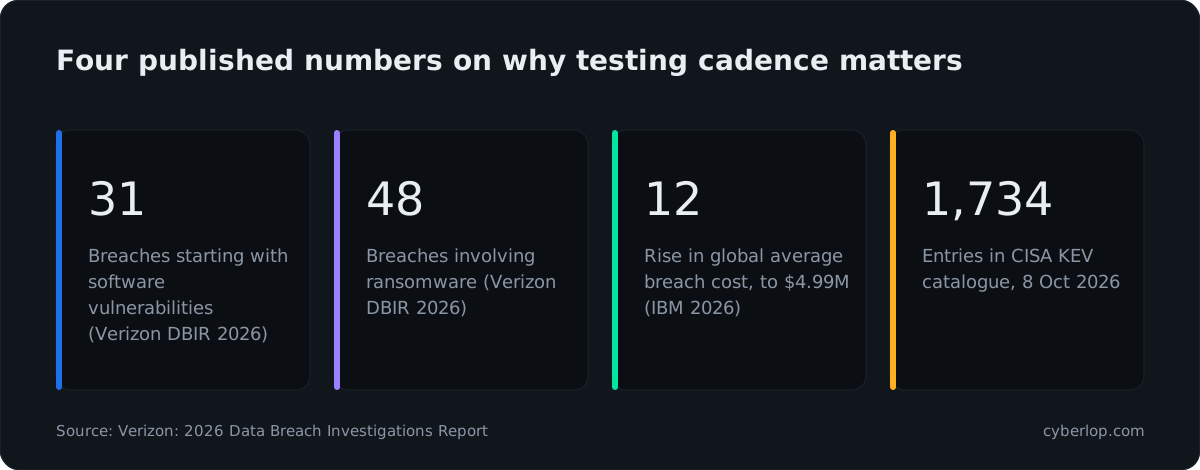
None of these numbers favours a platform. They argue for finding and fixing flaws on a regular rhythm, whichever mix of bounty, pentest and automation you choose.
Do you need a disclosure policy whichever platform you pick?
Yes, in practice. CISA's Binding Operational Directive 20-01 requires US federal agencies to publish a vulnerability disclosure policy that includes a commitment to "not recommend or pursue legal action against anyone for security research activities that the agency concludes represents a good faith effort" (CISA: BOD 20-01). Private companies are not bound by it, but it is a sound template.
For a simple start, publish a security.txt file. RFC 9116 defines it as a "machine-parsable format" that helps organisations describe their disclosure practices, with two required fields, Contact and Expires, served at /.well-known/security.txt (IETF: RFC 9116). It costs an hour and works with any platform.
Where does Cyberlop fit next to HackerOne and Bugcrowd?
Cyberlop is a different kind of tool, not a third crowd. It is software that tests your own web apps and their APIs, so it suits the checks you want between human engagements. It is one option among several, and a team may reasonably use it alongside either platform.
It finds vulnerabilities with black-box, grey-box and white-box testing. In white-box mode it reads your code while testing the running app, so a finding can point to a file and line. It reports what it actually exploited: each finding carries the request, the response, a screenshot where a person can see it, and the line of code. Severity and confidence are kept apart, and findings carry CWE and OWASP references.
A fix is checked by re-running the exact exploit against the new code. It also checks business-logic flaws and cross-account access, meaning one signed-in account reaching another's data or functions. It can run privately inside your own network, on a schedule or in CI/CD to gate a build, and agencies can run it under their own brand.
What it does not do is replace a crowd. A bounty brings outside creativity and a pentest brings a dated human-written report. Cyberlop brings repeatable, evidenced checks. See what the evidence looks like and how it compares with other approaches.
How do you run a fair trial of both platforms?
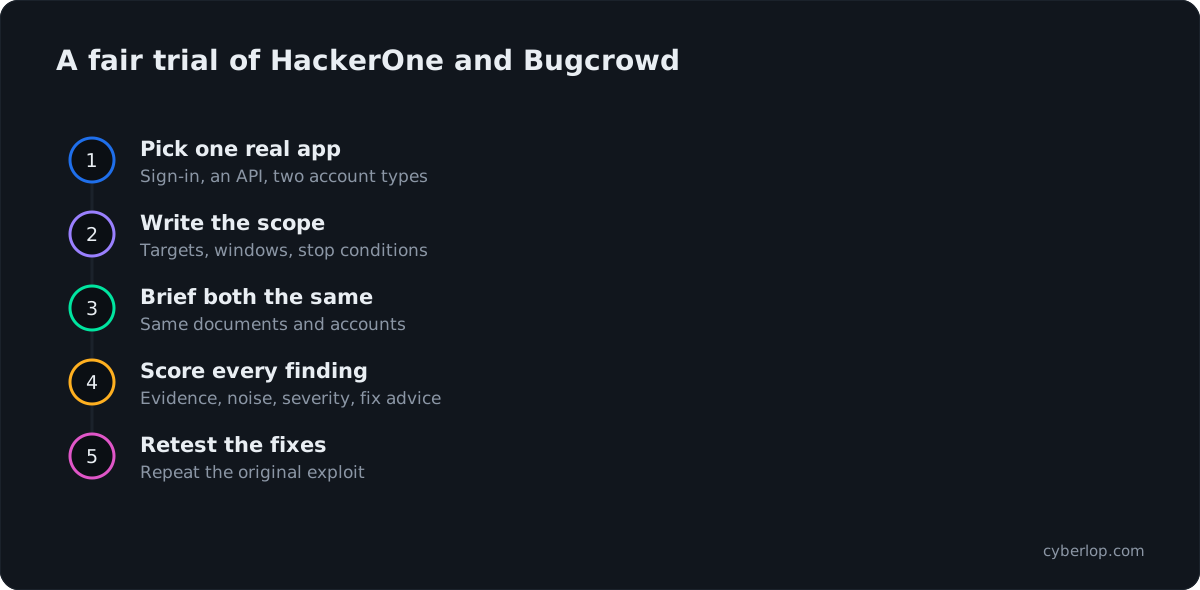
Give both vendors the same scope, the same accounts and the same dates, then score what comes back. Keep the trial small enough to finish in a few weeks.
- Pick one real app. Choose one with sign-in, an API and at least two account types.
- Write down the scope. Name targets, windows and stop conditions, and get written authorisation.
- Agree the report format. Ask each vendor for a sample report and a sample retest before starting.
- Brief both the same way. Same documents, same test accounts, same contact.
- Score every finding. Reproducible? Evidence attached? Correct severity? Useful fix advice?
- Retest the fixes. Check the exact exploit fails after your change.
- Decide on evidence. Compare time to first useful report, noise and the effort your team spent.
A simple scorecard for the trial.
| Score | Question | What good looks like |
|---|---|---|
| Evidence | Can a developer replay the issue? | Request, response and clear steps |
| Noise | How many duplicates or non-issues reached you? | Few, each explained |
| Severity | Did the rating match real business impact? | Reasoned and open to challenge |
| Speed | How long to the first useful report? | Within the time agreed up front |
| Retest | Was the fix confirmed with the original exploit? | Yes, in writing |
| Fit | Did it drop into your ticketing and review flow? | Findings landed where developers work |
What mistakes do teams make when buying from either platform?
Most regrets come from process, not product. These are the repeat offenders.
Three repeat mistakes
Launching a public bounty before fixing the basics
If a scoped test would find ten easy issues, a bounty will find them too, and you will pay for each. Fix the obvious ones first, then open the programme to a small private group.
Not budgeting engineering time for triage follow-up
Platform triage removes noise, but your developers still reproduce, fix and verify. Agree remediation targets by severity before the first report arrives.
Treating one test as the whole programme
No single method covers everything. Pair a crowd or a pentest with automated checks and a retest habit. The general comparison in DAST, SAST and IAST compared shows where each method fits. If you are weighing other platforms too, see best PTaaS platforms, Cobalt alternatives and Synack alternatives.
Questions people ask
Hackerone vs bugcrowd: FAQs
Is HackerOne better than Bugcrowd?
Neither is better in general. Both list bug bounty, vulnerability disclosure and pentest services, and both describe AI-assisted testing. The better fit depends on your scope, your triage capacity and the sample reports you receive, so run the same small trial with both.
What is the difference between bug bounty and penetration testing?
A bug bounty is an open-ended programme that pays researchers for valid findings. A penetration test is a scoped, dated engagement that ends in a report. Bounties suit ongoing discovery; pentests suit audits, customer requests and release checkpoints.
Does HackerOne do penetration testing?
Yes. HackerOne's pentest page describes Pentest as a Service with a vetted pool of testers matched to your asset type and technology stack, real-time findings, a final report and validation of patches. It also lists H1 Agentic Pentest, which combines AI agents with human experts.
Does Bugcrowd offer pentest as a service?
Yes. Bugcrowd lists Penetration Testing as a Service, with web application, mobile, network, API, IoT and cloud variants. Its page describes milestones shown on a dashboard, a real-time checklist, and final reports with an executive summary and detailed findings.
What is a vulnerability disclosure programme?
It is a published way for outsiders to report a security flaw, usually with a promise not to pursue good-faith researchers. It typically has no reward. CISA's BOD 20-01 requires US federal agencies to publish one, and a security.txt file is a simple first step.
Do I need a bug bounty if I already have a pentest?
Not necessarily. HackerOne itself says bounty programmes complement penetration testing. Start with a pentest and fix what it finds. Add a private bounty once you can triage a steady flow of reports and want researchers on new features.
What is the Bugcrowd Vulnerability Rating Taxonomy?
It is Bugcrowd's baseline priority scale for common vulnerability classes, from P1 (critical) to P5 (informational), published on GitHub under the Apache License 2.0. Some classes vary by context, so a rating can move with the real impact.
Can automated testing replace a bounty or a pentest?
Not entirely. Automated testing is good at repeatable checks on every release, while crowds and human testers bring creativity and reports auditors recognise. Many teams combine them: a pentest for evidence, automation for cadence, and a bounty once triage is ready.
Sources
Where the facts come from
- HackerOne: home page
- HackerOne: bug bounty
- HackerOne: pentest
- HackerOne: H1 Response
- Bugcrowd: home page
- Bugcrowd: Bug Bounty
- Bugcrowd: Pen Testing
- Bugcrowd: Vulnerability Disclosure
- Bugcrowd: Attack Surface Management
- Bugcrowd: Vulnerability Rating Taxonomy (GitHub)
- Verizon: 2026 Data Breach Investigations Report
- IBM: Cost of a Data Breach Report 2026
- CISA: Known Exploited Vulnerabilities catalog
- CISA: BOD 20-01
- IETF: RFC 9116 (security.txt)
Keep reading
Related articles
Best PTaaS Platforms in 2026: 9 Compared on Evidence, Retesting and Reporting
Nine PTaaS platforms compared on scope, evidence, retesting and reporting, from vendors' own sites, with six criteria to choose by.
Cobalt alternatives in 2026: seven options and how to choose
Cobalt alternatives compared from vendor sites: human-led PTaaS, hybrid and AI-led testing, with a checklist to choose and trial them.
Continuous penetration testing: how to run it alongside your annual pentest
What continuous penetration testing really means, how it compares with annual pentests, DAST and PTaaS, and how to run both in your pipeline.

Want repeatable checks between tests?
Cyberlop finds vulnerabilities in web apps and their APIs and reports only what it exploited, with the request, the response and the line of code. Ask us to run it on one of your applications.
Or start with a $199 pilot on one application: thirty days, success criteria agreed before day one, credited against the annual if you convert.