
Cobalt is a pentest-as-a-service platform that pairs a testing platform with a network of vetted human testers. Its closest alternatives are HackerOne Pentest, Bugcrowd, NetSPI and BreachLock; Synack and XBOW lean on AI, and Cyberlop adds code-aware testing. Choose by report audience, scope, proof and retest terms.
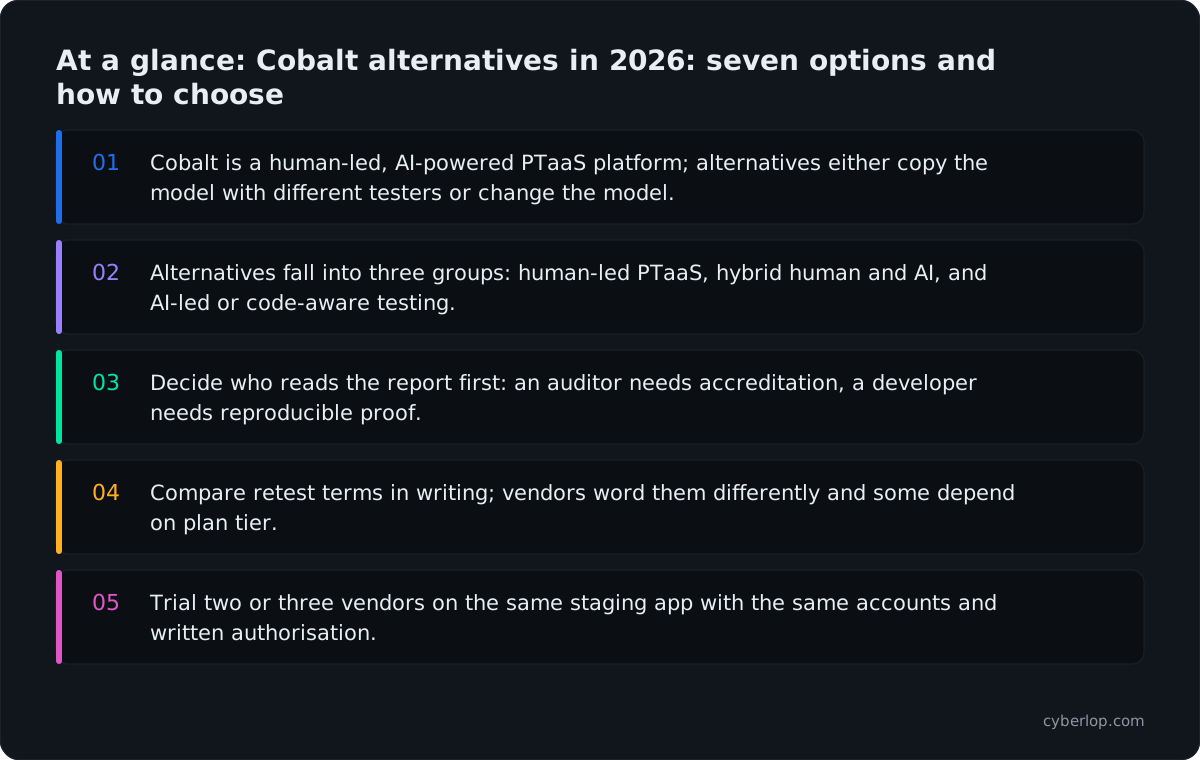
- Cobalt is a human-led, AI-powered PTaaS platform; alternatives either copy the model with different testers or change the model.
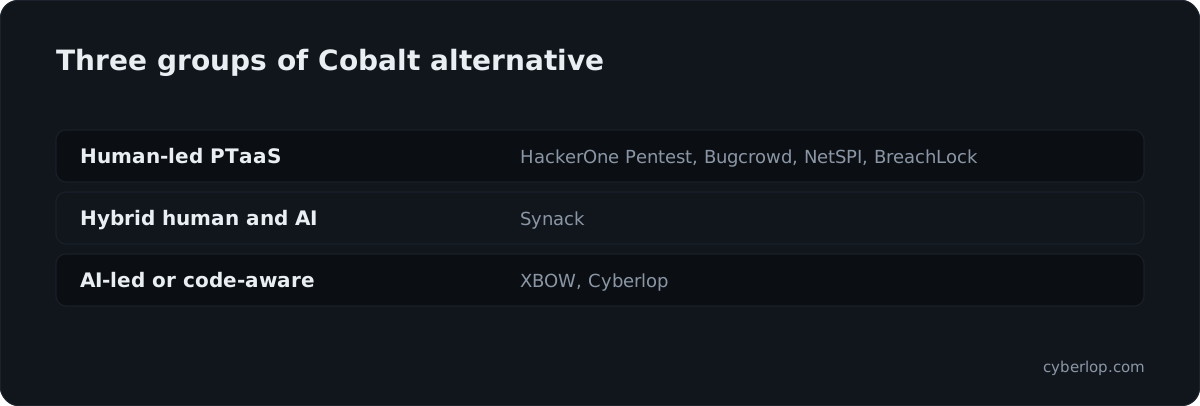
- Alternatives fall into three groups: human-led PTaaS, hybrid human and AI, and AI-led or code-aware testing.
- Decide who reads the report first: an auditor needs accreditation, a developer needs reproducible proof.
- Compare retest terms in writing; vendors word them differently and some depend on plan tier.
- Trial two or three vendors on the same staging app with the same accounts and written authorisation.
The best Cobalt alternatives in 2026 depend on what you want to change: more human pentesters, a faster AI-led option, a different compliance badge, or a tool that reads your code. Cobalt is a penetration testing as a service (PTaaS) platform, and the closest alternatives are HackerOne Pentest, Bugcrowd Pen Test as a Service, Synack, NetSPI and BreachLock, with XBOW and Cyberlop as AI-led or code-aware options. This guide compares them using only what each vendor publishes.
Cobalt is a security vendor whose site describes "human-led, AI-powered pentesting that scales with your attack surface". Every vendor statement below was read on the vendor's own site on 7 October 2026. No prices appear here: see each vendor's pricing page.
What is Cobalt, and how does its pentest model work?
Cobalt sells pentest as a service through a software platform backed by a network of vetted testers. A team scopes a test on the platform, testers work through it, and findings arrive in the platform as they are found.
The products, in the vendor's words
On its home page, Cobalt describes the platform as a way to "launch in hours, get real-time findings and direct access to testers, automate remediation workflows". It names Cobalt Core, a network of "500+ vetted security experts", and says Cobalt Sage AI powers every pentest, from scoping through remediation.
The same page lists 50+ integrations for remediation workflows, autonomous pentesting for rapid repeat cycles, continuous testing programmes and a DAST product that monitors web applications and APIs. Its offensive security services cover application pentesting, network and cloud security testing, red teaming, code review and digital risk assessments.
Retesting and plans
Cobalt's pricing page describes annual tiers called Standard, Premium and Enterprise, and a consumption model built on "Cobalt Credits". It also promotes "unlimited on-demand retesting throughout your contract term", and says availability depends on the tier. Read the plan details for your tier before you compare it with a rival's retest terms. We give no figures here.
What Cobalt's own research shows
Cobalt publishes a yearly State of Pentesting Report. The 2026 edition combines pentest data from "over 16,500 pentests conducted on nearly 3,000 organizations over a five-year period" with a survey of 450 security professionals. It reports a high-risk finding half-life of 10 days for the top-performing teams and 249 days for the bottom tier. That spread is the useful part for any buyer: the pentest finds the problem, and the fix pace decides whether it matters.
Why do teams look for Cobalt alternatives?
Teams rarely leave a PTaaS vendor because it failed; they leave because the need changed. Each reason below points to a different kind of alternative.
1. Do you need a specific certification or auditor view?
Some buyers need pentesters or a report format that a named auditor, regulator or customer already accepts. Check which accreditations a vendor lists on its own site. BreachLock, for example, advertises CREST-certified pentests, and HackerOne lists CREST among the standards it addresses.
2. Do you want the testing to start from your code?
If you want findings that point to the file and line, you need a white-box approach, where the tester reads the code while testing the running app. Check whether a vendor's pages describe it, and whether grey-box testing with signed-in accounts is included.
3. Do you want to run tests on your own timetable?
If you ship weekly, a test booked once or twice a year leaves gaps. An AI-led or scheduled option can re-test after each release. See continuous penetration testing for how the models differ.
4. Does your code have to stay inside your network?
Regulated and enterprise buyers sometimes cannot send source code or traffic to a third party. Ask every vendor where testing runs and where data goes.
5. Are you an agency or MSSP?
A reseller needs white-label reports and multi-client handling. That is a separate comparison: see pentest platforms for MSSPs.
How do the Cobalt alternatives compare at a glance?
Seven alternatives fit into three groups: human-led PTaaS, hybrid human and AI services, and AI-led testing. Each row below is taken from the vendor's own pages.
Summary of seven alternatives and Cobalt
| Option | Model the vendor describes | Stated scope | Retest, per the vendor | Cyberlop |
|---|---|---|---|---|
| Cobalt | Human-led, AI-powered PTaaS; Cobalt Core of 500+ vetted experts | Applications, network, cloud, red teaming, code review | Unlimited on-demand retesting; depends on tier | Reference point for this page |
| HackerOne Pentest | AI agents plus human experts | Attack surface, SOC 2, ISO 27001, CREST and other mappings | Retesting after remediation is a stated step | Different model: exploit-backed, code-aware |
| Bugcrowd Pen Test as a Service | CrowdMatch-curated teams; automated scanners plus manual testing | Web, mobile, network, API, IoT, cloud | 12 months of retesting on Standard and Plus tiers | No crowd; software-driven |
| Synack | Synack Red Team plus Sara AI Pentesting | Web, cloud, API, host and network, attack surface | Continuous cycles verify remediation | Web apps and APIs only |
| NetSPI | 350+ in-house experts with purpose-built AI | Application, cloud, network, AI/ML, hardware and more | Remediation testing included | Narrower scope, closed-loop retest |
| BreachLock | PTaaS plus Breach360 autonomous testing | ASM, autonomous and PTaaS in one workflow | Unlimited retesting | Reads code in white-box mode |
| XBOW | Autonomous, continuous pentesting with working exploits | Applications and APIs | Case file with reproducible exploit per finding | Also proof-led; adds code lines |
| Cyberlop | Black-, grey- and white-box testing of web apps and APIs | Web apps and their APIs | Re-runs the exact exploit on the fix | — |
The last column is a plain-language note on how Cyberlop relates to each row, not a ranking. Cyberlop does not run a human tester network, and several rivals cover network, cloud and hardware where it does not.
Why does application pentesting still matter in 2026?
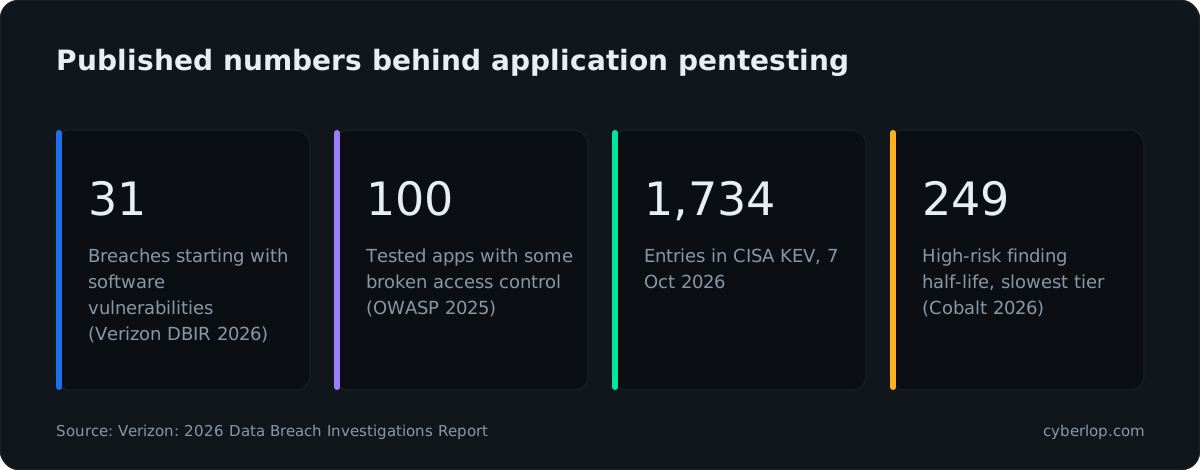
Application pentesting still matters because attackers keep using software flaws to get in, and broken access control keeps topping the lists. Four published numbers set the context.
- In the Verizon 2026 Data Breach Investigations Report, 31% of breaches start with software vulnerabilities, ahead of stolen passwords as the top way in.
- In OWASP Top 10:2025, 100% of applications tested had some form of broken access control.
- The CISA Known Exploited Vulnerabilities catalog listed 1,734 entries on 7 October 2026 (see KEV catalog).
- Cobalt's 2026 report puts the half-life of high-risk findings at 10 days for the fastest teams and 249 days for the slowest.
The last number deserves attention when you compare vendors. A pentest that ends with a PDF has done half the job. Ask how each vendor helps you fix and prove the fix.
Which human-led PTaaS platforms are closest to Cobalt?
HackerOne Pentest, Bugcrowd Pen Test as a Service, NetSPI and BreachLock are the closest to Cobalt's model: a platform, named testers, live findings and retesting. They differ in how they source testers and which standards they stress.
HackerOne Pentest
What the vendor says
HackerOne's Agentic Pentest page describes "a coordinated system of AI agents and human experts". It says expert pentesters are selected for your technology stack and that "every vulnerability is reviewed, validated, and documented by expert pentesters". The page states that agents may assist with reconnaissance and repeatable validation "under strict guardrails", with human pentesters retaining full oversight.
The workflow listed is scoping, agentic and human-led testing, real-time reporting, retesting after remediation and a final report. Findings integrate with GitHub, Jira, Slack and ServiceNow, and the page names SOC 2, ISO 27001, CREST, NIST CSF 2.0, FISMA, NIST 800-53, GDPR and DORA.
Where it wins, and who it suits
Teams that already run bug bounty or other programmes on HackerOne can keep pentests in the same place. The stated human review of every finding appeals to buyers who want a person to sign off. See HackerOne vs Bugcrowd for the bounty side.
Bugcrowd Pen Test as a Service
What the vendor says
Bugcrowd's PTaaS page says teams can "launch standard or customized testing in less than 72 hours" and propose a scope that fits their assets. It uses CrowdMatch to curate testers, mentions global CREST accreditation and combines "automated scanners to find common vulnerabilities and experienced human testers for in-depth manual assessments".
Standard and Plus tiers include "12 months of retesting (with 1 report update)" for relevant asset types such as web applications, networks and APIs. Findings flow to GitHub, Slack, Trello, Jira, Qualys and Kenna, and a dashboard shows prioritised findings and tester progress.
Where it wins, and who it suits
Buyers who want a defined retest window written into the offer, and who like the crowd-matching idea, are the target. Bugcrowd's product list also includes bug bounty, vulnerability disclosure, red team and attack surface management, so it can grow with a security programme.
NetSPI
What the vendor says
NetSPI's PTaaS page describes "350+ in-house security experts", human-led pentesting rather than outsourced testers, and a platform pairing experts with purpose-built AI. Its home page lists application (web, API, mobile), cloud (AWS, Azure, Google Cloud), network, AI/ML, mainframe and hardware or IoT testing. Remediation testing is included, with PDF reports plus trend dashboards, and the company talks about moving "projects to programs".
Where it wins, and who it suits
Larger organisations that need one provider across application, cloud, network and hardware, with dedicated delivery management, get the most from it. A web-only product team may not need that breadth.
BreachLock
What the vendor says
BreachLock's home page offers to "scope, schedule, and launch CREST-certified pentests in just 24-48 hours" with unlimited retesting and audit-ready reporting. Findings are mapped to SOC 2, PCI DSS, ISO 27001, HIPAA and more. It also sells Breach360, described as "Agentic AI-Powered Penetration Testing Trained on 40K+ Real-World Pentests", and says attack surface management, autonomous pentesting and PTaaS sit in a single workflow.
Where it wins, and who it suits
Teams under audit time pressure can get a CREST-certified test plus an autonomous option from one vendor. As with any speed claim, ask what the 24-48 hours covers: scoping, kick-off or the finished report.
Which hybrid and AI-led options sit beside or replace Cobalt?
Synack and XBOW both put AI at the centre of testing, with different amounts of human review. Cyberlop is a third option that adds code reading. Use them when speed and repeat testing matter more than a booked human engagement.
Synack
What the vendor says
Synack's platform page describes a PTaaS platform "combining agentic AI and human expertise". The Synack Red Team is described as "over 1,500 of the world's most skilled and trusted security researchers", and the platform manages researcher access, submissions and payments. AI-led testing is called Sara AI Pentesting, with expert validation of exploitable findings. Human-led engagements come in three durations named Synack14, Synack90 and Synack365. The home page lists web, cloud, API, host and network testing plus attack surface management. Integrations named include Jira, Microsoft, ServiceNow, Splunk, Qualys and Tenable.
Where it wins, and who it suits
Buyers who want a vetted researcher community managed for them, with a choice of AI-led or human-led duration, fit best. Our Synack alternatives guide covers the same ground from the other side.
XBOW
What the vendor says
XBOW's site describes an autonomous offensive security platform that runs continuous pentesting and proves exploitability with working exploits before findings reach a team. It says you can "point XBOW at a URL and it does the rest", and that each finding comes with a case file including the attack path, a reproducible exploit, decision logs and remediation guidance. It lists scope controls, audit logs and alignment with SOC 2, ISO 27001, PCI DSS and NIS 2.
Where it wins, and who it suits
Engineering-led teams that want release-by-release testing instead of an annual engagement are the natural users. Autonomy raises a scoping question: check how the vendor limits what the agent may touch. More in XBOW alternatives.
Where does Cyberlop fit among Cobalt alternatives?
Cyberlop is one option for teams that want proof-backed findings on web apps and APIs without waiting for a tester's calendar. It is not a human tester network, and it does not cover network, cloud or hardware testing.
What it does
Cyberlop finds vulnerabilities in web apps and their APIs with black-box, grey-box and white-box pentesting. In white-box mode it reads your code while testing the running app, so a finding can point to the file and line. It reports only what it actually exploited: each finding carries the request, the response, a screenshot where a person can see it, and the line of code. If it did not break it, it does not report it.
Severity and confidence are kept apart (see severity vs confidence), and findings carry CWE and OWASP references. It checks business-logic flaws and cross-account access, meaning one signed-in account reaching another's data or functions.
A fix is proven by re-running the exact exploit against the new code, a closed-loop retest, not by a fresh scan. It can run on a schedule or in CI/CD and gate a build, and private scanning keeps your code inside your own network. Agencies and MSSPs can run it under their own brand (partners).
Who it suits, and who should pick something else
It fits product teams with a web app or API, releases more frequent than a yearly test, and a wish to see the request, response and code line behind each finding. Pick a human-led PTaaS vendor if you need a named person to author a report for an auditor, or if your scope includes network, cloud or hardware. Many teams sensibly use both: one for continuous proof, one for a scoped annual test. The honest page lists what Cyberlop does not do.
How do you choose a Cobalt alternative?
Choose by the reader of the output, the scope, the proof of each finding and the retest terms, in that order. A good choice is the one whose report your auditor accepts and whose findings your developers can reproduce in minutes.
Criteria that decide the choice
Who reads the report first?
If an auditor or customer reads it, check that the vendor's report format and accreditations are accepted by them. Our guides on SOC 2 penetration testing and reading a pentest report explain what reviewers look for. If developers read it first, favour proof, reproduction steps and tickets in your tracker.
What is in scope?
Write down web apps, APIs, mobile, cloud accounts and networks. Then compare against each vendor's stated scope. A vendor listing many asset types is not automatically better for a web-only team, and a narrower tool is not automatically weaker.
How is a fix verified?
Ask whether a retest repeats the original exploit or runs a general scan, how many retests the plan includes, and how long they take. See retest and fix verification.
Selection checklist
| Question | Why it matters | What a good answer sounds like |
|---|---|---|
| Who tests? | Skill and accountability differ between employed staff, a vetted crowd and software | Named method, vetting process and who signs the report |
| What proves a finding? | Unproven findings cost triage time (false positives) | Request, response, steps to reproduce, screenshot |
| How are accounts handled? | Access flaws need several signed-in accounts | Test accounts you control, with written scope |
| Where does data go? | Source code and traffic may be sensitive | Stated hosting and an option to run inside your network |
| How does retest work? | A fix is only done once it is proven | Same exploit repeated, within the contract term |
| What does it plug into? | Findings should land where engineers work | Named integrations (Jira, GitHub and so on) you actually use |
| What is the pricing unit? | Tiers, consumption and subscriptions behave differently | A written quote based on your scope; check each pricing page |
Questions to put to every vendor
- Who exactly performs the testing, and who reviews every finding?
- Can I see a sample report, including one finding end to end?
- Which standards do you map findings to, and does an auditor I use accept them?
- How do you handle authentication, multi-factor sign-in and several test accounts?
- How do you test for IDOR and other cross-account access flaws?
- What are your safeguards on production, rate limits and testing windows?
- How long does it take from signing to first findings?
- What does a retest involve, and how many are included?
- Where is my code and traffic stored, and who can read it?
- What happens to my data and my account when the contract ends?
How do you trial the shortlist fairly?
Run two or three vendors on the same staging app, with the same accounts and the same written scope, and compare the output on proof and fix time. It is slower than reading feature pages and much more reliable.
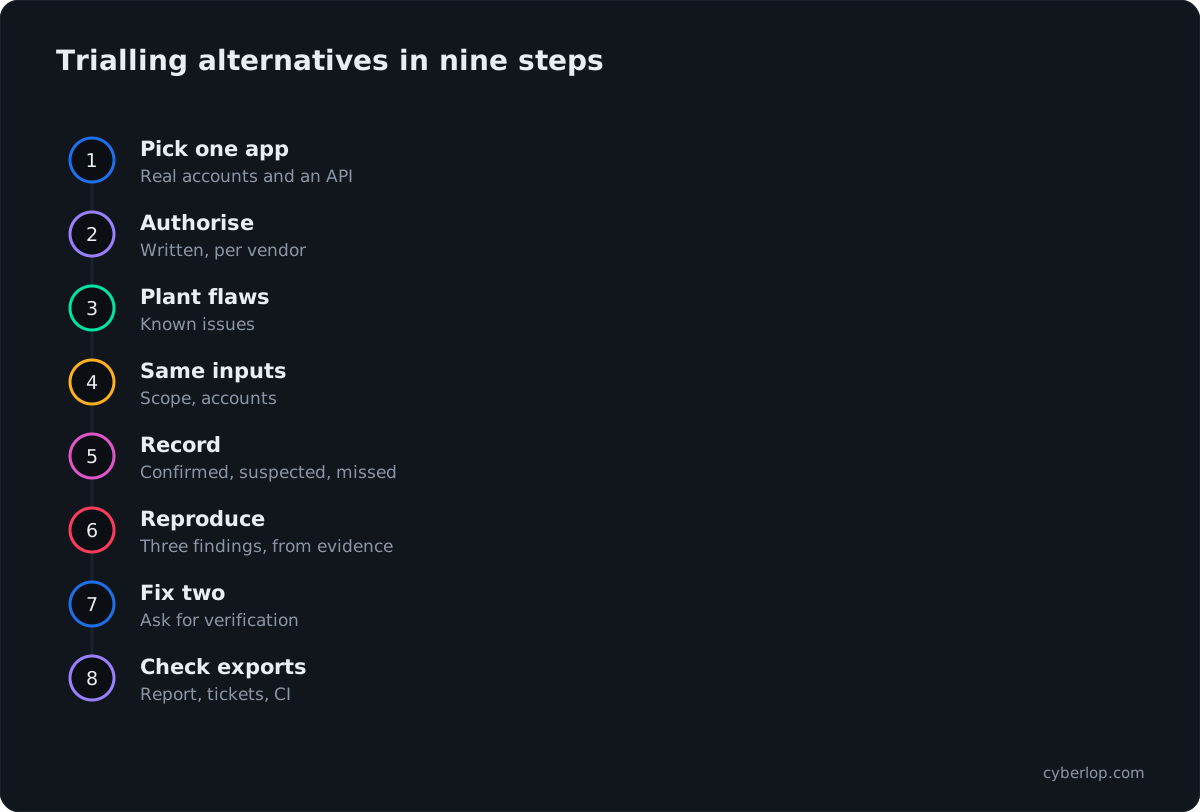
- Pick one application with real accounts and an API. A staging copy with test data is fine.
- Get written authorisation from whoever owns the system, for each vendor.
- Plant a few known flaws, such as one account reading another's invoice, so you can see what each vendor finds and misses.
- Give every vendor the same scope, accounts and rules of engagement (see rules of engagement).
- Record what is confirmed, what is only suspected and what is missed.
- Reproduce three findings from the evidence alone, in minutes, without asking the vendor.
- Fix two findings and ask each vendor to verify them.
- Check the exports: report format, tickets and CI hooks.
- Decide with security, engineering and your auditor in the room.
Mistakes that skew a trial
- Comparing a human-led engagement window with a one-hour automated run and calling the longer one deeper. Compare findings, not hours.
- Giving one vendor better test accounts than another.
- Counting findings instead of confirmed, reproducible findings.
- Ignoring who has to fix what comes back. See remediation SLAs.
What each group still leaves for you
No option does the fixing for you. Human-led platforms leave scheduling and the gap between tests with you. AI-led tools leave open who signs a report for an auditor. A code-aware tool leaves network and cloud testing to someone else. Plan for whichever gap your choice leaves, and see best PTaaS platforms and best AI pentesting tools for wider lists.
So which Cobalt alternative should you pick?
Pick by the problem you are solving, not by a league table.
- You want a similar human-led platform with different testers or standards: HackerOne Pentest, Bugcrowd Pen Test as a Service or NetSPI.
- You are racing an audit and want a CREST-certified test: BreachLock, or check the CREST claims on the others.
- You want a researcher community plus AI-led cycles: Synack.
- You want autonomous, continuous testing with exploit proof: XBOW. You want scheduled or CI-gated testing with exploit proof: Cyberlop.
- You want the finding to point to your code, tested from several angles, on your own network if required: Cyberlop.
- You need both a scoped annual test and continuous proof: combine one human-led vendor with one continuous option. See continuous penetration testing and penetration testing cost for how to weigh the budget without a figure on this page.
Before you switch, read how to choose a penetration testing company and the comparison hub. If you are still unsure, trial two on the same app.
Questions people ask
Cobalt alternatives: FAQs
What is Cobalt?
Cobalt is a security vendor whose site describes human-led, AI-powered pentesting delivered through a platform, backed by Cobalt Core, a network of 500+ vetted security experts. It also lists DAST, autonomous pentesting, red teaming and code review.
What are the best Cobalt alternatives in 2026?
The closest platform alternatives are HackerOne Pentest, Bugcrowd Pen Test as a Service, NetSPI and BreachLock. Synack and XBOW lean on AI-led testing, and Cyberlop offers black-box, grey-box and white-box testing of web apps and APIs. The best one depends on scope, auditor and release cadence.
Is there a Cobalt alternative with CREST-certified testing?
BreachLock's site advertises CREST-certified pentests, Bugcrowd's page mentions global CREST accreditation and HackerOne lists CREST among the standards it addresses. Check which entity holds the accreditation and whether your auditor accepts it.
Do Cobalt alternatives include free retests?
Vendors word it differently. Cobalt promotes unlimited on-demand retesting through the contract term, Bugcrowd lists 12 months of retesting on Standard and Plus tiers, NetSPI includes remediation testing and BreachLock says unlimited retesting. Read your plan, since terms can depend on tier.
Can an AI-led tool replace a human-led pentest?
Sometimes, depending on who must accept the report. AI-led tools suit frequent re-testing with proof of each finding, while an auditor or customer may ask for a named tester's report. Many teams use both. See the guide to AI pentesting tools for the limits.
What does a white-box Cobalt alternative do differently?
A white-box test reads your code while testing the running app, so a finding can point to the file and line. Cyberlop works this way in white-box mode, and also offers black-box and grey-box testing.
How do I compare pricing across Cobalt alternatives?
Ask each vendor for a written quote against the same scope and compare what is included: retests, report updates, integrations and re-scope. Tiers, consumption and subscriptions behave differently, so use each vendor's pricing page, not a table of figures.
Can an agency or MSSP use a Cobalt alternative under its own brand?
Some vendors run partner programmes, and Cyberlop lets agencies and MSSPs run it under their own brand. Check each vendor's partner page for white-label reports, multi-client handling and who owns the client relationship.
Sources
Where the facts come from
- Cobalt: home page
- Cobalt: pricing
- Cobalt: State of Pentesting Report 2026
- HackerOne: Pentest
- Bugcrowd: Pen Test as a Service
- Bugcrowd: products
- Synack: home page
- Synack: platform
- NetSPI: home page
- NetSPI: PTaaS
- BreachLock: home page
- XBOW: home page
- Verizon: 2026 Data Breach Investigations Report
- OWASP: Top 10:2025, A01 Broken Access Control
- CISA: Known Exploited Vulnerabilities catalog
Keep reading
Related articles
Best AI pentesting tools in 2026: ten compared, and how to choose
Ten AI pentesting tools compared from vendors' own sites, with a scoring sheet, a table by category and a plan for a fair trial on your own app.
Best PTaaS Platforms in 2026: 9 Compared on Evidence, Retesting and Reporting
Nine PTaaS platforms compared on scope, evidence, retesting and reporting, from vendors' own sites, with six criteria to choose by.
Continuous penetration testing: how to run it alongside your annual pentest
What continuous penetration testing really means, how it compares with annual pentests, DAST and PTaaS, and how to run both in your pipeline.

Test one app, compare the proof
Cyberlop finds vulnerabilities in web apps and APIs with black-box, grey-box and white-box pentesting, and reports only what it exploited, with request, response and the line of code. Ask us to run it on one of your applications.
Or start with a $199 pilot on one application: thirty days, success criteria agreed before day one, credited against the annual if you convert.