
Synack is a penetration testing vendor that combines the Synack Red Team, over 1,500 vetted researchers, with the Synack Platform and its Sara AI pentester. Alternatives are other crowd platforms (HackerOne Pentest, Bugcrowd), curated PTaaS (Cobalt, NetSPI, BreachLock), autonomous AI (XBOW) and proof-first testing (Cyberlop). Choose by report audience, tester vetting, proof and retest.
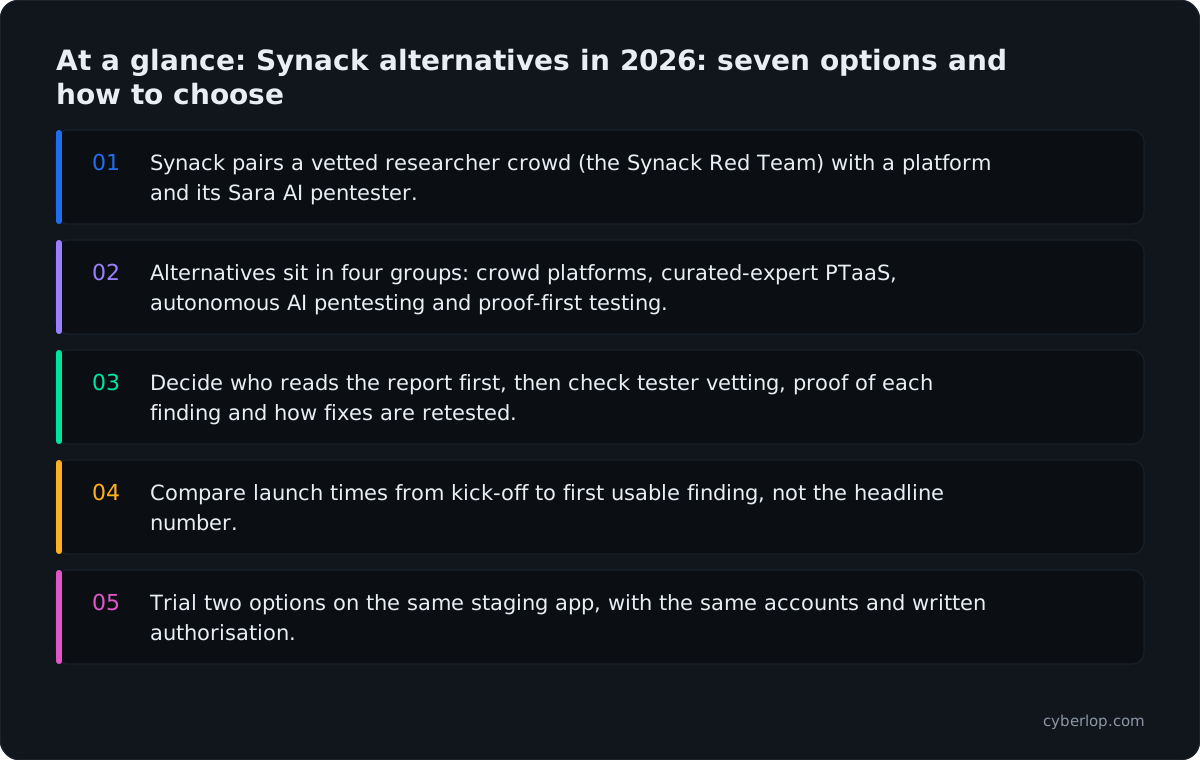
- Synack pairs a vetted researcher crowd (the Synack Red Team) with a platform and its Sara AI pentester.
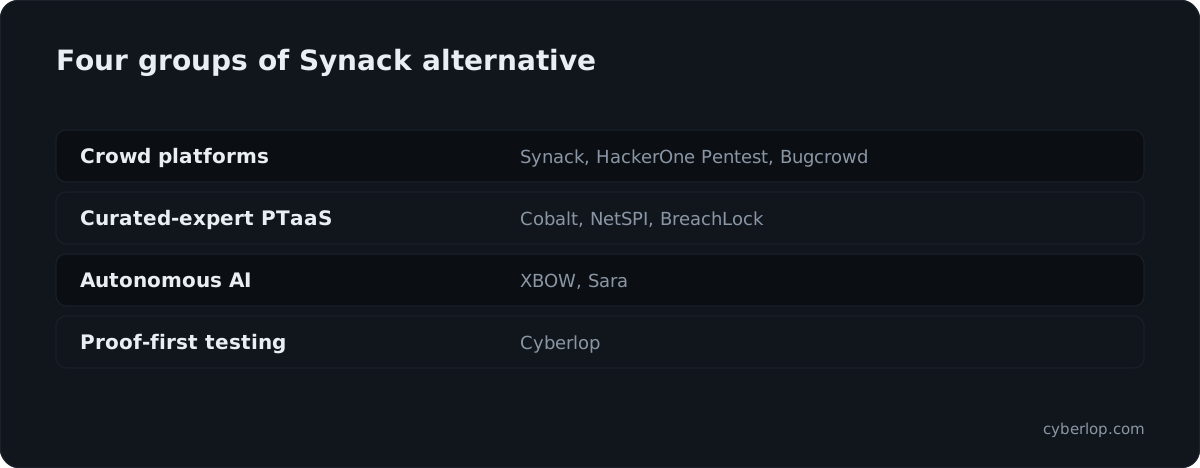
- Alternatives sit in four groups: crowd platforms, curated-expert PTaaS, autonomous AI pentesting and proof-first testing.
- Decide who reads the report first, then check tester vetting, proof of each finding and how fixes are retested.
- Compare launch times from kick-off to first usable finding, not the headline number.
- Trial two options on the same staging app, with the same accounts and written authorisation.
Synack alternatives in 2026 fall into four groups: other crowd-based platforms (HackerOne Pentest, Bugcrowd), curated-expert pentest as a service (Cobalt, NetSPI, BreachLock), autonomous AI pentesting (XBOW), and proof-first web and API testing such as Cyberlop. Which fits depends on who must trust the testers, how often you test, and what evidence your auditor or customer wants. This guide compares them using only what each vendor publishes.
Synack is a security testing vendor whose site describes a vetted crowd of researchers, the Synack Red Team (SRT), working through the Synack Platform, together with an agentic AI pentester called Sara. Every vendor statement below was read on the vendor's own site on 7 October 2026. No prices appear in this guide: see each vendor's pricing page or ask for a quote.
What is Synack, and how does its model work?
Synack is a crowdsourced-plus-AI penetration testing vendor. Its home page lists the Synack Red Team, penetration testing across several target types, the Synack Platform, Sara AI pentesting and attack surface management. The model pairs human researchers with automation, managed by Synack.
The Synack Red Team and the platform
Per the vendor's Synack Red Team page, the SRT "unites over 1,500 of the world's most skilled and trusted security researchers", who use patented technology to test continuously. The platform page says Synack handles intake, initial assessment, exploitability review and triage "so only validated findings reach your team", and that dedicated vulnerability operations teams remove duplicates and confirm findings meet Synack's validation standards.
The platform also pushes validated findings into Jira, Microsoft, ServiceNow and Splunk. Its reports track testing coverage, findings, remediation progress and risk reduction over time.
Penetration testing and Sara
On its penetration testing page Synack lists web applications, APIs, hosts, cloud instances (AWS, Azure, GCP) and development environments, delivered either continuously or at a point in time. It says results are "stored and searchable on the platform" rather than only in PDF reports, and it offers patch verification.
Sara, the "Synack Autonomous Red Agent", "identifies, validates, and prioritizes vulnerabilities across the enterprise attack surface". On the Sara page Synack says all findings are validated by Synack to eliminate false positives, and the report is "AI-generated and human-validated". It describes launches in under 2 minutes, validated findings in 4-5 days, and coverage of up to 25 web apps or 100 hosts per assessment.
Why do teams look for Synack alternatives?
Teams look elsewhere when their need differs from a managed crowd: a named team for one audit, a developer-first workflow, a lighter start, or a tool they can run on their own schedule. None of that is a flaw in Synack. These are different jobs.
Five reasons teams look elsewhere
1. You want a fixed, named team rather than a crowd
A crowd gives breadth: many researchers, many styles. Some buyers prefer one small team that learns the application. Bugcrowd says it "rotates testers whenever needed", while HackerOne says its pool avoids "tester rotation". Ask each vendor how tester continuity works for your engagement.
2. You need a fast start on one application
Several vendors publish launch times: Bugcrowd says tests launch "in less than 72 hours" and BreachLock says "24-48 hours". Synack says Sara launches in under 2 minutes, with validated findings in 4-5 days. Compare the clock from kick-off to first usable finding, not the headline.
3. You want to see the code behind the finding
Most managed testing is described from the outside of the application. If you want a finding to point to the file and line, you need a tool that reads source while testing the running app. White-box testing does that. See white-box testing and black-box testing for the difference.
4. You want testing inside your own network
Some teams cannot send code or traffic to a third party. Check each vendor's data-handling terms, and ask whether a version runs in your environment. XBOW states that deployment "aligns with your data separation, residency, and compliance requirements".
5. You want the work to sit in your CI pipeline
A managed engagement is scheduled work with people. A pipeline check runs on every build. Many teams use both, as the continuous penetration testing guide explains.
How do the alternatives compare at a glance?
The table lists each option's model as the vendor describes it. "See vendor" means the page we read did not state the detail, not that the feature is absent.
Summary of the alternatives, including Synack
| Option | Model, per vendor | Testers | AI role | Retest |
|---|---|---|---|---|
| Synack | Managed platform, continuous or point-in-time | Synack Red Team, 1,500+ vetted researchers | Sara, validated by Synack | Patch verification |
| HackerOne Pentest | Pentest with real-time findings | Vetted, globally distributed experts | H1 Agentic Pentest; in-platform copilot | Retesting after fix |
| Bugcrowd | Incentivised or flat-rate pen testing | CrowdMatch-curated teams | CrowdMatch AI selects testers | 12 months on Standard and Plus tiers |
| Cobalt | Human-led, AI-powered PTaaS | Cobalt Core, 500+ vetted experts | Cobalt Sage AI | Fix validation |
| NetSPI | Human-delivered PTaaS plus ASM | 350+ experts | Purpose-built AI alongside experts | See vendor |
| BreachLock | PTaaS, AI-led and human-led | CREST, OSCP, OSCE certified in-house testers | Agentic AI pentesting | Unlimited retesting |
| XBOW | Autonomous pentesting from a URL | Not a human service | Core of the product | See vendor |
| Cyberlop | Proof-first web and API pentesting | Black-, grey- and white-box pentesting | Exploits findings to confirm | Closed-loop retest |
Why does web and API testing still matter in 2026?
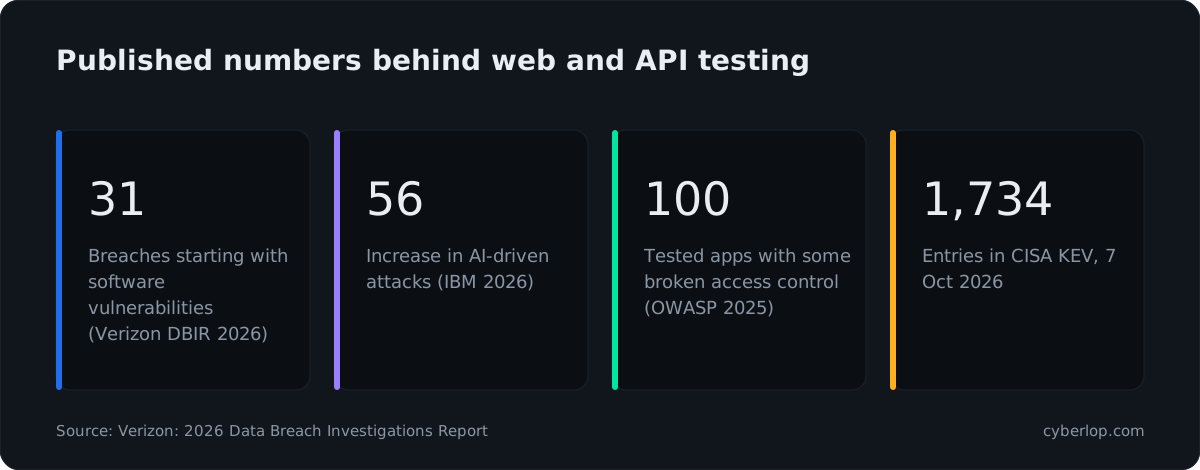
Attackers keep using software flaws, and access-control mistakes are common. Four published numbers frame the decision.
- The Verizon 2026 DBIR reports that 31% of breaches now start with a software vulnerability, ahead of stolen passwords as the top way in.
- IBM's Cost of a Data Breach Report 2026 reports a 56% increase in AI-driven attacks, and a global average breach cost that is a 12% increase on last year.
- The OWASP Top 10:2025 found some form of broken access control in 100% of the applications tested, and ranks it first.
- The CISA Known Exploited Vulnerabilities catalog showed 1,734 entries on 7 October 2026. See KEV catalog.
Broken access control depends on who is signed in and what that account should reach, so any test for it needs real accounts and a clear view of intended permissions. See broken access control and cross-account access.
Which crowd-based platforms are alternatives to Synack?
HackerOne Pentest and Bugcrowd are the closest in model: both connect you to vetted researchers through a platform. They differ from Synack in how testers are chosen, paid and rotated, so read each page for those details. For a wider view, see HackerOne vs Bugcrowd.
HackerOne Pentest
HackerOne's pentest page describes "vetted, globally distributed experts" with "real-time findings on the platform". Testing covers "web apps, APIs, networks, or mobile apps". Reports include "proofs of concept and recommendations for fixes", and HackerOne says it retests after remediation to confirm the fixes were implemented correctly.
Where it fits
Teams that already use HackerOne for vulnerability disclosure, or want one vendor across programmes, are the natural fit. HackerOne also lists H1 Agentic Pentest, and says agentic systems "may assist with reconnaissance and repeatable validation under strict guardrails". Compliance support is listed for SOC 2, ISO 27001 and GDPR.
Bugcrowd
Bugcrowd's pen test page describes a "pay for impact" model alongside flat-rate options, where testers are "rewarded based on results". It uses CrowdMatch AI to curate teams, says tests launch "in less than 72 hours", and states it has "global CREST accreditation for pen testing".
Where it fits
It appeals to buyers who like impact-based incentives and want findings in a dashboard, with integrations such as GitHub, Jira and Slack. The page says Standard and Plus tiers include "12 months of retesting (with 1 report update)" for specified asset types, so check which tier your assets fall under.
Which curated-expert PTaaS vendors should you consider?
If you want a defined pool of vetted testers rather than an open crowd, Cobalt, NetSPI and BreachLock are the usual shortlist. All three describe pentest as a service: a platform, scheduled engagements and reports. See pentest as a service and our best PTaaS platforms guide.
Cobalt
Cobalt calls its offer "Human-led, AI-powered pentesting that scales with your attack surface". Cobalt Core is a network of "500+ vetted security experts". The platform promises to "Launch in hours, get real-time findings and direct access to testers", with 50+ integrations and "fix validation". Cobalt also lists autonomous pentesting, red teaming, secure code review and DAST. More in Cobalt alternatives.
NetSPI
NetSPI describes "human-delivered, contextualized pentesting services" across application, network, cloud, AI/ML, mainframe and hardware testing, backed by "350+ experts". It also sells attack surface management and calls itself "the pioneer of Penetration Testing as a Service (PTaaS)". Larger organisations that want network and infrastructure testing in the same programme as application testing are the target.
BreachLock
BreachLock says you can launch "CREST-certified pentests in just 24–48 hours", with unlimited retesting and audit-ready reporting. Its testers are "Certified In-House — CREST, OSCP, OSCE and more", and findings are mapped to SOC 2, PCI DSS, ISO 27001 and HIPAA. It pairs this with agentic AI pentesting "Trained on 40K+ Real-World Pentests".
Which autonomous AI pentesting tools are alternatives to Synack?
Autonomous tools replace the crowd with software that explores the application and proves what it finds. Synack's own Sara is in this group, so the question is whether you want AI inside a managed service or as the product. See best AI pentesting tools and XBOW alternatives.
XBOW
XBOW says you can "point XBOW at a URL and it does the rest". It explores applications and APIs, chains vulnerabilities and proves exploitability "before a finding ever reaches your team". Each finding arrives as a case file with the attack path, "the working exploit that proves it", a decision log and remediation advice. You define the scope, and every action is logged and auditable.
Where it fits
Teams that want autonomous depth without scheduling people are the target. If an auditor requires a named human tester to sign the report, confirm that with your auditor first.
Where does Cyberlop fit?
Cyberlop is one option for teams that want findings with proof rather than a list of suspicions. It finds vulnerabilities in web apps and their APIs with black-box, grey-box and white-box pentesting.
What it does
In white-box mode Cyberlop reads your code while testing the running app, so a finding can point to the file and line. It reports what it actually exploited: each finding carries the request, the response, a screenshot where a person can see it, and the line of code. Its rule is "if we did not break it, we do not report it". Severity and confidence are kept apart, and findings carry CWE and OWASP references.
It checks business-logic flaws and cross-account access, meaning one signed-in account reaching another's data or functions. A fix is proven by re-running the exact exploit against the new code, a closed-loop retest, not by a fresh scan. It can run inside your own network (private scanning), on a schedule or in CI/CD, and it can gate a build.
Who it suits, and who should pick something else
It fits product teams that want proof and a fix check, and agencies and MSSPs that run it under their own brand (partners, agencies). Pick a different option if your priority is a large human crowd, a report signed by a named tester, or network and cloud-infrastructure coverage. See the comparison page and our honest limits.
Should you use a crowd, an AI pentester or a pipeline check?
A crowd or curated experts give depth and a signed deliverable. An AI pentester gives frequent, repeatable testing. A pipeline check gives fast feedback on each change. Most mature programmes combine two of these.
What each approach does well
| Approach | Strength | Watch for | Examples in this guide |
|---|---|---|---|
| Crowd of researchers | Many perspectives; creative, unusual attack paths | Tester rotation, triage effort, scheduling | Synack, HackerOne Pentest, Bugcrowd |
| Curated expert pool | Defined team; reports for audits | Engagement length; retest terms | Cobalt, NetSPI, BreachLock |
| Autonomous AI pentest | Fast launch; repeatable runs | Proof of each finding; scope controls | XBOW, Sara |
| Proof-first web and API testing | Exploit evidence, code line, fix re-test | Not a human crowd | Cyberlop |
The continuous penetration testing guide explains how to split these roles, and penetration testing cost explains cost drivers without quoting prices.
Is a crowdsourced pentest the same as a bug bounty?
No. A bug bounty is an open-ended programme that rewards researchers for valid reports, usually with no fixed end date. A crowdsourced pentest is a scoped, time-boxed engagement in which a selected group of vetted testers works to a written scope and delivers a report. Vendors blend the two in different ways, so ask each one which you are buying.
Questions that separate the two
- Is the scope fixed in writing, with start and end dates and rules of engagement (see rules of engagement)?
- Are testers chosen for your stack, or do you receive whatever the crowd submits?
- Is a report produced for your auditor, or only a stream of individual findings?
- Who removes duplicates and invalid reports before they reach your engineers?
Synack describes its triage and validation on the platform page, and HackerOne and Bugcrowd describe reports and retesting on theirs. What matters to your team is how much triage lands on you. For a deeper look at the programme side, read HackerOne vs Bugcrowd.
Why the answer matters for audits
A scoped engagement with a dated report maps neatly to the pentest report that SOC 2 and ISO 27001 auditors usually ask for. An open programme may need a separate summary. Ask your auditor which they accept before choosing; the SOC 2 and ISO 27001 pages explain the controls involved.
How do you choose a Synack alternative?
Choose by the output you must hand to someone else, then by who tests, then by proof and retest. The table turns that into questions you can put to every vendor in one week.
Criteria that decide the choice
| Criterion | Question for the vendor | Good answer looks like |
|---|---|---|
| Report audience | Who reads it first: auditor, customer, engineer? | A sample report for that reader |
| Tester vetting | How are testers selected, and can I see their certifications? | Written vetting and certification detail |
| Authenticated testing | Can you test behind login, with two accounts? | Documented account handling |
| Proof | Does every finding include request, response and a working exploit? | Reproducible evidence |
| Retest | How is a fix verified, and for how long? | Written retest terms |
| Data location | Does code or traffic leave my network? | Clear data-handling terms |
| Scope | Web, API, mobile, cloud, network? | A list that matches your estate |
| Cadence | Continuous, scheduled or one-off? | Matches release rhythm |
Questions to put to every vendor
- Show me a real, redacted report, not a marketing sample.
- Who validates a finding before I see it, and how?
- What happens when a fix fails the retest?
- What are the scope and rules of engagement, in writing?
- How do findings reach Jira or my pipeline?
- What do I still have to do myself?
For a longer list, see how to choose a penetration testing company, SOC 2 penetration testing and how to read a penetration test report.
How do you trial the shortlist fairly?
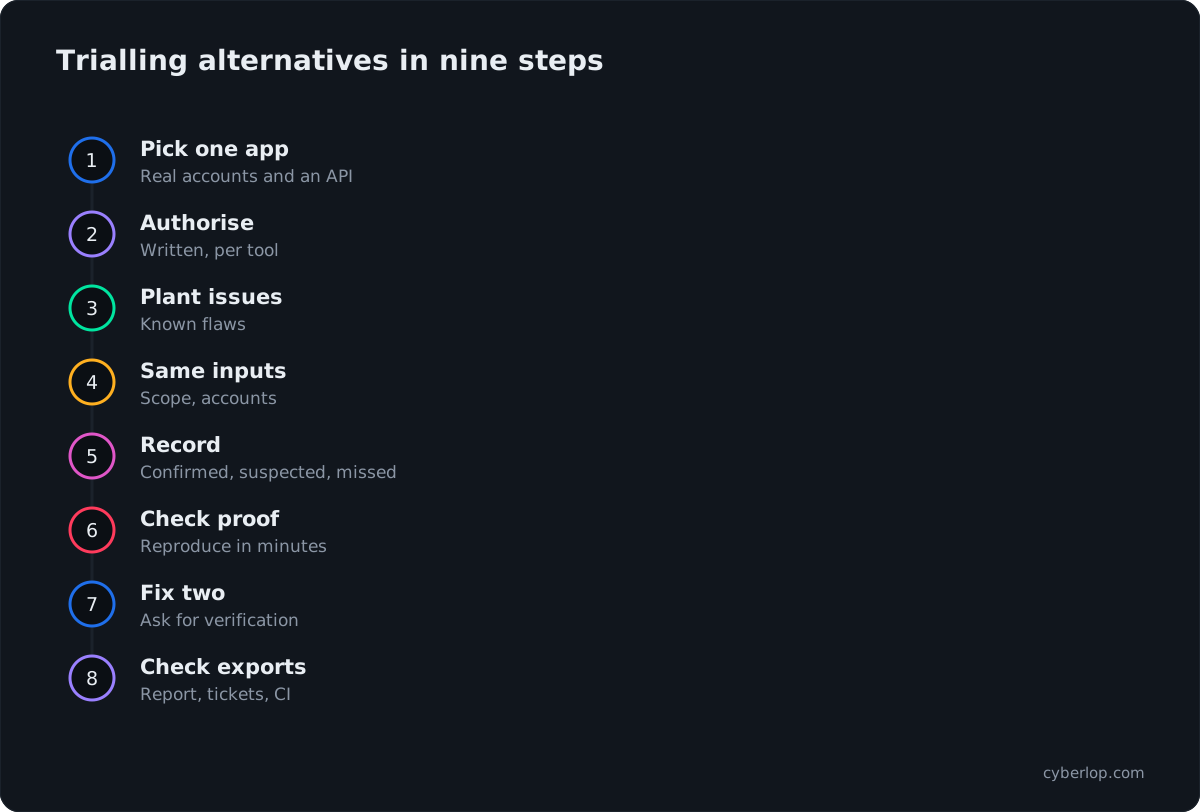
Run each option against the same staging application with the same accounts and written authorisation, then compare confirmed findings, misses and the quality of proof. Allow two to three weeks for a fair trial.
Mistakes that skew a trial
- Giving one vendor more context, accounts or documentation than another.
- Counting suspected issues as findings.
- Skipping the fix check, which is where vendors differ most.
- Choosing on a demo rather than a report on your own application.
What each option still leaves to you
No option replaces secure design, code review or patching. A pentest of any kind is a dated sample of your risk; plan remediation owners before the report arrives. If your estate includes hosts and cloud accounts, check coverage in writing: Intruder alternatives and Astra Security alternatives cover related tools.
So which Synack alternative should you pick?
Pick HackerOne Pentest or Bugcrowd if you want a platform and a researcher community, Cobalt, NetSPI or BreachLock for a defined expert pool and audit reports, XBOW for autonomous depth, and Cyberlop for proof-backed web and API findings with a fix check. Keep Synack on the list if a vetted crowd with managed triage is what you want. Run two on the same app and let the evidence decide.
Questions people ask
Synack alternatives: FAQs
What is Synack?
Synack is a security testing vendor. Its site describes the Synack Red Team of over 1,500 vetted researchers, the Synack Platform, penetration testing across web, API, host and cloud targets, and Sara, an agentic AI pentester.
What are the best Synack alternatives?
It depends on the job. HackerOne Pentest and Bugcrowd are crowd-based platforms. Cobalt, NetSPI and BreachLock use curated expert pools. XBOW is autonomous. Cyberlop offers proof-backed web and API pentesting.
How does the Synack Red Team work?
Per Synack, the Synack Red Team unites over 1,500 vetted researchers who work through the Synack Platform. Synack says it handles intake, exploitability review and triage so only validated findings reach your team.
What is Synack Sara?
Sara is the Synack Autonomous Red Agent. Synack says it identifies, validates and prioritises vulnerabilities, and that all findings are validated by Synack before the report reaches you.
Is Synack better than HackerOne Pentest or Bugcrowd?
No vendor wins on every point. All three use vetted researchers through a platform. Differences lie in tester selection, incentives, rotation, launch time and retest terms, so compare sample reports from each.
Can AI pentesting replace a crowdsourced pentest?
Sometimes, for frequent and repeatable testing. A crowd or expert team adds human creativity and a named deliverable some auditors expect. Many teams run both and ask each vendor how findings are proven.
Which Synack alternative suits SOC 2 or ISO 27001 evidence?
Auditors usually want a scoped test, a dated report and proof of retest. HackerOne, Bugcrowd and BreachLock describe compliance-ready reports on their sites. Confirm what your auditor accepts before you buy.
How do I compare these vendors fairly?
Use the same staging app, accounts and written authorisation for each. Count confirmed findings and misses, check the proof, then fix two findings and ask each vendor to verify the fix.
Sources
Where the facts come from
- Synack: home page
- Synack: Synack Red Team
- Synack: penetration testing
- Synack: Sara
- Synack: platform
- HackerOne: Pentest
- Bugcrowd: penetration testing
- Cobalt: home page
- NetSPI: home page
- BreachLock: home page
- XBOW: home page
- Verizon: 2026 Data Breach Investigations Report
- IBM: Cost of a Data Breach Report 2026
- OWASP: Top 10:2025, A01 Broken Access Control
- CISA: Known Exploited Vulnerabilities catalog
Keep reading
Related articles
Astra Security alternatives in 2026: nine options and how to choose
Astra Security alternatives compared from vendor sites: human-led PTaaS, AI pentesting, DAST in CI, attack surface tools and open source.
Best AI pentesting tools in 2026: ten compared, and how to choose
Ten AI pentesting tools compared from vendors' own sites, with a scoring sheet, a table by category and a plan for a fair trial on your own app.
Best PTaaS Platforms in 2026: 9 Compared on Evidence, Retesting and Reporting
Nine PTaaS platforms compared on scope, evidence, retesting and reporting, from vendors' own sites, with six criteria to choose by.

Compare the proof on one app
Cyberlop finds vulnerabilities in web apps and APIs with black-box, grey-box and white-box pentesting, and reports only what it exploited, with request, response and the line of code. Ask us to run it on one of your applications.
Or start with a $199 pilot on one application: thirty days, success criteria agreed before day one, credited against the annual if you convert.