
Home / Blog / Best ptaas platforms 2026
Compare
Best PTaaS Platforms in 2026: 9 Compared on Evidence, Retesting and Reporting
PTaaS puts penetration testing on a platform, but platforms differ in who tests, how findings are proven and what a retest means. Here is how nine options compare, using only what each vendor publishes.
Cyberlop Labs · Updated · 14 min read
PTaaS (penetration testing as a service) is penetration testing delivered through a platform with live findings, retests and integrations. The best PTaaS platforms in 2026 depend on scope and proof: Cobalt, HackerOne Pentest, Bugcrowd, Synack, NetSPI, BreachLock, Astra and ImmuniWeb are human-led or hybrid; Cyberlop is code-aware for web apps and APIs.
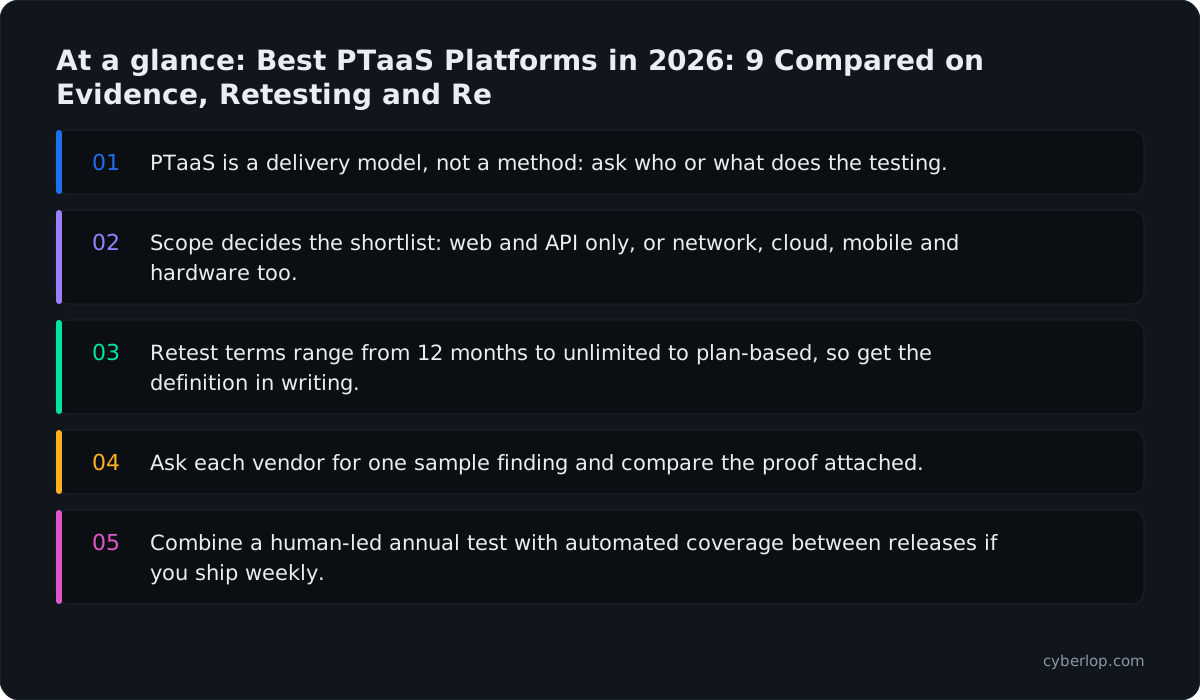
- PTaaS is a delivery model, not a method: ask who or what does the testing.
- Scope decides the shortlist: web and API only, or network, cloud, mobile and hardware too.
- Retest terms range from 12 months to unlimited to plan-based, so get the definition in writing.
- Ask each vendor for one sample finding and compare the proof attached.
- Combine a human-led annual test with automated coverage between releases if you ship weekly.
The best PTaaS platforms in 2026 differ mostly in who does the testing and what they hand back: Cobalt, HackerOne Pentest, Bugcrowd, Synack, NetSPI, BreachLock, Astra Security and ImmuniWeb all sell penetration testing as a service, and Cyberlop is a code-aware option beside them. PTaaS (penetration testing as a service) is a model where a software platform handles scoping, findings, retests and reporting around real penetration testing. This guide compares them using only what each vendor publishes.
Every vendor statement below was read on that vendor's own site on 7 October 2026. We give no prices, credits or plan figures for anyone: see each vendor's pricing page. Where a tool wins, we say so; where a limit is not stated by the vendor, we do not invent one.
What is PTaaS, and how is it different from a one-off pentest?
PTaaS is penetration testing delivered through a platform instead of a PDF emailed at the end. The test itself is still a penetration test: NIST SP 800-115 defines it as testing in which evaluators "mimic real-world attacks" to find ways around the security features of a system (NIST CSRC glossary). What PTaaS changes is the workflow around that test.
In practice that means you scope and book on a dashboard, see findings while the test runs, route them to your build and ticket tools, and ask for a retest inside the same platform. The pentest as a service label covers a wide range, from human-only networks of testers to AI-led tools, so the name alone tells you little.
Traditional pentest versus PTaaS
| Question | Traditional engagement | PTaaS platform |
|---|---|---|
| How do you start? | Statement of work, kick-off call, calendar slot. | Scope and launch from a dashboard; vendors describe launch in hours or days. |
| When do you see findings? | In the final report. | As they are found, in the platform. |
| How are fixes checked? | A separate retest, often a new engagement. | A retest inside the same platform, on terms the vendor sets. |
| Where do results live? | A PDF. | A searchable platform with exports and ticket integrations. |
| What stays the same? | A person or system must still try to exploit the weakness. | Same. Ask who or what does that work. |
Why testing at all? The numbers that justify the budget
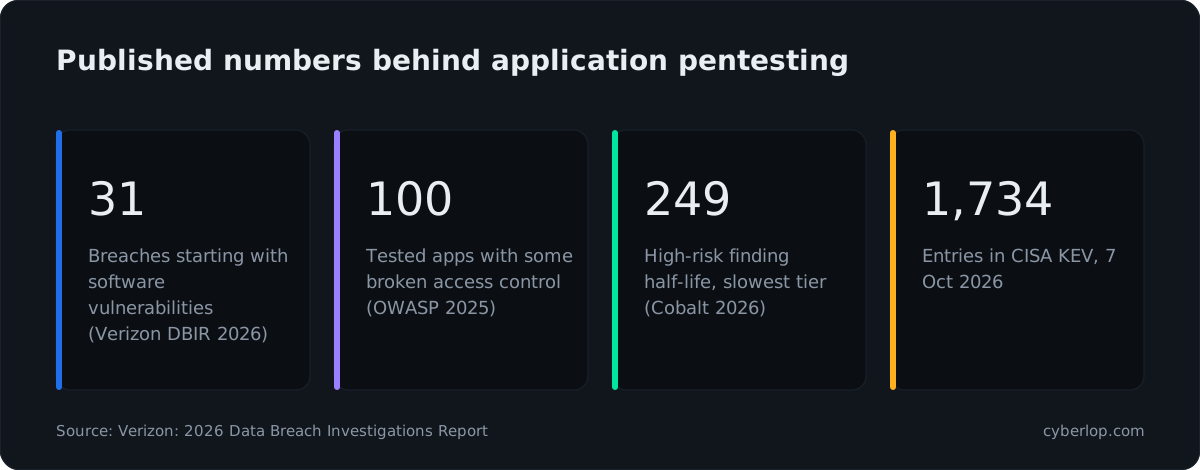
Software flaws are now a leading way in. The Verizon 2026 Data Breach Investigations Report finds that software vulnerabilities start 31% of breaches, now ahead of stolen passwords as the way in. The OWASP Top 10:2025 reports that "100% of the applications tested were found to have some form of" broken access control, the number one category.
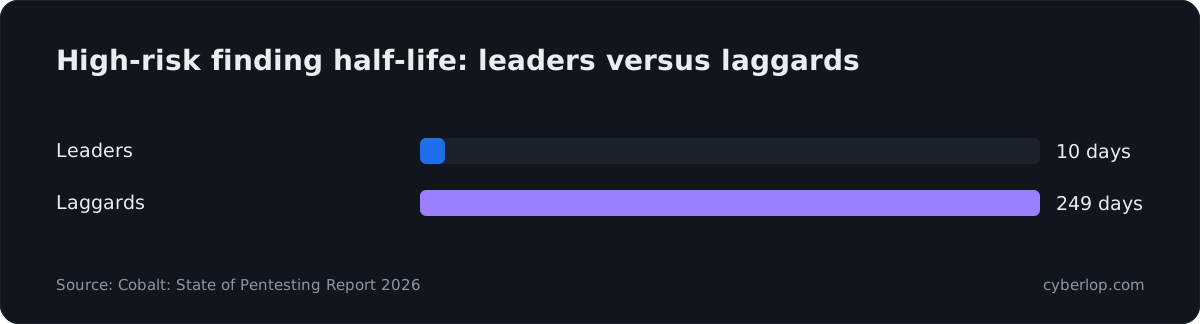
Finding is only half of it. Cobalt's State of Pentesting Report 2026, built from "over 16,500 pentests" across "nearly 3,000 organizations", reports a high-risk finding half-life of 10 days for leaders and 249 days for laggards. The CISA Known Exploited Vulnerabilities catalog listed 1,734 entries when we read it. A platform that shortens the path from finding to verified fix matters more than one that only lengthens the report.
Which are the best PTaaS platforms in 2026?
Shortlist by delivery model first, then by name. The eight established platforms below fall into four groups, and Cyberlop sits in a fifth. Order inside this section is by group, not by rank.
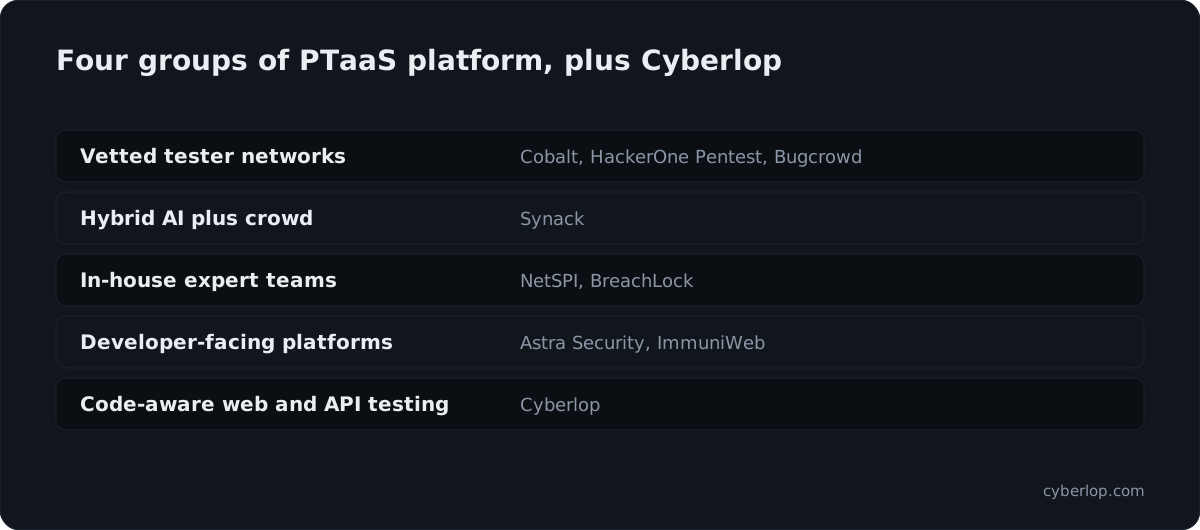
- Human-led platforms with a vetted tester network: Cobalt, HackerOne Pentest, Bugcrowd.
- Hybrid AI plus crowd: Synack.
- In-house expert teams: NetSPI, BreachLock.
- Developer-facing platform plus scanners: Astra Security, ImmuniWeb.
Cobalt
Cobalt's home page describes "human-led, AI-powered pentesting that scales with your attack surface", with a platform to "launch in hours, get real-time findings and direct access to testers". It names the Cobalt Core, a network of "500+ vetted security experts", and says Cobalt Sage AI supports testing from scoping to remediation. It lists 50+ integrations, on-demand reports, and services covering application pentesting (web apps, APIs, AI/LLM systems), network and cloud testing, red teaming and code review.
Where Cobalt fits
Teams that want recurring pentests, direct chat with the tester and a long list of workflow integrations. See our Cobalt alternatives guide for the closer comparison.
HackerOne Pentest
HackerOne's Pentest page describes two offers: H1 Pentest, a pentest service built on "a vetted pool of elite pentesters", and H1 Agentic Pentest, "a coordinated system of AI agents and human experts". Testers are "matched to your asset type and technology stack". Listed scope covers web applications, APIs, networks, mobile, cloud (AWS and Azure), source code review and AI/LLM testing. Results arrive "as they are discovered", final reports include proofs of concept, and retesting follows remediation. It lists Jira, Slack, GitHub and ServiceNow integrations.
Where HackerOne fits
Organisations already running programmes with HackerOne, or those who want a named compliance list on the vendor page: SOC 2, ISO 27001, GDPR, NIST CSF 2.0, CREST, FISMA, NIST 800-53 and DORA are all listed there. Compare it with Bugcrowd in our HackerOne vs Bugcrowd guide.
Bugcrowd Pen Test as a Service
Bugcrowd's PTaaS page says you can "launch standard or customized testing in less than 72 hours". It uses "CrowdMatch AI technology" to curate teams, holds "global CREST accreditation", and says testers can be "rotated whenever needed". The Standard and Plus tiers include "12 months of retesting (with 1 report update)" for their asset types. A dashboard gives real-time visibility, and findings flow to GitHub, Slack, Trello, Qualys, Jira and Kenna.
Where Bugcrowd fits
Buyers who value a stated launch window, a stated retest period and the option to change testers mid-programme. Read the tier table on the page, because report type and retest terms differ by tier.
Synack
Synack's platform page combines "agentic AI and human expertise". Sara AI Pentesting and Sara Continuous AI Pentesting are the AI-led options; Synack14, Synack90 and Synack365 are the human-led options, "ranging from 2 weeks to year-round". The Synack Red Team is "over 1,500 of the world's most skilled and trusted security researchers". The pentesting page lists web applications, APIs, hosts and more, plus "real-time reporting and patch verification". Integrations include Jira, Microsoft, ServiceNow, Splunk, Qualys and Tenable.
Where Synack fits
Larger estates that want a large researcher pool, host and network coverage alongside web and API, and an AI option for recurring coverage. Our Synack alternatives post covers the trade-offs.
NetSPI
NetSPI's PTaaS page stresses "350+ in-house pentesters" who are "employed, not outsourced". Listed scope is the widest in this guide: application (web, API, mobile, thick client), cloud (AWS, Azure, GCP), network, mainframe, hardware and IoT, and AI/LLM assessments. It describes "live, interactive vulnerability reports", "remediation testing", "trend analysis and real-time dashboards" and an open API with ticketing integrations.
Where NetSPI fits
Enterprises with mixed estates and a security team that wants one provider across application, cloud and network work, with trend reporting for leadership.
BreachLock
The BreachLock home page promises "CREST-certified pentests in just 24-48 hours with unlimited retesting and audit-ready reporting", mapped to SOC 2, PCI DSS, ISO 27001 and HIPAA. It also lists agentic AI penetration testing "trained on 40K+ real-world pentests", attack surface management, and a single data model across all three. It says it keeps CREST, OSCP and OSCE certified testers in-house.
Where BreachLock fits
Teams under audit deadlines who want a fast start and retesting included in the offer. Confirm what "unlimited" covers in your contract before you rely on it.
Astra Security
Astra's pentest page describes "offensive pentests by certified pentesters" following OWASP, SANS, CREST and PTES standards, a "vulnerability management console" with CVSS-based prioritisation, the option to "assign vulnerabilities to engineers", and a "publicly verifiable pentest certificate" you can share with customers. The home page adds scanners: DAST for "over 10,000 vulnerabilities", API security for "shadow, zombie, and undocumented APIs" and a cloud scanner. It lists Jira, Slack and CI/CD integrations.
Where Astra fits
Software companies that want pentest, scanning and a customer-facing certificate in one console. See our Astra Security alternatives guide.
ImmuniWeb
ImmuniWeb's site pairs machine learning with its own expert testers. It quotes IDC on its "unique zero false positive SLA" and lists web and API testing, mobile, continuous penetration testing and scanning, attack surface management and cloud penetration testing, with DevSecOps and CI/CD integrations. The quote is the analyst's wording as shown by the vendor, so ask ImmuniWeb for the SLA terms.
Where ImmuniWeb fits
Buyers whose main pain is noise and triage time, who want the accuracy commitment written into the contract.
How do the platforms compare on scope, retesting and reporting?
The table below puts the published facts side by side. A blank or "not stated" cell means the page we read did not say, not that the feature is missing. Confirm each point with the vendor.
PTaaS platforms side by side (vendor-published facts)
| Platform | Who does the testing | Scope listed on its site | Retest, as published | Reporting and workflow |
|---|---|---|---|---|
| Cobalt | Cobalt Core, 500+ vetted experts; Sage AI | Application, network, cloud, red team, code review | Continuous testing programmes; retest terms on its plans page | On-demand reports; 50+ integrations |
| HackerOne Pentest | Vetted pentesters; optional Agentic Pentest | Web, API, network, mobile, cloud, code, AI/LLM | Retesting after remediation | Real-time findings; proofs of concept; Jira, Slack, GitHub, ServiceNow |
| Bugcrowd | CrowdMatch-curated teams; CREST accredited | Not listed on the PTaaS page we read; check its products page | 12 months on Standard and Plus (1 report update) | Dashboard; downloadable report; GitHub, Slack, Trello, Qualys, Jira, Kenna |
| Synack | Synack Red Team, 1,500+ researchers; Sara AI | Web, API, hosts, cloud | Patch verification | Searchable platform; Jira, Microsoft, ServiceNow, Splunk, Qualys, Tenable |
| NetSPI | 350+ in-house pentesters | Application, cloud, network, mainframe, hardware, AI/LLM | Remediation testing | Live reports; trend dashboards; open API |
| BreachLock | In-house CREST, OSCP, OSCE testers; agentic AI | PTaaS, autonomous pentesting, attack surface management | Unlimited retesting, per its home page | Audit-ready reporting mapped to SOC 2, PCI DSS, ISO 27001, HIPAA |
| Astra Security | Certified pentesters plus scanners | Apps, APIs, cloud | Re-scans to verify fixes, by plan | Vulnerability console; shareable certificate; Jira, Slack, CI/CD |
| ImmuniWeb | Machine learning plus expert testers | Web, API, mobile, cloud, attack surface | Not stated on the page we read | Zero false positive SLA (as quoted from IDC); CI/CD integrations |
| Cyberlop | Pentesting product: black-box, grey-box, white-box | Web apps and their APIs | Closed-loop retest: the exact exploit is re-run on the new code | Request, response, screenshot where visible, line of code; CWE and OWASP references; CI/CD gate |
Reading the table honestly
Three patterns stand out. First, the human-led platforms list the widest scope, including networks, hardware and mainframe; if you need those, an app-layer tool will not cover them. Second, retest terms vary from "12 months" to "unlimited" to "by plan", so a headline comparison of "retesting included" hides real differences. Third, only some pages say how a finding is proven, so ask each vendor what it attaches to a finding.
Where does Cyberlop fit among PTaaS platforms?
Cyberlop is one option, aimed at web applications and their APIs. It finds vulnerabilities with black-box, grey-box and white-box pentesting. In white-box mode it reads your code while testing the running app, so a finding can point to the file and line.
What each finding carries
Cyberlop reports what it actually exploited. Each finding has the request, the response, a screenshot where a person can see it, and the line of code. If it did not break it, it does not report it. Severity and confidence are kept apart, and findings carry CWE and OWASP references. See how evidence works.
Retest, business logic and delivery
A fix is proven by re-running the exact exploit against the new code, a closed-loop retest, not by a fresh scan. It checks business-logic flaws and cross-account access, where one signed-in account reaches another's data or functions. It can run inside your own network (private scanning), on a schedule or in CI/CD to gate a build, and agencies and MSSPs can run it under their own brand (partners).
Capability questions, by approach
| Question to ask | Human-led platform | AI-led or hybrid platform | Cyberlop |
|---|---|---|---|
| Does a named person review findings? | Yes, by design; check who and when. | Varies; vendors describe human validation or none. | Reports only what it exploited, with request and response; ask us about human review. |
| Is the finding tied to a line of code? | Only if code review is in scope. | Not generally stated. | Yes in white-box mode. |
| Is the fix proven with the original exploit? | Retest terms vary by vendor. | Varies. | Yes, closed-loop retest. |
| Can it run inside your network? | Ask the vendor. | Ask the vendor. | Yes, private scanning. |
| Does it cover networks, hardware, mainframe? | Several vendors list these. | Some list hosts and cloud. | Scope is web apps and their APIs. |
| Can it gate a build? | Via integrations. | Via integrations. | Yes, in CI/CD. |
If your auditor wants a named human tester's signed letter, or you need network and hardware scope, one of the human-led platforms above is the sturdier fit. If your risk is in the application layer and you want proof with code context, include Cyberlop in the shortlist. Our compare hub and honest page say more about limits.
How do you choose a PTaaS platform?
Choose by scope, proof, retest terms and fit with your build process, in that order. Cost comes after, and you will get it from each vendor's pricing page or sales team. Our guide to choosing a penetration testing company has a longer question list.
Six criteria that decide the shortlist
- Scope match. List the assets: web app, APIs, mobile, cloud accounts, internal network. Drop any platform whose published scope misses a must-have. Write the scope and rules of engagement before you ask for quotes.
- Proof per finding. Ask for a sample finding. You want the request, the response, reproduction steps and, ideally, the code location.
- Retest terms. Ask how many, for how long, and whether the retest re-runs the original exploit. See fix verification.
- Tester continuity. Ask whether the same testers return, or whether you can rotate them.
- Workflow fit. Check the integrations you use today: Jira, GitHub, Slack, ServiceNow, your CI system.
- Data handling. Ask where code and credentials go, and whether testing can run inside your network.
Criterion 1 in practice: map scope to platform
A SaaS company with one web app and a public API has a narrow scope; most platforms here list it. A group with plant systems, mainframes or hardware needs a vendor that lists them, and in this guide that points to NetSPI and, for several asset types, HackerOne Pentest. Write the scope first and let it cut the list.
Criterion 2 in practice: ask for a sample finding
A good finding lets an engineer reproduce the issue in minutes. Look for the exact request, the exact response, the account used, the impact in plain words, and a severity and confidence rating that are not blended. Our post on how to read a penetration test report shows the anatomy.
Checklist to run with every vendor
| Ask | What a good answer sounds like | Red flag |
|---|---|---|
| Who tests my app? | Named roles, vetting, option to keep or rotate testers. | "Our platform" with no detail on people or AI. |
| How is a finding proven? | Request, response, steps, impact, sample shown. | A scanner score only. |
| How is a fix verified? | The original issue is re-tested and the result recorded. | A fresh scan counts as a retest. |
| What is in scope and out? | Written scope; limits stated. | "Everything" without a list. |
| Where does my data go? | Clear data location and access controls. | No answer about code and credentials. |
| What do I get for my auditor? | A report format your auditor accepts, confirmed with them. | A promise that it "meets" a framework. |
What should you check about evidence, retesting and reporting?
Check three things: what proves a finding, what proves a fix, and what your auditor sees. These are where PTaaS platforms differ most and where vendor pages say least.
Evidence: proof or suspicion?
Every false positive burns engineer time. Vendors approach it differently: Synack's page describes expert review before findings reach you, HackerOne says final reports include proofs of concept, BreachLock leads with "proof of which ones are exploitable", and ImmuniWeb quotes a zero false positive SLA. Ask each to show the same class of finding, such as one account reading another's data, and compare what arrives. See exploited, not suspected for our view of the standard.
Retesting: what exactly is repeated?
A retest can mean a person checks the fix by hand, a scanner reruns, or the original exploit is replayed. The first and third prove the fix; the second only shows a signature is gone. Written terms differ: Bugcrowd states 12 months on Standard and Plus, BreachLock states unlimited, Astra ties re-scans to plans. Put the definition in the contract. Our closed-loop retest entry explains the strongest form.
Reporting: one document or a living record?
Auditors often ask for a point-in-time report, and engineers want a live list. The good platforms offer both. Check that you can export a report, that each finding has a stable ID, and that closed findings keep their evidence. For SOC 2 and PCI DSS 11.4 work, ask your auditor what they accept before you pick a platform; our SOC 2 penetration testing post covers it.
Which PTaaS platform suits which team?
Match the platform to the team, not the other way round. These pairings come from the vendors' own descriptions, not from a ranking.
| If you are... | Look first at | Why (per vendor pages) |
|---|---|---|
| A SaaS team with a web app and API | Cobalt, Bugcrowd, Astra Security, Cyberlop | Web and API scope listed; stated launch windows; developer integrations |
| An enterprise with network, cloud and hardware | NetSPI, Synack, HackerOne Pentest | Broader scope listed, including hosts and networks |
| Short of time before an audit | BreachLock, Bugcrowd | Stated launch windows and framework mapping |
| Tired of noisy findings | ImmuniWeb, Synack, Cyberlop | Stated accuracy commitment, expert validation, or exploited-only reporting |
| A pentest agency or MSSP | Cyberlop; see the MSSP post | White-label option; see our pentest platform for MSSP guide |
Can you combine two?
Yes, and many teams do. A human-led platform gives a named tester and a report for an annual cycle; an automated or AI-led tool covers every release in between. Our continuous penetration testing and best AI pentesting tools posts cover that split, and continuous pentesting is defined in the Knowledge Hub.
What mistakes do buyers make with PTaaS?
- Comparing brochures, not samples. Ask for one real finding from each vendor.
- Treating "retesting included" as one thing. Terms differ in length, count and method.
- Skipping scope. Unlisted assets go untested, and the report will not say so loudly.
- Forgetting the fix side. Fixes need an owner and a remediation SLA. Cobalt's 10-day versus 249-day half-life shows what that gap costs.
- Buying one test for a changing app. If you ship weekly, a single annual test is out of date within weeks. See the cost drivers in penetration testing cost.
Questions people ask
Best ptaas platforms 2026: FAQs
What is the best PTaaS platform in 2026?
There is no single best. Cobalt, HackerOne Pentest, Bugcrowd, Synack, NetSPI, BreachLock, Astra Security and ImmuniWeb each describe a different model, and Cyberlop focuses on web apps and APIs with code context.
Choose by scope, proof per finding, retest terms and workflow fit, then ask for a sample finding from your top two.
Is PTaaS the same as a vulnerability scanner?
No. A scanner looks for known signatures. PTaaS is penetration testing delivered through a platform, where a person or an exploiting system tries to confirm a weakness. Some vendors add scanners beside it, so check what the test itself involves.
Is PTaaS manual or automated?
It depends on the vendor. Cobalt, HackerOne, Bugcrowd, NetSPI and Synack describe human testers, several with AI help. Synack, BreachLock and HackerOne also describe AI-led options. Ask who does the exploiting and who reviews it.
Does PTaaS include retesting?
Usually, but terms differ. Bugcrowd states 12 months of retesting on Standard and Plus tiers, BreachLock states unlimited retesting, and Astra ties re-scans to plans. Get the number, the duration and the method written into the contract.
Will a PTaaS report satisfy SOC 2 or PCI DSS?
Vendors map findings to frameworks such as SOC 2, PCI DSS and ISO 27001, but your auditor decides what they accept. Ask them for their requirements before you buy, then ask the vendor for a sample report in that format.
How fast can a PTaaS test start?
Vendors publish different launch times: Cobalt says launch in hours, Bugcrowd says less than 72 hours on its page, and BreachLock says 24-48 hours. Real start dates depend on scope and access, so ask for a scheduled date.
Can PTaaS replace an annual pentest?
It can replace the one-off format, since testing and retesting happen in the platform. It does not replace the need for a written scope and an owner for fixes. Many teams keep one human-led test a year and add automated coverage between releases.
Where does Cyberlop fit?
Cyberlop finds vulnerabilities in web apps and their APIs with black-box, grey-box and white-box pentesting, reports only what it exploited, and proves fixes by re-running the exploit. It is one option, not a replacement for network or hardware testing.
Sources
Where the facts come from
- NIST CSRC: penetration testing (SP 800-115 definition)
- Verizon: 2026 Data Breach Investigations Report
- OWASP: Top 10:2025, A01 Broken Access Control
- Cobalt: State of Pentesting Report 2026
- CISA: Known Exploited Vulnerabilities catalog
- Cobalt: home page
- HackerOne: Pentest
- Bugcrowd: Pen Test as a Service
- Synack: platform
- Synack: penetration testing
- NetSPI: PTaaS
- BreachLock: home page
- Astra Security: pentest
- Astra Security: home page
- ImmuniWeb: home page
Keep reading
Related articles
Best AI pentesting tools in 2026: ten compared, and how to choose
Ten AI pentesting tools compared from vendors' own sites, with a scoring sheet, a table by category and a plan for a fair trial on your own app.
Cobalt alternatives in 2026: seven options and how to choose
Cobalt alternatives compared from vendor sites: human-led PTaaS, hybrid and AI-led testing, with a checklist to choose and trial them.
Continuous penetration testing: how to run it alongside your annual pentest
What continuous penetration testing really means, how it compares with annual pentests, DAST and PTaaS, and how to run both in your pipeline.

Add proof to your PTaaS shortlist
Cyberlop finds vulnerabilities in web apps and APIs with black-box, grey-box and white-box pentesting, reports only what it exploited, and proves each fix by re-running the exploit. Ask us to run it on one of your applications.
Or start with a $199 pilot on one application: thirty days, success criteria agreed before day one, credited against the annual if you convert.