
Invicti and Acunetix are products of one company, Invicti Security. Since 3 August 2026 Acunetix is called Invicti Web + API, the proof-based DAST package of the Invicti platform. The wider packages add code, supply-chain and on-premises options. Choose by scope, deployment and your own trial.
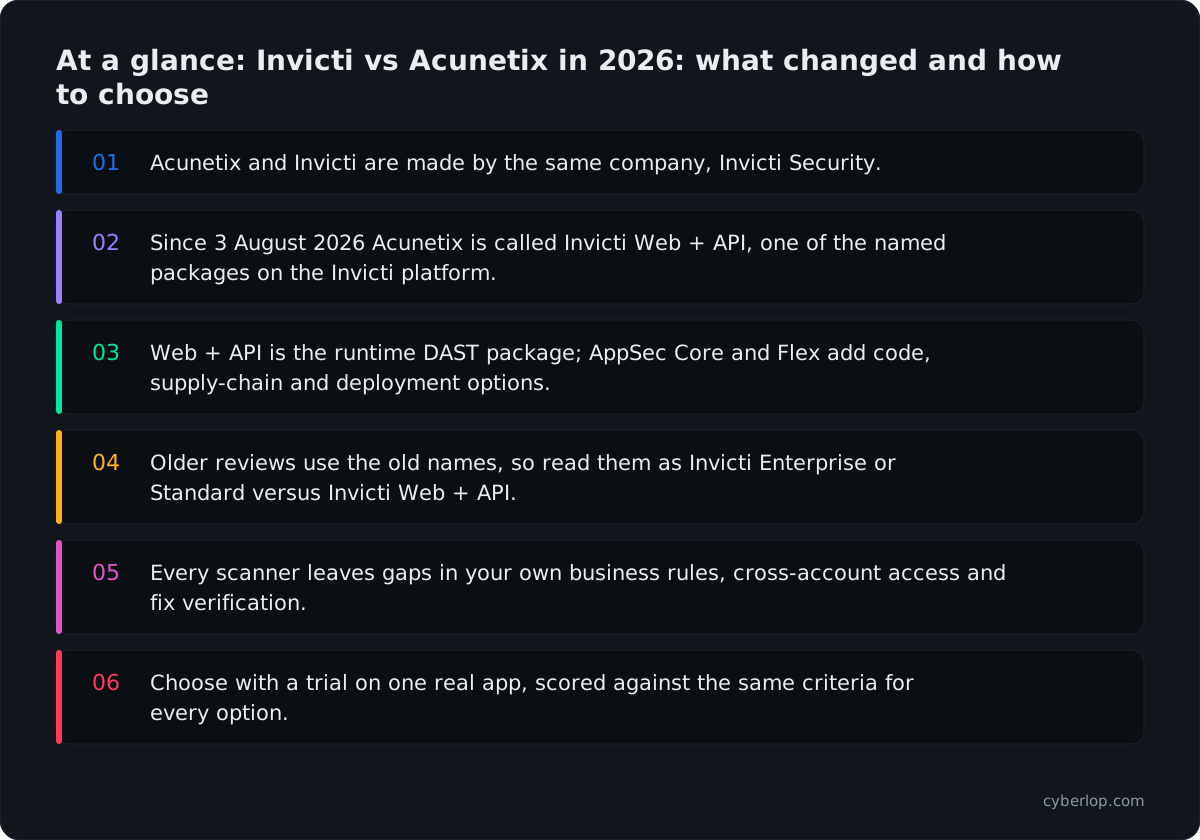
- Acunetix and Invicti are made by the same company, Invicti Security.
- Since 3 August 2026 Acunetix is called Invicti Web + API, one of the named packages on the Invicti platform.
- Web + API is the runtime DAST package; AppSec Core and Flex add code, supply-chain and deployment options.
- Older reviews use the old names, so read them as Invicti Enterprise or Standard versus Invicti Web + API.
- Every scanner leaves gaps in your own business rules, cross-account access and fix verification.
- Choose with a trial on one real app, scored against the same criteria for every option.
Invicti and Acunetix are made by the same company, Invicti Security, and since 3 August 2026 Acunetix is no longer sold under its own name: it is called Invicti Web + API. So the 2026 answer to "Invicti vs Acunetix" is less "which scanner?" and more "which package of the Invicti platform?". Web + API is the dynamic-scanning package; the wider Invicti platform adds code, supply-chain and posture tooling on top.
Invicti vs Acunetix is the search for the difference between two dynamic application security testing (DAST) products from one vendor. A DAST product tests a running web application or API from the outside and reports the vulnerabilities it can confirm. This guide uses only what the vendor publishes on its own sites, docs and news pages, read on 7 October 2026. It names no prices (see the vendor's pricing page) and does not claim that either product beats anything else.
What is the difference between Invicti and Acunetix?
Historically, Invicti (formerly Netsparker) was the enterprise-oriented scanner and Acunetix the faster, simpler one for smaller teams. In 2026 the names no longer map to two separate products in the same way: Acunetix is now Invicti Web + API, and "Invicti" is the name of the platform that packages it.
The vendor's own older comparison page drew the old line plainly: Invicti was pitched at large estates that want deep integrations and heavy automation, while Acunetix was pitched at smaller teams that like to drive scans themselves. That page still carries the pre-rename names, so treat it as history. The vendor's comparison page is useful for the thinking behind each product, not for today's product names.
A short timeline from the vendor's own pages
The table below lists the dated events that matter for a buyer, each taken from a vendor announcement.
| Date | What the vendor announced | Why a buyer cares |
|---|---|---|
| 7 Mar 2022 | Netsparker renamed Invicti. The post says Acunetix "is very much still in market" and would be brought "closer to the core Invicti brand". | The consolidation was flagged four years before the rename. |
| 23 Mar 2026 | Invicti publishes a write-up of the Miercom DAST Scanner Security Benchmark 2026. | A third-party benchmark, reported by the vendor on its own blog. |
| 3 Jun 2026 | Invicti AppSec Core launched as an all-in-one platform: DAST/API scanning, SAST, SCA, container security, secrets detection, IaC scanning. | A package that goes beyond runtime testing. |
| 29-30 Jul 2026 | Invicti Agentic Pentest announced. | An AI-led pentest offering beside the scanners. |
| 3 Aug 2026 | "Acunetix Is Now Invicti Web + API." | Same capabilities, new name. |
| 29 Sep 2026 | Invicti announces it is a Leader in the IDC MarketScape: Worldwide Dynamic Application Security Testing 2026 Vendor Assessment. | Analyst recognition, as reported by the vendor. |
How are Invicti and Acunetix related, according to the vendor?
They sit under one parent. The vendor's comparison page calls them two different web application security products from Invicti Security. The August 2026 rename moves Acunetix into the Invicti platform's naming.
The rename announcement is careful about what it does and does not change. It says "The capabilities are the same. The team behind them is the same." For existing customers it says nothing changes on August 3, with "No disrupted workflows, no new logins, no reconfigured integrations." It describes Invicti Web + API as one of three packages within the wider platform. The announcement does not discuss deployment models or licensing, so ask the vendor about those directly.
The packages on the Invicti pricing page
The vendor's pricing page names four packages. We list them without figures, because that page is where figures live.
- Web + API is the runtime package: DAST, multilayer API discovery, stateful API security, proof-based scanning and CI/CD automation with cloud hosting. This is the former Acunetix.
- AppSec Core combines web and API testing with code and supply-chain security: SAST, IaC scanning, SCA, container security, SBOM and vulnerability management.
- AppSec Flex builds on AppSec Core with custom roles, CSPM integration and flexible deployment, including on-premises, air-gapped and multi-cloud options.
- Agentic Pentest is the AI-led option: the vendor scopes it to one application and its APIs and promises audit-ready reports.
The Invicti documentation site also lists Invicti Enterprise and Invicti Standard, with on-demand and on-premises variants, role-based access control, API security tooling and an interactive testing (IAST) feature called Invicti Shark. Those long-running product lines have their own documentation, separate from the newer platform docs. If you already run one of them, ask your account team how it maps to the packages above.
Invicti vs Acunetix: how do the features compare?
On the vendor's current pages, proof-based DAST for web applications and APIs is the shared core. The platform packages add code-side coverage, posture management and enterprise controls. Table 1 compares Invicti Web + API (formerly Acunetix) with the broader Invicti platform packages.
Table 1: Invicti Web + API versus the wider Invicti platform
| Capability | Invicti Web + API (formerly Acunetix) | Wider Invicti platform (AppSec Core / Flex) |
|---|---|---|
| Proof-based DAST on web apps | Yes. "Proof-based scanning to confirm many vulnerabilities" | Yes. Same runtime testing, plus runtime context for prioritising |
| API testing | REST, GraphQL and SOAP; stateful API testing | REST, SOAP, GraphQL; API discovery for shadow APIs |
| Instrumented (IAST-style) testing | AcuSensor, with install guides for PHP, .NET, Java and Node.js | Invicti Shark is documented for Invicti Enterprise and Standard |
| Out-of-band detection | AcuMonitor | See the vendor's platform docs |
| SAST, SCA, IaC, secrets, containers | Not in this package | Yes, in AppSec Core |
| Posture management and correlation | Not in this package | ASPM, and DAST-to-SAST correlation |
| Custom roles, air-gapped or on-premises options | Pricing page says "cloud hosting"; acunetix.com also references on-premises. Confirm with the vendor | Named for AppSec Flex |
| CI/CD and ticketing integrations | Yes, such as Jira, GitHub and GitLab | Yes; the vendor cites dozens of integrations |
| AI-led pentesting | "AI-assisted testing" is named in the rename post | Agentic Pentest is a separate package |
Read the "not in this package" cells as packaging, not as shortcomings. The pricing page states what each package includes; it is the buyer's job to decide which parts of the pipeline need covering.
What the vendor says about accuracy
The vendor makes several performance claims on its pages. They are the vendor's claims, so test them yourself. The Invicti Web + API page cites "99.98% Confirmation accuracy for exploitable vulnerabilities", "8x Faster scanning compared to leading competitors" and "40% More vulnerabilities found compared to other leading DAST products".
The vendor also reports that, in the Miercom DAST Scanner Security Benchmark 2026, it "detected all 31 critical vulnerabilities" across 11 intentionally vulnerable applications. The write-up does not say who commissioned the benchmark. Treat the result as vendor-reported and run your own bake-off, as described in the how-to-choose section.
What do the docs say about logins, integrations and reports?
The documentation is where the products differ in detail, and it is the best place to check your own stack before a trial. The points below come from the vendor's Acunetix documentation, which is now presented under the Invicti Web + API name, and from the Invicti documentation site.
Scan authentication
The Acunetix documentation lists form authentication with a recorded login sequence, plus HTTP Basic, Digest, NTLM and Kerberos, OAuth2 and client certificates. Two-factor authentication is covered for user accounts. For scan sessions, the question is not whether a method is listed but whether your own login flow survives a full scan, so test the exact flow you use in production.
The Invicti platform page also covers a different login: your staff signing in to the platform itself, through identity providers such as Okta, Azure Active Directory and PingFederate, or through SAML single sign-on. That decides who may use the tool, not how the tool signs in to your application. Keep the two questions apart when you read a feature list.
Integrations and reports
The Acunetix documentation lists issue trackers (Jira, Azure DevOps, GitHub, GitLab, Bugzilla, ServiceNow), CI/CD systems (Jenkins, GitLab CI/CD, Azure Pipelines, CircleCI), chat tools (Slack, Microsoft Teams) and DefectDojo for vulnerability management. It also lists pre-built reports for OWASP Top 10, PCI DSS, HIPAA, ISO 27001 and NIST SP 800-53. Invicti's pages describe integrations with CI/CD tools such as Jenkins, GitHub Actions, GitLab and Azure Pipelines, and with Jira, ServiceNow, Slack and Microsoft Teams. The sets overlap heavily, so the deciding factor is usually one specific tool in your pipeline.
A report that maps findings to a standard helps an audit conversation, but it is not proof of compliance. If you buy for audit evidence, read our notes on PCI DSS and SOC 2 expectations and ask what your auditor will accept.
Who should choose Invicti, and who should choose Invicti Web + API (Acunetix)?
Choose by the size of the programme around the scanner, not by the logo. If the job is "scan our web apps and APIs and send confirmed findings to developers", Web + API is the package named for it. If the job also covers code, dependencies, containers and one view of risk, the wider platform packages are the fit.
When Invicti Web + API (formerly Acunetix) fits
A small team that wants runtime testing without extra modules
Historically the pitch was simplicity for teams with no dedicated security group, and the vendor still describes the product as built for "accurate, fast DAST". Web + API covers authenticated testing, API scanning, CI/CD hooks and reporting.
A team that wants source-aware scanning on a few stacks
AcuSensor is the product's instrumentation option. The vendor documents installation for PHP, .NET, Java and Node.js. If your apps run on one of those stacks, include an instrumented scan in the trial. It can add detail that a purely outside-in scan cannot.
When the wider Invicti platform fits
A team with many apps and a central security function
AppSec Flex is where the vendor places custom roles, flexible deployment and CSPM integration. If you must run on-premises or air-gapped, the pricing page names that package. Those controls matter more once several teams share one instance.
A team that wants runtime and code findings together
AppSec Core adds SAST, software composition analysis, IaC, secrets and container scanning. The vendor also announced DAST-to-SAST correlation, which links a confirmed runtime finding to the code behind it. If your backlog is mostly "which of these 4,000 static alerts is real?", that correlation is the feature to test.
A team that wants AI-led testing beside the scanner
Agentic Pentest is a separate package. The vendor describes autonomous reconnaissance, parallel AI agents across classes such as SQL injection, SSRF and deserialisation, and validated findings with proof. The launch post also lists scope enforcement and rate limiting. Compare it against other options in our best AI pentesting tools guide.
Is Acunetix discontinued, and what should existing customers do?
No. The vendor's wording is a rename, not a retirement: capabilities and team are "the same", and nothing changes for customers on 3 August. The acunetix.com home page now opens with "Acunetix is now Invicti Web + API" and uses "formerly Acunetix" beside the new name.
Three practical steps follow. First, check your contract and invoices for the new name so procurement records match. Second, ask your account team how the product maps to the four named packages. Third, confirm your deployment model in writing, because the rename post does not address it. Anyone comparing quotes should also read our Acunetix alternatives guide, which covers other vendors.
What does any DAST package still leave for your team?
A DAST package finds what it can test and confirm from outside. It does not know your business rules, who should see which record, or whether the fix you shipped really closed the hole. These gaps apply to every scanner, not only the two in this guide.
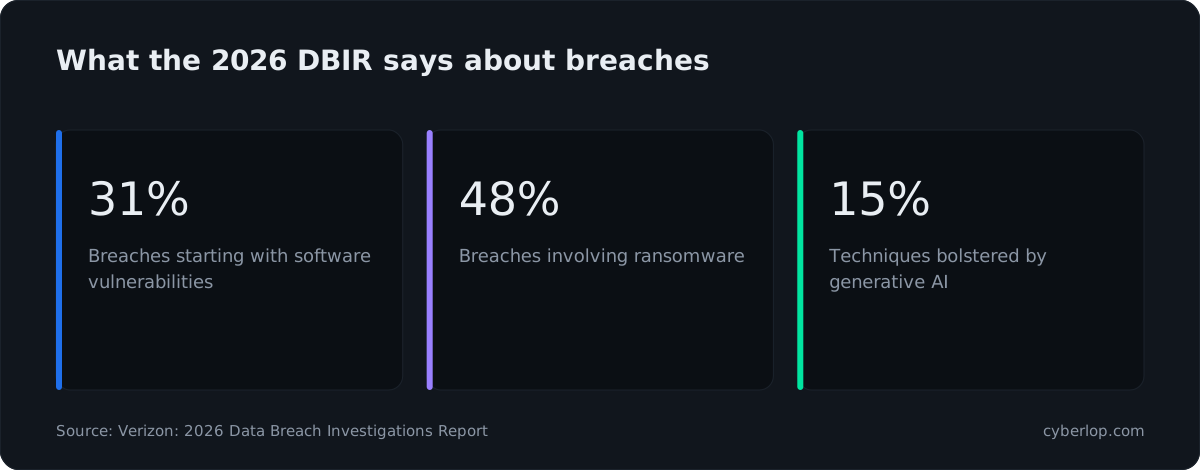
The stakes explain why teams keep layering tools. The Verizon 2026 Data Breach Investigations Report says 31% of breaches now start with software vulnerabilities, "beating stolen passwords as the top way attackers get in". The CISA Known Exploited Vulnerabilities catalog showed 1,734 entries when we read it on 7 October 2026, and each is a flaw that has been exploited in the wild. The IBM Cost of a Data Breach Report 2026 calls the global average cost a record high, up 12% on the previous year.
Access control is the example that matters most
The OWASP Top 10:2021 ranks broken access control first. OWASP reports that "94% of applications were tested for some form of broken access control", with 34 CWEs mapped to the category. Whether account A may read account B's invoice is a rule only your team can state, so a scanner needs your input to check it. Both product lines touch on it: Invicti names BOLA and BFLA detection, and Acunetix lists role-based user flows. The open question for you is how much set-up it takes on your apps.
Four gaps to plan for with any scanner
- Your rules. Pricing, limits, approvals and business-logic flaws need test cases written against how your product should behave.
- Cross-account access. Checking what one signed-in account can reach that it should not takes at least two accounts per role and a clear plan. See why your scanner has one login.
- Proof you can read. Ask for the request, the response and, ideally, the line of code. See how to read a finding.
- A verified fix. A fresh scan shows the issue is gone from that scan. Re-running the exact exploit shows the same hole is closed; see closed-loop retest.
Where does Cyberlop fit next to Invicti and Acunetix?
Cyberlop is a different kind of tool, so it is better seen as an option beside a scanner than a replacement for one. Cyberlop finds vulnerabilities in web apps and their APIs with black-box, grey-box and white-box pentesting.
In white-box mode it reads your code while testing the running app, so a finding can point to the file and line. It reports what it actually exploited: each finding carries the request, the response, a screenshot where a person can see it, and the line of code. Severity and confidence are kept apart, and findings carry CWE and OWASP references.
It checks business-logic flaws and cross-account access, and it proves a fix by re-running the exact exploit against the new code. It can run inside your own network (private scanning), on a schedule or in CI/CD with a build gate, and agencies can run it under their own brand. See how it works and a real finding. Many teams will keep a DAST package for broad, repeatable coverage and add a proof-led pentest for the flaws a scanner cannot know to look for.
How do you choose between Invicti and Acunetix?
Choose in two steps. First fix the scope you need covered. Then trial each option on one real application against the same checklist. The questions below turn that into criteria you can score.
Table 2: Six decision criteria
| Criterion | Ask yourself | Points toward |
|---|---|---|
| Scope of testing | Do we need runtime testing only, or code and supply-chain too? | Runtime only: Web + API. Code too: AppSec Core or Flex |
| Deployment | Must scans run on-premises or air-gapped? | The pricing page names AppSec Flex for these. Confirm for Web + API |
| Authentication | Do our apps use SSO, MFA or multi-step logins? | Trial it. Check the vendor's login-recording and OAuth2 documentation against your login |
| APIs | Which API styles and definitions do we run? | Both list REST, GraphQL and SOAP. Test with your own definitions |
| Workflow | Where do findings go: Jira, GitHub, GitLab, a pipeline gate? | Check each integration in the docs for your exact tool |
| Triage capacity | Who will triage the output every week? | Fewer people favour a simpler package. A central team favours roles and ASPM |
A four-week trial, step by step
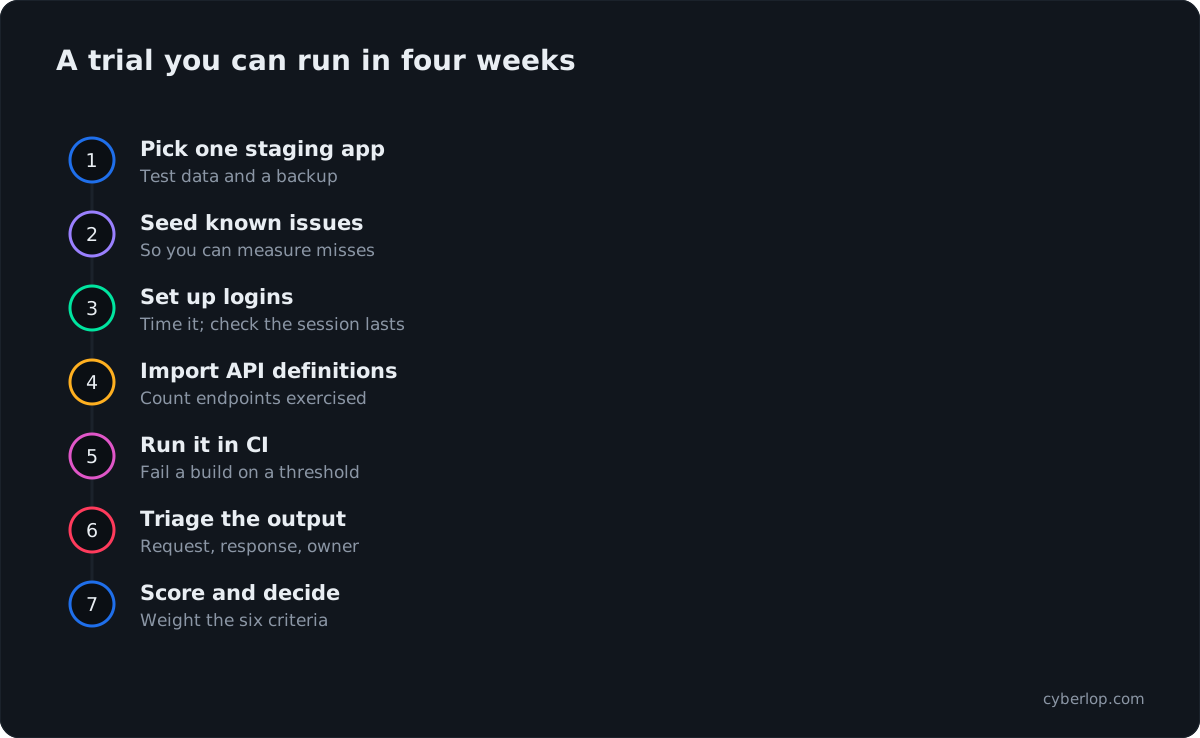
- Pick one staging app. Use test data and a backup, because scanners send state-changing requests.
- Seed known issues. Write down flaws you already know, so you can measure what each tool finds and misses.
- Set up logins. Time how long authentication takes and whether the session survives the whole scan.
- Import your API definitions. Count the endpoints each tool actually exercises, not the ones it lists.
- Run it in CI. Record scan time and check you can fail a build on a threshold.
- Triage the output. For each finding, ask for the request and response, and note how many a developer could fix without a meeting.
- Score and decide. Weight the six criteria in Table 2 and pick the option that wins on the ones you care about.
What a good trial result looks like
A good result is not the longest list. It is a short list where each item reproduces, has a clear owner and survives a retest. Our guide to the best DAST tools sets out how to compare more vendors, and DAST vs SAST vs IAST explains how the testing types fit together. If a result sounds certain but cannot be reproduced, treat it as a false positive until proven otherwise; exploited, not suspected explains why that matters.
The naming map in one view
Because the names changed, keep this map beside your notes when you read older reviews and forum threads.
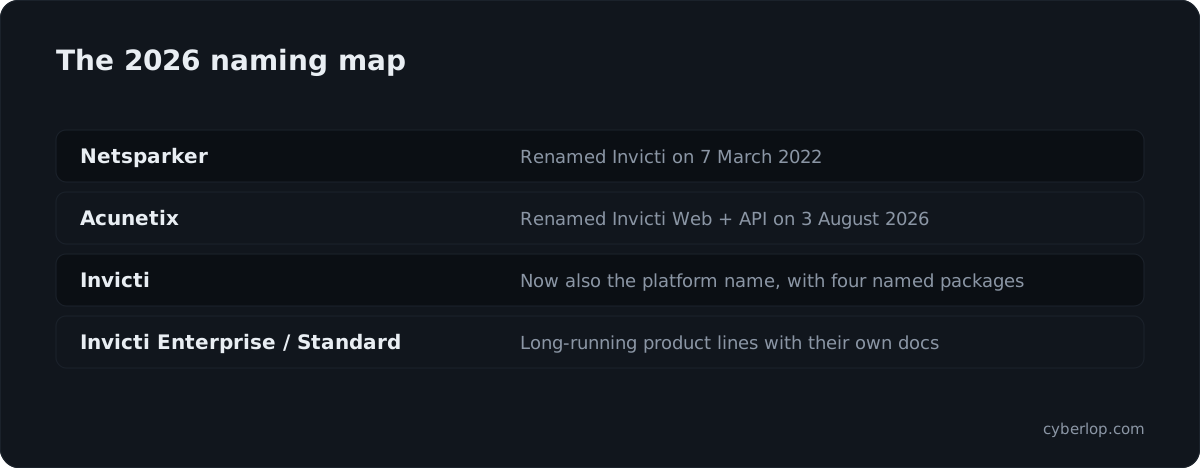
Older reviews that say "Invicti vs Acunetix" were written before the rename. Read them as comparing Invicti Enterprise or Standard (formerly Netsparker) with the product now called Invicti Web + API.
Questions people ask
Invicti vs acunetix: FAQs
Is Acunetix the same as Invicti?
They come from the same company, Invicti Security, but were sold as two products. Since 3 August 2026 Acunetix is called Invicti Web + API, one of the packages on the Invicti platform.
The vendor says the capabilities and the team are the same.
Is Acunetix being discontinued?
The vendor describes a rename, not a retirement. Its announcement promises existing customers no disrupted workflows, new logins or reconfigured integrations on 3 August.
For anything about future licensing, ask your account team in writing.
Which is better, Invicti or Acunetix?
Neither is better in general. Web + API suits teams that want proof-based web and API scanning. The wider platform packages suit teams that also want code, dependency and container coverage or on-premises options.
Decide using a trial on one of your own apps.
Do Invicti and Acunetix use the same scanning engine?
The vendor's pages describe proof-based scanning in both, and the rename post says the capabilities are the same. The vendor does not publish an engine-level comparison on those pages, so ask for one if it matters to your decision.
Does either one test APIs?
Yes. The Invicti Web + API page lists REST, GraphQL and SOAP, and the Invicti platform pages describe shadow API discovery and BOLA and BFLA detection. Test with your own API definitions to see how much is covered.
Can Invicti or Acunetix run on-premises?
Invicti names on-premises, air-gapped and multi-cloud options under AppSec Flex, and its documentation covers Invicti Enterprise on-premises. The pricing page lists Web + API with cloud hosting, while acunetix.com also references on-premises.
Confirm the model for your package before you buy.
Do I still need a pentest if I have a DAST scanner?
Often yes. A scanner is good at broad, repeatable coverage. Rules specific to your product, such as who may see which record, need test cases written for your app or a proof-led pentest.
The two are complements; see our guide to continuous penetration testing.
What did the Acunetix rename change for existing customers?
According to the announcement, nothing on the day itself. Check your contract, invoices and support portal for the new name, and ask how your licence maps to the four named packages.
Sources
Where the facts come from
- Acunetix: Acunetix Is Now Invicti Web + API
- Acunetix: Invicti Web + API (formerly Acunetix) home page
- Acunetix: Invicti Web + API documentation
- Invicti: Invicti vs Acunetix comparison page
- Invicti: Netsparker is now Invicti (7 March 2022)
- Invicti: packages page
- Invicti: platform overview
- Invicti: Invicti AppSec Core launch (3 June 2026)
- Invicti: Agentic Pentest launch
- Invicti: Miercom DAST benchmark write-up (23 March 2026)
- Invicti: IDC MarketScape leader announcement (29 September 2026)
- Invicti docs: Invicti Enterprise and Standard
- Invicti docs: documentation home
- Verizon: 2026 Data Breach Investigations Report
- CISA: Known Exploited Vulnerabilities Catalog
- IBM: Cost of a Data Breach Report 2026
- OWASP: Top 10:2021 A01 Broken Access Control
Keep reading
Related articles
Acunetix alternatives in 2026: nine options and how to choose
Acunetix alternatives compared from vendor docs: suites, developer-first DAST, open source and attack surface tools, plus how to switch safely.
Best AI pentesting tools in 2026: ten compared, and how to choose
Ten AI pentesting tools compared from vendors' own sites, with a scoring sheet, a table by category and a plan for a fair trial on your own app.
Best DAST tools 2026: twelve compared and how to choose
Twelve DAST tools compared from vendor docs: authentication, APIs, CI/CD, proof and deployment, plus a decision table and a one-week bake-off.

Need proof beside your scanner?
Whichever scanner you pick, Cyberlop adds pentesting that reports what it actually exploited, with the request, the response and the line of code. Ask us to run it on one of your applications.
Or start with a $199 pilot on one application: thirty days, success criteria agreed before day one, credited against the annual if you convert.