
XBOW is an autonomous offensive security platform that uses AI agents to test web applications and APIs and validate exploits. The main XBOW alternatives are AI platforms (Aikido, Escape, NodeZero), human-led services (Cobalt, HackerOne), open-source agents (Strix, Shannon) and StackHawk. Choose by scope, proof, deployment and review.
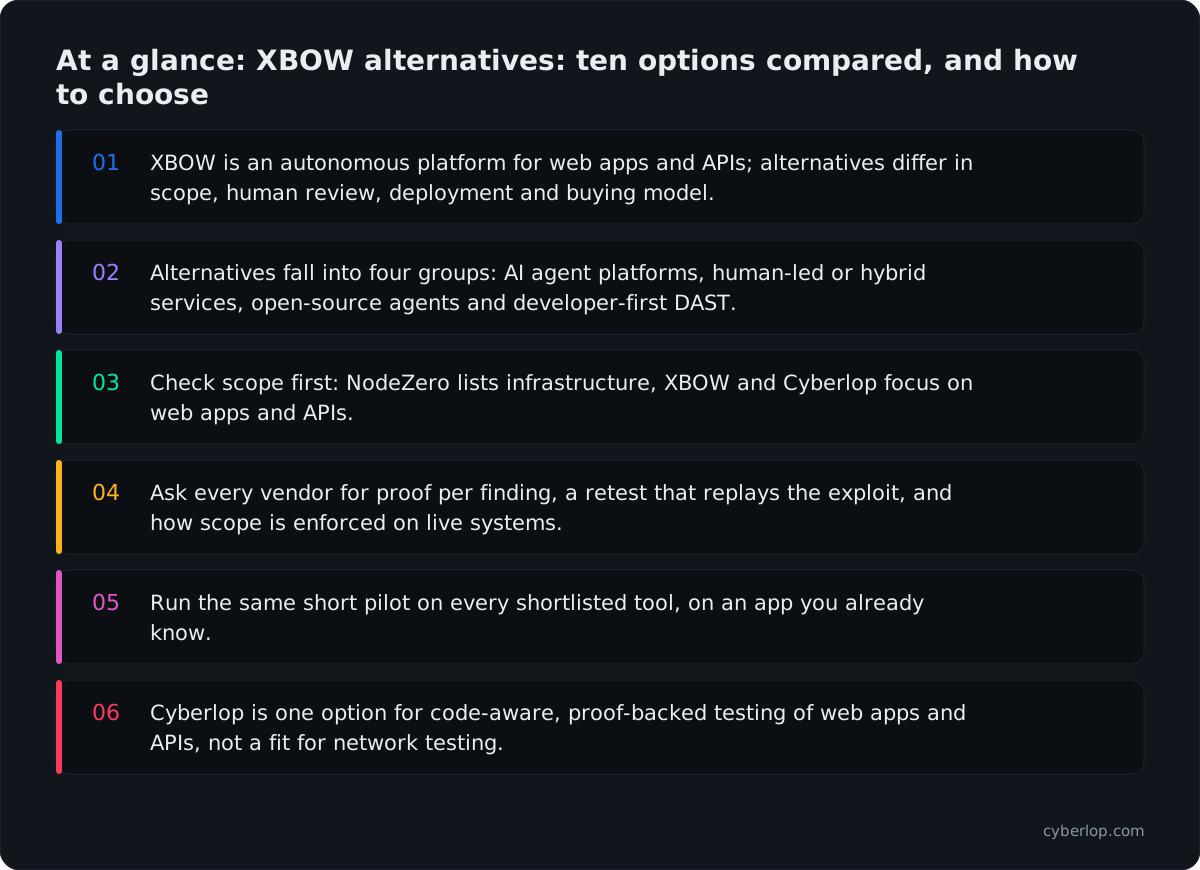
- XBOW is an autonomous platform for web apps and APIs; alternatives differ in scope, human review, deployment and buying model.
- Alternatives fall into four groups: AI agent platforms, human-led or hybrid services, open-source agents and developer-first DAST.
- Check scope first: NodeZero lists infrastructure, XBOW and Cyberlop focus on web apps and APIs.
- Ask every vendor for proof per finding, a retest that replays the exploit, and how scope is enforced on live systems.
- Run the same short pilot on every shortlisted tool, on an app you already know.
- Cyberlop is one option for code-aware, proof-backed testing of web apps and APIs, not a fit for network testing.
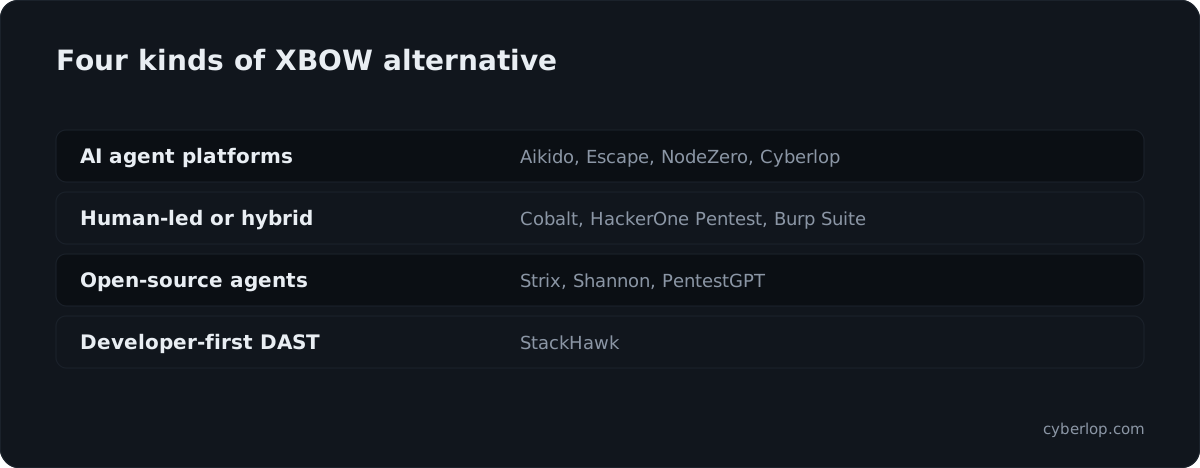
XBOW is an autonomous offensive security platform that uses AI agents to test web applications and APIs and to prove exploitability before a finding reaches you. The best XBOW alternatives depend on what you need: a human-led test (Cobalt, HackerOne Pentest), another AI agent platform (Aikido, Escape, Horizon3.ai NodeZero), an open-source agent you run yourself (Strix, Shannon, PentestGPT), or a developer-first scanner in CI (StackHawk).
Below you will find what XBOW says it does, why a team might look elsewhere, ten alternatives described only from their own sites and repositories, a comparison table and seven criteria for choosing. This page quotes no prices. Every vendor sets and changes its own, so check each pricing page.
What is XBOW?
XBOW is a vendor of AI-driven penetration testing for web applications and APIs. Its homepage describes an "autonomous offensive security platform" that explores an application the way an attacker would and validates exploitability itself, so that findings arrive with working proof rather than as suspicions.
What XBOW says it does
From XBOW's homepage and platform page:
- You point it at a URL and define the scope. It builds a map of applications, endpoints, parameters and authentication flows.
- Findings are meant to be validated. It chains weaknesses into working exploits, and the output is described as a case file with evidence, severity and remediation.
- It runs continuously or on demand, and retests when your applications change.
- You can give it documentation, credentials, API specifications and architecture notes as context.
- It has an API to launch pentests programmatically, with integrations listed in its documentation for Jira, Microsoft Sentinel and Security Copilot.
- Deployment options are described as aligned to data separation, residency and compliance needs such as SOC 2, ISO 27001, PCI DSS and NIS 2.
- The site says XBOW ranked first on HackerOne in June 2025 as the first autonomous system to do so.
Its pricing page describes usage-based pricing that scales with coverage rather than a fixed annual engagement, with quotes on request and availability through major cloud marketplaces. We do not repeat figures; ask XBOW for a quote.
What counts as an autonomous pentest
An autonomous pentest is a penetration test where software agents choose their own next step, send the requests, read the responses and try to exploit what they find, with no person directing each move. It sits between a DAST scanner, which runs a fixed list of checks, and a human-led engagement. Our wider guide, AI penetration testing in 2026, covers the technology; best AI pentesting tools covers the market.
Why do teams look for XBOW alternatives?
Teams usually look elsewhere for fit, not because a tool failed. They want a different scope, deployment model, buying route or level of human review, and no single tool covers every need. Five questions send most buyers to compare.
Scope beyond web applications and APIs
XBOW's platform page describes testing web applications and APIs. If your risk also sits in internal networks, Active Directory, cloud accounts or Kubernetes, you need a tool built for infrastructure testing, and you would normally run it alongside an application tester rather than instead of one.
Human review and a named tester
Some buyers, or their auditors and customers, want a person to review and sign the result. Human-led and hybrid providers sell exactly that. It is a procurement preference rather than a technical gap, and it is worth asking your auditor before you decide.
Source code access and where the tool runs
If you want findings that point to a file and line, you need a tool that reads your code. If your policy says code must not leave your network, you need a tool that can run inside it, or one you host yourself. Open-source agents and private-scanning products address this.
Buying route and budget model
A usage-based subscription suits some budgets and not others. A team that wants a single scoped test, an open-source tool it can trial without a contract, or a per-developer scanner in CI may prefer a different buying model. Compare quotes on the same scope; our guide to what drives pentest cost explains why.
Where in the workflow it works
XBOW is a platform you launch tests from. Some teams would rather have testing inside the developer's loop, where the same agent that wrote the code can run a scan and fix what it finds. That is a different shape of product.
Why does the choice matter in 2026?
Attackers use the same software flaws that testers look for, and they now use AI to find them faster. Three numbers set the context.
- Verizon's 2026 Data Breach Investigations Report says 31% of breaches now start with software vulnerabilities, beating stolen passwords as the top way in.
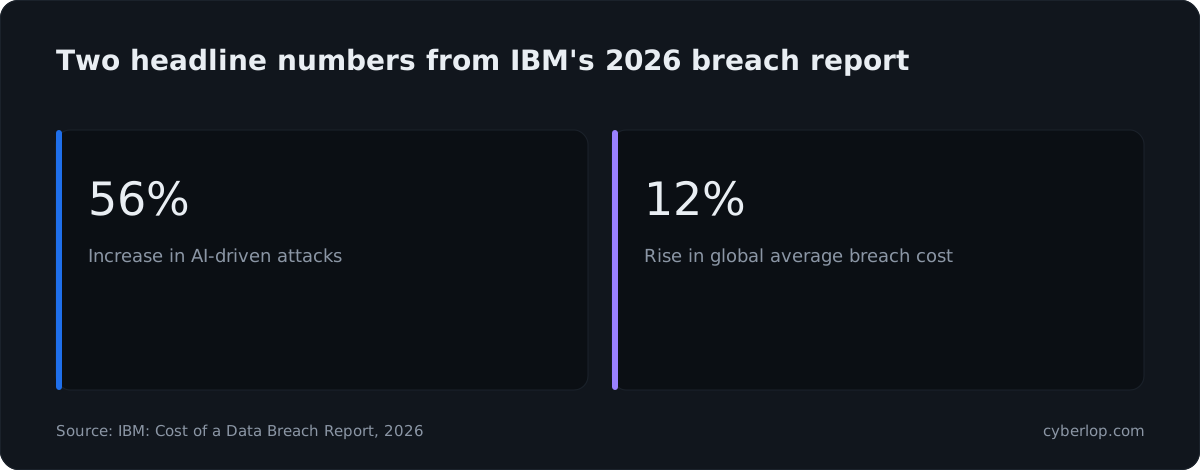
- IBM's Cost of a Data Breach Report 2026 reports a 56% increase in AI-driven attacks, and a record-high global average breach cost, up 12% on last year.
- The CISA Known Exploited Vulnerabilities catalog listed 1,734 entries when we read it on 7 October 2026. See KEV catalog for how to use it.
In all three, the way in is a software flaw that is found and used fast. Testing more often, with evidence, narrows that window. Which tool you pick matters less than whether you test every release and can trust what it reports.
What are the best XBOW alternatives?
The alternatives fall into three groups: AI agent platforms, human-led or hybrid services, and developer-first or open-source tools. Order within a group is not a ranking. Every statement below comes from the vendor's own site or repository, read on 7 October 2026.
AI agent platforms
Aikido Security (AI Pentest)
Aikido's AI pentest page describes "hundreds of autonomous agents" that find and exploit flaws across apps, APIs and infrastructure. It offers white-box, grey-box and black-box modes, and lists IDOR, OWASP Top 10, prompt injection and business-logic errors among its targets. Reports are described as suitable for SOC 2 and ISO 27001 evidence. Teams already on Aikido's wider platform are the natural fit. Source.
Escape
Escape sells business-logic-aware DAST, attack-surface management and an AI pentesting product that reasons over a graph of your application. Its site lists proof of exploitability as screenshots, execution logs and validated attack paths, CI/CD triggers with security gates, and integrations with coding assistants for remediation. API-heavy teams that want scanning and agentic testing in one tool are the natural audience. Source.
Horizon3.ai NodeZero
NodeZero is built around infrastructure. Its page lists internal, external, cloud and Kubernetes pentesting, web application testing and an Active Directory password audit. Internal tests run from a Docker host or a virtual appliance; external tests run from the Horizon3 cloud. Security and IT operations teams that need network and identity coverage will want it, though that is a different job from testing application logic. Source.
Human-led and hybrid services
Cobalt
Cobalt calls its model "human-led, AI-powered pentesting". It cites a network of 500+ vetted testers, an AI layer called Cobalt Sage that orchestrates testing and powers autonomous agents, a platform for launching tests and viewing results in real time, and more than 50 integrations. Choose it for named testers, reports and direct contact with the people doing the work. Source.
HackerOne Pentest
HackerOne pairs vetted human pentesters with agentic systems. Its page says that on supported web tests, agents can help with recon and repeat checks inside set guardrails, while human pentesters supervise the work and review every agent finding. It includes a scoping assistant, retesting after fixes, and reports with proofs of concept for standards such as SOC 2 and ISO 27001. Choose it if you want a person accountable for each finding. Source.
PortSwigger Burp Suite
PortSwigger describes Burp Suite Professional as its manual web penetration testing toolkit for hands-on professionals, Burp Suite DAST as an enterprise scanner for AppSec and vulnerability management teams, and Burp AT as agentic AI that extends human-led pentesting. In-house testers and agencies that want to stay in control of the test, with automation around it, are its core users. Source.
Developer-first and open-source tools
Strix
Strix is an open-source AI pentesting tool under the Apache-2.0 licence. Its repository says agents run your code dynamically, find vulnerabilities and validate them with working proofs of concept. It needs Docker and an API key for a supported model provider, includes an HTTP proxy, browser and shell tooling, and integrates with CI/CD. A managed cloud and an enterprise tier also exist. The repository warns that it should be used only on targets you are authorised to test. Source.
Shannon
Shannon, from Keygraph, is described as an autonomous AI pentester for web applications and APIs that combines source-code analysis with live exploitation and includes only vulnerabilities with a working proof of concept. The open-source edition uses the AGPL-3.0 licence, with commercial licensing separate. Its repository warns that it is not a passive scanner, that its agents can create users and change application state, and that it should not be run against production. Source.
PentestGPT
PentestGPT is an MIT-licensed agent that runs recon, exploit and report pipelines in a CTF mode or a pentest mode. It runs on top of the Claude Code or Codex CLI and was published at USENIX Security 2024. The repository says it is for education and authorised testing, used at your own risk. It is for researchers and practitioners who want to experiment, not for a team that needs reporting and support. Source.
StackHawk
StackHawk is DAST for developers: runtime tests against a running app that surface what is exploitable, with agent skills for Claude Code, Cursor, Codex and GitHub Copilot so a coding agent can fix a finding and rescan it. Engineering-led teams that want security results where code is written, rather than a periodic engagement, will like it. Source.
How do the XBOW alternatives compare?
Side-by-side comparison
The table summarises what each vendor's own pages say. "Partial" means the page describes it but with conditions, or only for some tests. Cells with a dash were not stated on the pages we read.
| Tool | Main model | Web apps and APIs | Network or cloud | Reads source code | Human review | Self-host or open source |
|---|---|---|---|---|---|---|
| XBOW | AI agents, on demand or continuous | Yes | Not described | Documentation and context accepted | Not described | Deployment options described |
| Aikido AI Pentest | AI agents | Yes | Apps, APIs and infrastructure | White-box mode | Not described | Not described |
| Escape | DAST plus AI pentesting | Yes | Attack surface management | Not described | Not described | Not described |
| Horizon3.ai NodeZero | Autonomous pentesting | Web app testing | Internal, external, cloud, Kubernetes | Not described | Built for pentesters too | Docker host or appliance for internal tests |
| Cobalt | Human-led, AI-powered PTaaS | Yes | Network and cloud pentesting | Not described | Yes | Not described |
| HackerOne Pentest | Humans with agents | Yes | Not described | Not described | Reviews all agent findings | Not described |
| Burp Suite | Manual toolkit, DAST, agentic AI | Yes | Not described | Not described | Human-led | Not described |
| Strix | Open-source agents | Yes | Not described | Code analysis included | You decide | Apache-2.0, runs locally |
| Shannon | Open-source white-box agent | Yes | Not described | Yes | You decide | AGPL-3.0 |
| PentestGPT | Open-source agent | Yes | CTF and pentest categories | Not described | You decide | MIT |
| StackHawk | Developer-first DAST | Yes | Not described | Agents fix with source context | Not described | Not described |
| Cyberlop | AI pentesting; black, grey and white-box | Yes | Web apps and APIs | White-box mode | Evidence per finding | Private scanning |
A few cells are our reading rather than a vendor statement. "Not described" means we did not find it on the pages cited, not that the product lacks it. Confirm anything that decides your purchase with the vendor in writing.
Where does Cyberlop fit?
Cyberlop is one option among those above, aimed at web applications and their APIs. It finds vulnerabilities with black-box, grey-box and white-box pentesting. In white-box mode it reads your code while testing the running app, so a finding can point to the file and line.
It reports what it actually exploited. Each finding carries the request, the response, a screenshot where a person can see it and the line of code. If we did not break it, we do not report it. Severity and confidence are kept apart, and findings carry CWE and OWASP references.
A fix is proven by re-running the exact exploit against the new code, not by a fresh scan. Cyberlop checks business-logic flaws and cross-account access, can run inside your own network (private scanning), can run on a schedule or in CI/CD and gate a build, and agencies and MSSPs can run it under their own brand.
It is a fit if you want code-aware findings with proof and a closed-loop retest. It is not a fit if you need network or Active Directory testing, or a named human tester; in that case choose from the groups above. We have not published a detection rate, and the honest page says why. See sample proof on the evidence page.
How do you choose between XBOW and its alternatives?
Choose by scope first, then evidence, then deployment, then buying model. Run the same short pilot on every shortlisted tool against an application you already know well, and judge them on the same checklist.
Seven selection criteria
1. Scope
List what must be tested: web apps, APIs, mobile back ends, internal networks, cloud accounts, identity. Cross out any tool whose own pages do not cover the list.
2. Test mode
Decide whether you need black-box, grey-box or white-box testing. Code-aware testing finds more of what lives in your logic and tells developers where to look. Our comparison of the three shows the trade-offs.
3. Proof
Ask for the request, the response and a reproduction, not a score. A finding without a proof of concept costs your team triage time and adds false positives to the backlog.
4. Business logic and cross-account access
Many serious flaws are broken rules, not bad payloads: one customer reading another's invoice, a coupon applied twice. Ask how the tool finds a business-logic flaw and tests cross-account access, and ask for an example on an app like yours.
5. Data handling and deployment
Ask where your code, credentials and findings go, which model provider sees them, and whether the tool can run on-premises. Open-source agents send data to the model provider you configure.
6. Safety on live systems
Autonomous agents can create accounts, submit forms and change state. Shannon's own repository says not to run it on production. Ask every vendor how scope is enforced, how actions are logged and what the test does to a staging database.
7. Workflow and retest
Check that results reach Jira or your issue tracker, that tests can run in CI/CD, and that a retest replays the original exploit. A closed-loop retest is stronger than a rescan.
Which option suits which team
The table maps common situations to the group that usually fits. It is guidance, not a ranking.
| Your situation | Look first at | Why |
|---|---|---|
| Need a signed report from a named tester | Cobalt, HackerOne Pentest | Human-led or human-reviewed, with retesting |
| Need network, cloud and identity coverage | Horizon3.ai NodeZero | Infrastructure is its stated scope |
| Want an agent you can read and run yourself | Strix, Shannon, PentestGPT | Open-source repositories under permissive or copyleft licences |
| Want security inside the developer loop | StackHawk | Runs where code is written; agents fix and rescan |
| Already use a platform for scanning | Aikido, Escape | AI pentesting alongside existing scanning |
| Want code-aware findings with proof, on a schedule | XBOW, Cyberlop | Autonomous testing of web apps and APIs |
| Have in-house testers | Burp Suite | Manual toolkit with automation around it |
How do you run a fair pilot of two or three tools?
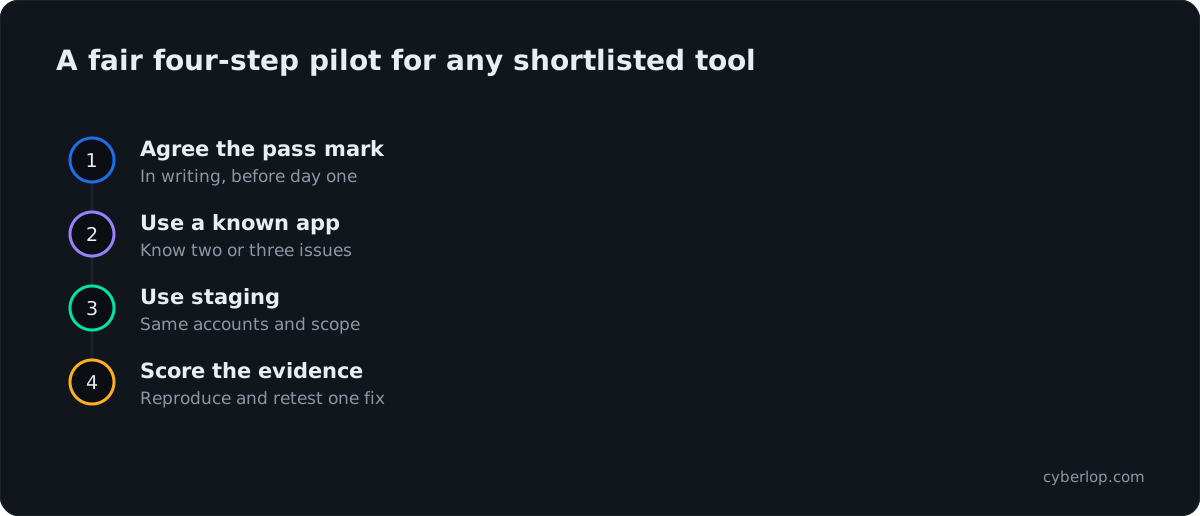
Run every shortlisted tool against the same application, with the same accounts and the same scope, and compare what each one proves. Four steps keep it fair.
- Agree the pass mark in writing. For example: all known issues found, no unproven findings, a retest of one fix.
- Use an application you know. Seed or recall two or three known issues so you can measure what is missed.
- Use a staging copy. Give each tool the same test accounts and scope so cross-account access can be checked.
- Score the evidence. For each finding ask whether a developer could reproduce it in ten minutes, then fix one and check how the tool confirms the fix.
Pair this with how to choose a penetration testing company and continuous penetration testing if you are also deciding how often to test. DAST vs SAST vs IAST explains the older categories, and our compare page collects the series.
Common mistakes when switching
- Comparing a network tool with an application tool as if they did the same job.
- Counting findings instead of proven findings.
- Skipping the retest step in the pilot.
- Pointing an autonomous agent at production before scope and logging are understood.
- Dropping human testing entirely. Agents widen coverage; people still review logic, payments and risk.
Whichever you pick, test on each release, not once a year, and keep the evidence for your auditors.
Questions people ask
Xbow alternatives: FAQs
What is XBOW?
XBOW is an autonomous offensive security platform from XBOW that uses AI agents to test web applications and APIs and validate exploitability. Its site describes continuous or on-demand testing, scope you define, and findings delivered with evidence, severity and remediation advice.
What are the best alternatives to XBOW?
It depends on the job. For human-led testing look at Cobalt or HackerOne Pentest. For other AI agent platforms look at Aikido, Escape or Horizon3.ai NodeZero. For open-source agents look at Strix, Shannon or PentestGPT. For testing in the developer loop look at StackHawk. Cyberlop is another option for web apps and APIs.
Is XBOW a replacement for a human penetration tester?
That is for you and your auditor to decide. XBOW describes an autonomous platform with validated findings. Other vendors, such as HackerOne, say human pentesters review all agent findings. If a customer or regulator expects a named tester's sign-off, ask them what they will accept before you choose.
Are open-source AI pentesting tools a safe alternative?
They are a real option for teams with the skill to run them. Strix, Shannon and PentestGPT each state that they must only be used with authorisation, and Shannon says not to run it against production because it can change application state. You also own the setup, the model keys and the triage.
Do AI pentesting tools cover networks and cloud as well as web apps?
Some do, some do not. Horizon3.ai NodeZero lists internal, external, cloud and Kubernetes pentesting. XBOW's platform page describes web applications and APIs. Check each vendor's scope page for your exact assets, and expect to use one tool for applications and another for infrastructure.
How should I compare quotes from different vendors?
Ask each vendor to quote the same scope: the same applications, APIs, accounts, test mode and number of retests. Pricing models differ, from usage-based subscriptions to per-engagement and open source with your own running costs, so compare total effort, not headline rates.
What proof should an AI pentest give me?
For each finding, at least the request, the response and steps a developer can repeat, plus a way to confirm the fix. A finding without a reproducible exploit is a suspicion and belongs in a scanner report, not a pentest report.
Sources
Where the facts come from
- XBOW: homepage
- XBOW: platform
- XBOW: documentation
- XBOW: pricing
- Aikido Security: AI Pentest
- Escape: product site
- Horizon3.ai: NodeZero
- Cobalt: homepage
- HackerOne: Pentest
- PortSwigger: Burp Suite
- Strix: GitHub repository
- Keygraph: Shannon GitHub repository
- PentestGPT: GitHub repository
- StackHawk: homepage
- Verizon: 2026 Data Breach Investigations Report
- IBM: Cost of a Data Breach Report 2026
- CISA: Known Exploited Vulnerabilities Catalog
Keep reading
Related articles
AI penetration testing in 2026: what it can and cannot do
AI penetration testing in 2026: what it does well, where it fails, how accurate it is, and questions to ask before you trust a tool.
Best AI pentesting tools in 2026: ten compared, and how to choose
Ten AI pentesting tools compared from vendors' own sites, with a scoring sheet, a table by category and a plan for a fair trial on your own app.
Black box vs white box penetration testing: which to choose
Black, grey and white box penetration testing compared: what each finds and misses, how effort differs, when to choose each and how to combine them.

See how it compares on your app
Cyberlop finds vulnerabilities in web apps and their APIs with black-box, grey-box and white-box pentesting, and reports only what it exploited, with the request, the response and the line of code. Ask us to run it on one of your applications.
Or start with a $199 pilot on one application: thirty days, success criteria agreed before day one, credited against the annual if you convert.