
Aikido vs Snyk is a choice between two developer security platforms. Aikido bundles SAST, SCA, secrets, containers, IaC, cloud posture and DAST as one platform; Snyk sells separate products plus Evo for AI development. Both now offer AI pentesting. Trial both on one app; neither scanner proves business-logic flaws.
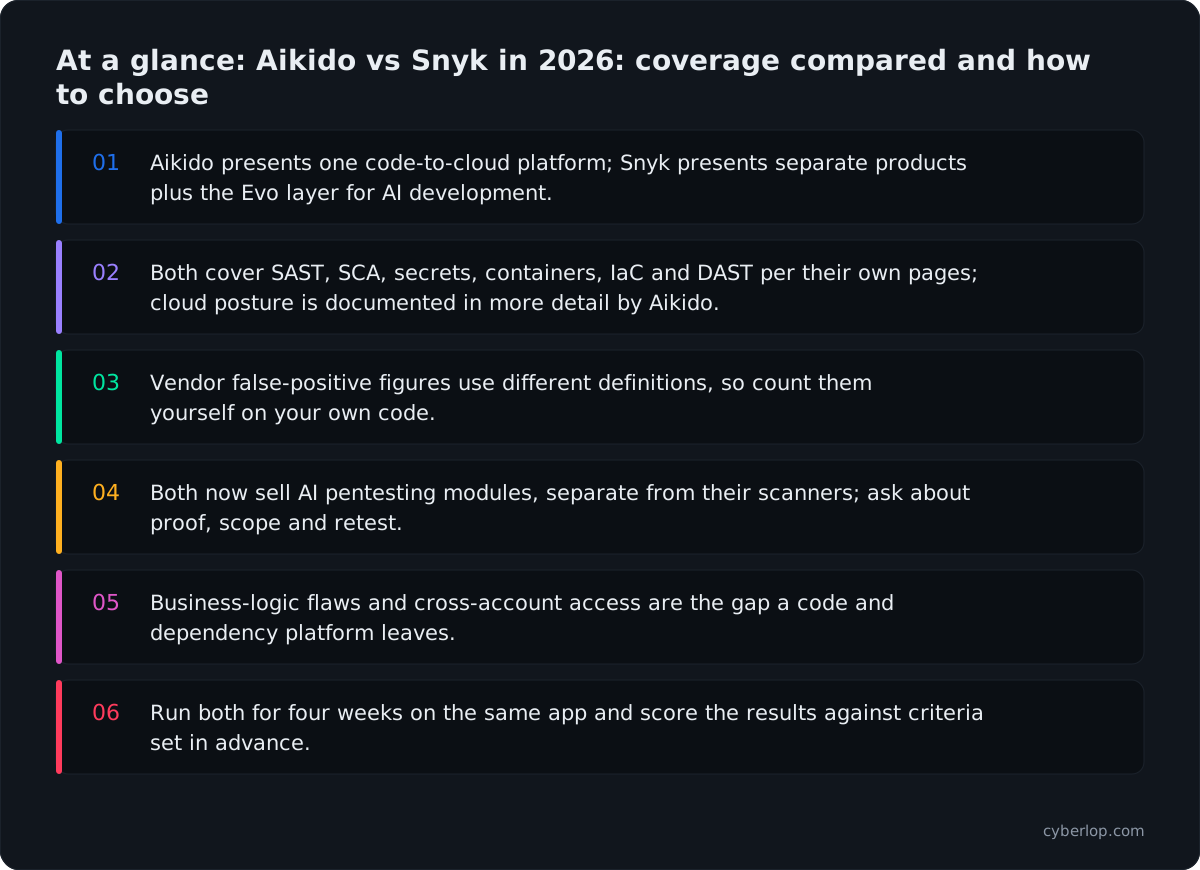
- Aikido presents one code-to-cloud platform; Snyk presents separate products plus the Evo layer for AI development.
- Both cover SAST, SCA, secrets, containers, IaC and DAST per their own pages; cloud posture is documented in more detail by Aikido.
- Vendor false-positive figures use different definitions, so count them yourself on your own code.
- Both now sell AI pentesting modules, separate from their scanners; ask about proof, scope and retest.
- Business-logic flaws and cross-account access are the gap a code and dependency platform leaves.
- Run both for four weeks on the same app and score the results against criteria set in advance.
Aikido and Snyk are both developer security platforms, and the main difference is shape: Aikido sells one code-to-cloud platform with every scanner in the box. Snyk sells a family of named products (Snyk Code, Snyk Open Source, Snyk Container, Snyk IaC, Snyk API & Web) plus the newer Evo layer for AI-driven development. Pick Aikido for breadth with little setup. Pick Snyk for depth, governance and ecosystem. Neither core scanner proves a business-logic flaw for you, though both now sell separate AI pentesting modules.
Aikido vs Snyk is a comparison of two application security platforms that scan your code, dependencies, containers and running apps. This guide uses only what each vendor publishes on its own website and docs, read on 7 October 2026. It names no prices (see each vendor's pricing page) and does not rank them on quality, because neither vendor publishes an independent benchmark of the other.
What is the difference between Aikido and Snyk?
Aikido presents one platform with three groups of capability: code, cloud and runtime. Snyk presents separate products you can adopt one at a time, with Evo as a newer layer for AI agents and AI-built software. Both cover the classic developer-security set: SAST, SCA, secrets, containers, IaC and DAST.
The vendors also describe themselves differently. Aikido's pages talk about noise reduction and getting "from found to fixed, autonomously". Snyk's documentation talks about how to "scan, prioritize, and fix vulnerabilities" across code, open-source dependencies, container images and cloud configurations, with SSO, user roles and Snyk Broker for administration at scale.
Aikido vs Snyk at a glance
The table lists what each vendor's own pages name. A blank "not stated" means we did not find it on the vendor's pages, not that it is missing.
| Capability | Aikido | Snyk |
|---|---|---|
| SAST | Yes, 25+ languages, inline, PR and CI | Snyk Code, in IDE and pull requests |
| SCA (dependencies) | CVEs, malware, licence and EOL; SBOM in CycloneDX or SPDX | Snyk Open Source; SBOM on the Enterprise plan |
| Secrets | Across IDE, CI and Git | Snyk Secrets, before commit |
| Containers | Container image and VM scanning | Snyk Container, with base-image advice and Kubernetes monitoring |
| IaC | IaC scanning | Snyk IaC, with drift management |
| Cloud posture | CSPM for AWS, Azure and GCP, agentless | Docs mention cloud configurations; check depth on a trial |
| DAST | Surface Monitoring (DAST), black-box | Snyk API & Web (DAST) |
| AI pentesting | Aikido AI Pentest | Evo Continuous Offensive Security |
| AI agent security | Not stated on the pages we read | Evo: agentic development security, AI-SPM, agent red teaming |
| Private-network option | Local code and container scanning; Broker for internal apps | Snyk Broker, an open-source proxy |
How do Aikido and Snyk compare on code scanning?
Both vendors scan source code and dependencies and open fix pull requests. The differences are in how each describes triage, language coverage and where the results appear.
SAST: Aikido SAST vs Snyk Code
Static application security testing reads source code without running it. It is the earliest place to catch injection-style bugs and unsafe patterns, and it is where a finding can name the exact line.
What Aikido says about its SAST
Aikido states support for "25+ programming languages", including JavaScript, TypeScript, Python, Java, C#/.NET, PHP, Ruby, Go, Kotlin, Swift and Rust. It says an "AI reachability engine" and AI triage cut false positives, and that findings come "with the exact file and line". Results appear as you type, in pull requests and in CI. It offers "one-click AutoFix" with confidence levels and can open a pull request with the proposed fix.
What Snyk says about Snyk Code
Snyk describes Snyk Code as a SAST tool that finds and fixes code vulnerabilities, with "real-time, in-line results" in the IDE and pull requests. It names JavaScript, Python, PHP, Go and .NET among the supported languages and says coverage is "constantly expanding". It says its engine models "25M+ data flow cases" and prioritises by application context. It also states coverage for LLM libraries such as OpenAI and Hugging Face.
SCA: Aikido vs Snyk Open Source
Software composition analysis checks the open-source packages you depend on for known vulnerabilities, licences and malware. It matters more each year: the 2025 edition of the OWASP Top 10 ranks "Software Supply Chain Failures" third, as published by OWASP.
Aikido says it scans dependencies "for CVEs, malware, license and EOL issues" and checks reachability at dependency, function and runtime-context level. It can produce an SBOM in CycloneDX or SPDX with one click. Snyk says Snyk Open Source is "powered by our team's database of open source vulnerability intelligence", scores risk using "over a dozen objective and contextual factors" (reachability is one) and opens fix pull requests with the needed upgrades. Snyk lists SBOM support under its Enterprise plan and licence compliance under Team and Enterprise.
Secrets and code quality
Both detect hard-coded credentials before they ship; see secret scanning. Snyk's page says to "stop hardcoded secrets before commit". Aikido lists secrets detection across IDE, CI and Git, and adds code-quality analysis and malware detection to the same platform. If you already run a separate secrets tool, check whether you would keep it.
What about DAST, containers, IaC and cloud?
Both vendors cover the layers around the code, but only Aikido describes a cloud-posture scanner in detail on its product pages. Snyk's documentation covers cloud configurations without that level of detail on the pages we read.
DAST: running-app testing
DAST tests a running app from the outside, so it sees what source code cannot: response headers, deployed configuration and what the live API returns. Check authenticated testing first, because most real flaws sit behind a login.
- Aikido Surface Monitoring (DAST): scans "from the outside (black-box)", with Automated API Discovery for REST and GraphQL, and OpenAPI import. It supports authenticated testing with credentials you provide, and its page states "Aikido doesn't support login scripts". It says it is "designed not to stress or break your production site".
- Snyk API & Web (DAST): supports "authenticated scans, to scan applications that use SSO or OpenID Connect". It reads OpenAPI, Postman and Swagger definitions, runs in CI/CD or on a schedule, and states a 0.08% false-positive rate and "over 30,000" detectable vulnerabilities. Treat both as vendor claims to test on your own app.
Containers, IaC and cloud
Containers
Snyk Container integrates with Docker Hub, Amazon ECR, Azure ACR, Google GCR, JFrog Artifactory, VMware Harbor and Red Hat Quay, gives base-image recommendations and monitors workloads in Kubernetes. Aikido lists container image scanning and virtual machine scanning, connected through its registry setup.
Infrastructure as code
Snyk IaC names Terraform, CloudFormation, Kubernetes, Helm charts and ARM templates and adds drift management. Aikido scans infrastructure as code files as part of its code scanning. If Helm or ARM matters to you, test your own files; the product pages do not list formats for Aikido in the same way.
Cloud posture
Aikido's CSPM "continuously audits your cloud configurations" across AWS, Azure and GCP through read-only APIs, with no agent to install. It lists checks such as public storage buckets, unencrypted databases and overly permissive IAM policies. For the concept, see cloud security posture management.
Coverage by layer, side by side
The second table maps each layer to the question it answers. It shows which gaps remain after either platform is in place.
| Layer | Question it answers | Aikido | Snyk |
|---|---|---|---|
| Source code | Is the code written unsafely? | SAST, secrets, code quality | Snyk Code, Snyk Secrets |
| Dependencies | Are my packages vulnerable or malicious? | SCA, malware, licence, EOL | Snyk Open Source |
| Build output | Are images and IaC safe to ship? | Container, VM, IaC | Snyk Container, Snyk IaC |
| Running app | What does the live app expose? | DAST, API scanning | Snyk API & Web |
| Cloud account | Is the account configured safely? | CSPM | Check docs |
| Exploit proof | Can a person reach data they should not? | AI Pentest module | Evo COS module |
How do Aikido and Snyk handle AI pentesting in 2026?
Both vendors now sell an AI pentesting module on top of their scanners. They are separate offerings from SAST, SCA and DAST, so ask about them separately in a trial.
Aikido AI Pentest
Aikido describes three phases: Discovery maps features and endpoints, Exploitation sends "100's of agents" at specific attack vectors, and Validation runs extra checks "to avoid false-positives and hallucinations". It states "whitebox, greybox, and blackbox testing", with whitebox included as standard. It also lists "MFA-compatible login" and "Role-based access testing".
Output includes report formats aimed at SOC 2 and ISO 27001 audits. A "Human in the Loop" step pauses when a vulnerability could be escalated and shows you the attack analysis first. Aikido says results arrive "within hours". For how this category works in general, see best AI pentesting tools.
Evo Continuous Offensive Security from Snyk
Snyk describes Evo Continuous Offensive Security as a replacement for point-in-time pentesting, with three components: AI Pentesting for architectural flaws and business-logic abuses, Agent Red Teaming for prompt injection and data exfiltration against AI agents, and Dynamic Testing (DAST) for common classes such as XSS and SQL injection. Snyk's page says it is aimed at CISOs, AppSec teams and AI engineering teams, who get "reproducible exploit evidence for prioritization".
What to ask either vendor about pentesting
- Does each finding include the request and response that triggered it?
- Can it test one signed-in account reaching another account's data?
- Does it read your code, and does the finding point to a file and line?
- How is a fix confirmed: by a fresh scan or by repeating the exact exploit?
How do deployment, privacy and workflow differ?
Both are SaaS platforms with options for private networks. The detail that matters is what stays inside your network: source code, tokens or both.
Aikido's pricing page lists "local code & container image scanning" for organisations with sensitive source code, and a "broker for internal apps" so private environments can be pentested and scanned "without exposing them to the internet". Snyk Broker is described in its docs as "an open-source proxy that securely connects Snyk to on-premises and private-network systems", where the client "runs within your internal network", so sensitive data such as SCM tokens stays inside the perimeter. Snyk's documentation also has a section on data handling covering generative AI use, residency and compliance.
Pull request and release gating
Aikido documents "PR & Release Gating" for pull requests and feature branches. Snyk lists SCM and CI/CD integrations, a CLI, IDE plugins and an API under developer tools. Both can fail a build on a policy; check how each defines the threshold, because a gate on noisy output gets switched off within weeks.
IDE and coding agents
Snyk's platform page names integrations with coding agents including Claude, Cursor, Copilot, Codex and Windsurf. Aikido's docs list plugins that scan and remediate "while coding". If your team writes much of its code with assistants, our guide to vibe coding security covers the risks that appear.
How should you read the vendor claims?
Treat every percentage on a vendor page as a hypothesis to test on your own code. The figures are not measured the same way, and they differ even within one vendor.
Aikido's home page says "99% fewer false positives", its SAST page says AI triage "cuts false positives by up to ~95%", and a customer quote on its comparison page cites "92% noise reduction". Snyk's API & Web page states a 0.08% false-positive rate, and Snyk Code says its IDE fixes are "80%-accurate". These can all be true under their own definitions, yet none is a test of your application. The way to compare is to count false positives yourself on code you know.
What do neither Aikido nor Snyk replace?
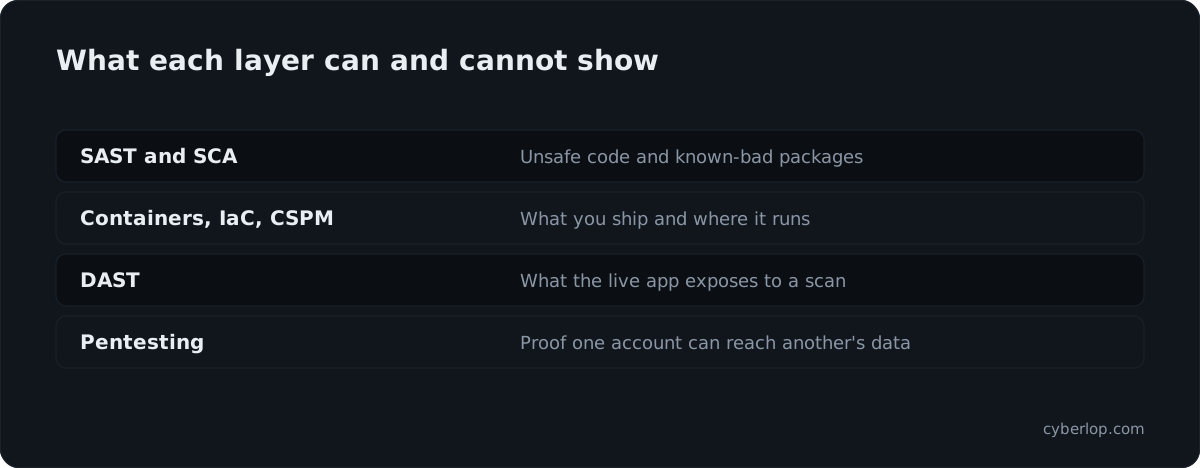
A code-and-dependency platform finds known-bad patterns and known-bad packages. It does not, by itself, show that a logged-in person can reach another customer's data. Those flaws live in how your app decides who may do what.
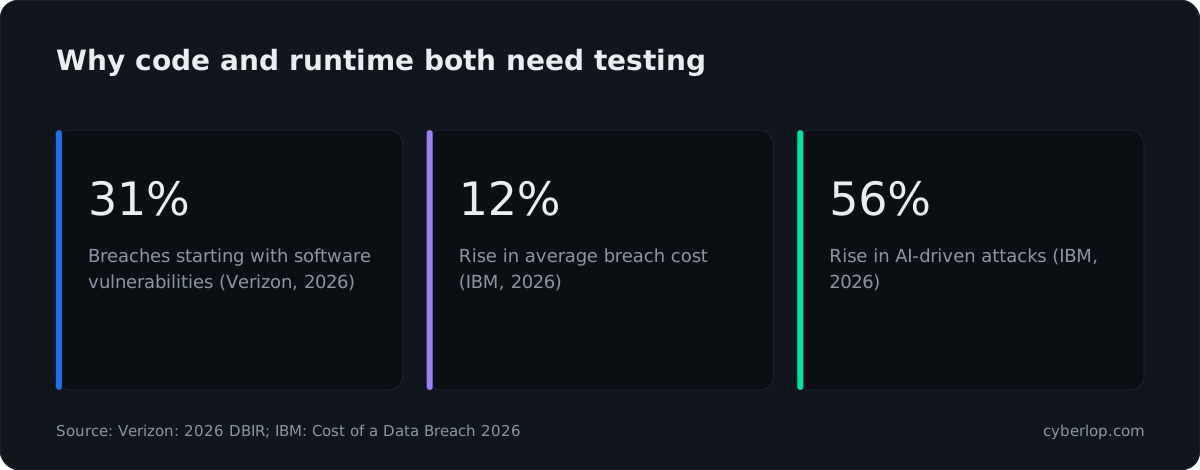
The numbers explain why this gap matters. In the 2026 Verizon report, 31% of breaches now start with software vulnerabilities, ahead of stolen passwords as the top way in. IBM's Cost of a Data Breach Report 2026 reports that the global average breach cost reached a record high, "a 12% increase over last year", and a "56% increase in AI-driven attacks". OWASP ranks Broken Access Control first in its Top 10 for 2025. And CISA's Known Exploited Vulnerabilities catalog lists 1,734 entries as read on 7 October 2026; see the KEV catalog for how to use it.
Four gaps a platform leaves
Business-logic flaws
A coupon applied twice or a refund larger than the order is valid code doing the wrong thing. No signature matches it. See business-logic flaws.
Cross-account access
This is broken access control: one signed-in account reading or changing another's data. Finding it means testing with real sessions and real objects, which is why an access control testing checklist starts with accounts, not tools.
Proof for a human reader
A developer decides faster with the request, the response and the line of code in one place. Our page on reading a finding shows what that looks like.
Fix verification
A green rescan means the signature went away. A closed-loop retest repeats the original exploit against the new code, which is a stronger check.
Where does Cyberlop fit?
Cyberlop pentests web apps and their APIs, so it works beside a platform like Aikido or Snyk, not instead of one. It is one option among several, including the AI pentesting modules above.
It finds vulnerabilities with black-box, grey-box and white-box pentesting. In white-box mode it reads your code while testing the running app, so a finding can point to the file and line. It reports only what it exploited, each finding carries the request, the response and a screenshot where a person can see it, and a fix is proven by re-running the exact exploit. It checks business-logic flaws and cross-account access, can run inside your own network, and can run in CI/CD and gate a build. See how it works and a real finding.
How do you choose between Aikido and Snyk?
Choose on team shape and risk, not on a feature count, because both lists are long. The table turns that into concrete criteria.
Decision criteria
| If this describes you | Lean towards | Why, per the vendors' pages |
|---|---|---|
| Small team wanting one console for code, cloud and runtime | Aikido | Code, cloud and runtime modules are presented as one platform |
| Cloud posture is a named audit item | Aikido | CSPM is documented for AWS, Azure and GCP |
| Large estate with SSO, roles and governance needs | Snyk | Docs cover SSO, hierarchy, user roles and Broker |
| Many package ecosystems, deep dependency intelligence | Snyk | Snyk Open Source is backed by its own vulnerability database |
| Heavy use of AI coding agents or AI-built features | Snyk | Evo covers agent security, AI-SPM and agent red teaming |
| Need a white-box pentest report for an auditor | Either pentest module, or a specialist | Aikido lists SOC 2 and ISO 27001 reports; Snyk's page speaks of continuous, auditable evidence |
| Authenticated DAST with scripted logins | Test both | Aikido states it does not support login scripts; Snyk lists SSO and OpenID Connect |
Six questions to settle before you buy
- Which languages and package managers do we use? Check both lists against your lockfiles.
- Where may code and tokens go? Decide whether you need local scanning or a broker.
- How do we log in to test? Confirm the DAST can hold a session for your login flow.
- What gates a build? Pick a threshold you will keep.
- Who triages? Count the hours a week the output costs.
- What will we still need? Name the gaps above and who covers them.
How do you trial Aikido and Snyk fairly?
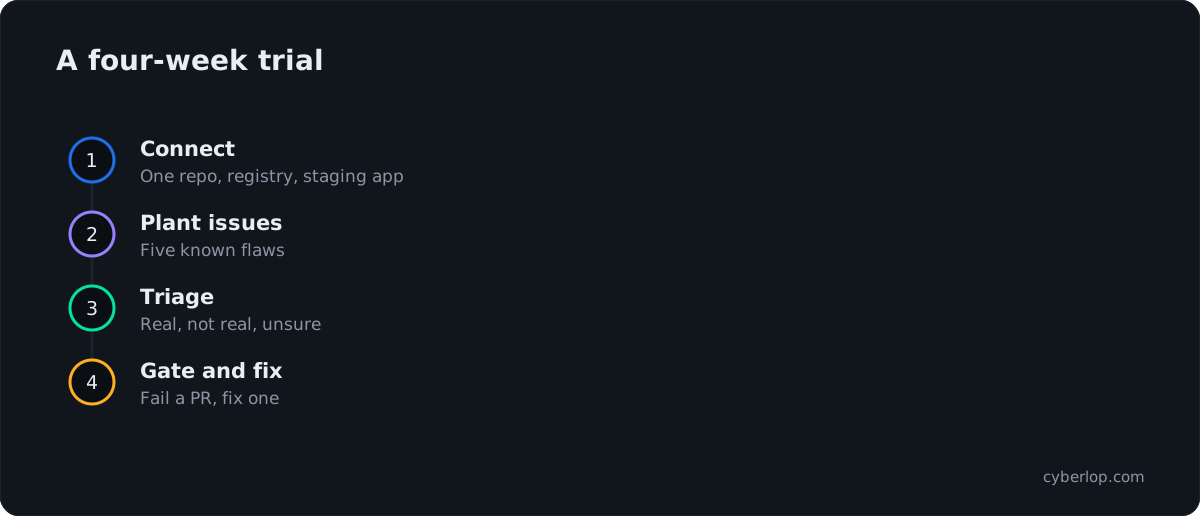
Run both on the same repository and the same staging app with the same rules, for the same four weeks, and score them against criteria written before day one.
The trial plan
This table assigns a measure to each week so the result is a count, not an impression.
| Week | Task | What to record |
|---|---|---|
| 1 | Connect one repo, one registry and one staging app | Setup time and blockers |
| 2 | Plant five known issues (a vulnerable package, a hard-coded key, an injectable route, a missing ownership check, a mis-set bucket policy) | Which each tool caught |
| 3 | Triage every finding to a verdict: real, not real, unsure | False positives and hours spent |
| 4 | Fail a pull request on a threshold and fix one finding | Gate behaviour and fix quality |
Use test data, a backup and written permission, because dynamic scanners send state-changing requests. Then add one test neither platform runs by default: ask a pentesting tool to try reading account B's data from account A. That single check shows which gaps are yours.
For wider context, read DAST vs SAST vs IAST, the shortlist in best DAST tools, and the other comparison pages in this series.
Questions people ask
Aikido vs snyk: FAQs
Is Aikido better than Snyk?
Neither vendor publishes an independent benchmark of the other, so no honest page can say so. Aikido presents one platform across code, cloud and runtime. Snyk presents separate products with deep governance and an AI-agent layer. Run both on the same app and count what each catches.
Does Aikido replace Snyk?
Aikido lists SAST, SCA, secrets, containers, IaC and DAST, so on paper it covers the same ground as Snyk's core products. Whether it replaces Snyk for you depends on your languages, governance needs and any Snyk-specific features you use. Test your own repositories.
Do Aikido and Snyk both include DAST?
Yes. Aikido calls it Surface Monitoring (DAST) and says it scans from the outside, black-box. Snyk calls it Snyk API & Web and lists SSO and OpenID Connect authenticated scans. Check how each handles your login flow before you rely on it.
Do they replace a penetration test?
Their scanners do not. Both vendors also sell separate AI pentesting modules: Aikido AI Pentest and Snyk's Evo Continuous Offensive Security. Whether that satisfies an auditor or your own risk needs is a question to put to the vendor and to the auditor.
Which is better for a startup?
Aikido describes a single platform covering code, cloud and runtime, which suits a team that wants one tool. Snyk suits teams that want product-by-product adoption and strong governance. See each vendor's pricing page and run the four-week trial above.
Can either run inside our own network?
Both describe options. Aikido's pricing page lists local code and container scanning and a broker for internal apps. Snyk Broker is an open-source proxy whose client runs inside your network. Confirm exactly which data leaves your network in each setup.
What do neither of them find?
Business-logic flaws and cross-account access need testing with real signed-in accounts and a human-readable proof. A code or dependency scan has no way to see that account A can read account B's invoice. Add pentesting for that layer.
Sources
Where the facts come from
- Aikido: platform overview
- Aikido: SAST
- Aikido: open-source dependency scanning (SCA)
- Aikido: Surface Monitoring (DAST)
- Aikido: AI Pentest
- Aikido: cloud posture management (CSPM)
- Aikido: pricing page (features and deployment sections)
- Aikido: comparison with Snyk
- Aikido: documentation
- Snyk: platform
- Snyk: Snyk Code
- Snyk: Snyk Open Source
- Snyk: Snyk Container
- Snyk: Snyk IaC
- Snyk: Snyk API & Web (DAST)
- Snyk: Evo Continuous Offensive Security
- Snyk: documentation
- Snyk: Snyk Broker documentation
- Verizon: 2026 Data Breach Investigations Report
- IBM: Cost of a Data Breach Report 2026
- OWASP: Top 10:2025
- CISA: Known Exploited Vulnerabilities Catalog
Keep reading
Related articles
Access control testing checklist: sideways, upward and across tenants.
A step-by-step access control testing checklist for web apps and APIs: account planning, sideways, upward and cross-tenant checks, evidence and retests.
Best AI pentesting tools in 2026: ten compared, and how to choose
Ten AI pentesting tools compared from vendors' own sites, with a scoring sheet, a table by category and a plan for a fair trial on your own app.
Best DAST tools 2026: twelve compared and how to choose
Twelve DAST tools compared from vendor docs: authentication, APIs, CI/CD, proof and deployment, plus a decision table and a one-week bake-off.

Need proof beside your platform?
Whichever platform you choose, Cyberlop pentests your web app and its APIs and reports what it actually exploited, with the request, the response and the line of code. Ask us to run it on one of your applications.
Or start with a $199 pilot on one application: thirty days, success criteria agreed before day one, credited against the annual if you convert.