
Home / Blog / Burp suite enterprise alternatives
Compare
Burp Suite Enterprise alternatives in 2026: Burp Suite DAST and seven tools compared
Burp Suite Enterprise Edition is now Burp Suite DAST. Here is what it does, seven alternatives described from their own vendors' pages, and how to choose.
Cyberlop Labs · Updated · 13 min read
Burp Suite Enterprise Edition is now called Burp Suite DAST, PortSwigger's scheduled web vulnerability scanner built on the Burp Suite Professional engine. Alternatives are Invicti, Qualys, Tenable, Rapid7, Veracode, StackHawk and ZAP. Choose by sign-in coverage, API support, proof per finding, where it runs and pipeline fit, then test two on your own app.
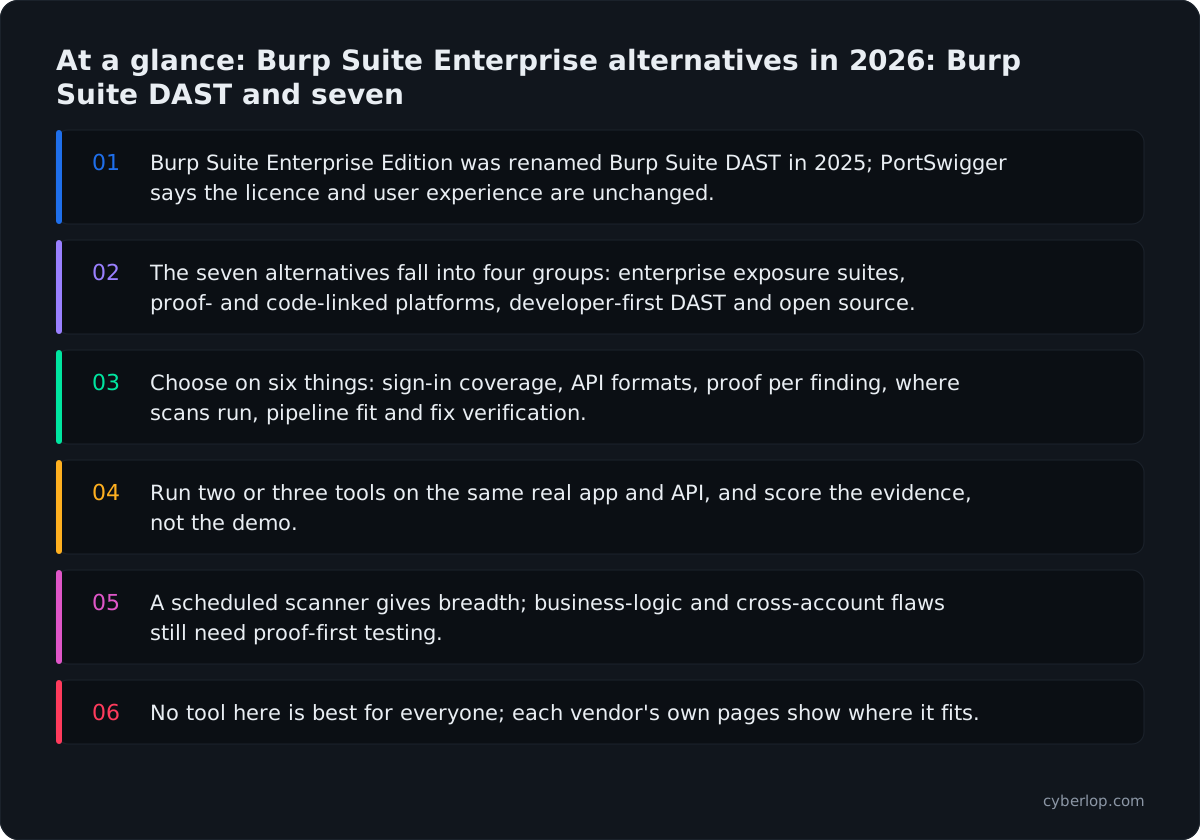
- Burp Suite Enterprise Edition was renamed Burp Suite DAST in 2025; PortSwigger says the licence and user experience are unchanged.
- The seven alternatives fall into four groups: enterprise exposure suites, proof- and code-linked platforms, developer-first DAST and open source.
- Choose on six things: sign-in coverage, API formats, proof per finding, where scans run, pipeline fit and fix verification.
- Run two or three tools on the same real app and API, and score the evidence, not the demo.
- A scheduled scanner gives breadth; business-logic and cross-account flaws still need proof-first testing.
- No tool here is best for everyone; each vendor's own pages show where it fits.
The best Burp Suite Enterprise alternatives in 2026 depend on what you need the scanner for: enterprise suites (Invicti, Qualys, Tenable, Rapid7, Veracode) suit portfolio reporting, developer-first tools (StackHawk) suit pipelines, and open source (ZAP) suits teams that will tune it themselves. First, check the name: Burp Suite Enterprise Edition is now called Burp Suite DAST, so you may only be comparing against the product under its new label.
Burp Suite Enterprise Edition is PortSwigger's scheduled web vulnerability scanner for many applications at once, renamed Burp Suite DAST in 2025. This guide compares it with seven alternatives using only what each vendor publishes on its own site, docs or GitHub page, read on 7 October 2026. It names no prices (see each vendor's pricing page) and does not claim any product beats another.
What is Burp Suite DAST, formerly Burp Suite Enterprise Edition?
Burp Suite DAST is PortSwigger's enterprise dynamic application security testing product, sold until 2025 as Burp Suite Enterprise Edition. PortSwigger's rename announcement says the old name made some buyers think it was a licensing tier of Burp Suite Professional, and that "your license and user experience remains unchanged". The DAST 2025.5 release page is dated 22 May 2025.
What the product does
According to PortSwigger's product page, Burp Suite DAST is built on the same scanning engine as Burp Suite Professional. It lists these capabilities:
- Scheduling: portfolio-wide scans, run nightly, weekly or ad hoc.
- Crawling: a Chromium-based crawler for JavaScript single-page applications.
- Authentication: session-aware authenticated testing, with Basic, Bearer Token, API Key and OAuth 2.0 support.
- APIs: definitions from Postman Collections, OpenAPI, SOAP and GraphQL.
- CI/CD: Jenkins, GitHub Actions, GitLab CI, Azure DevOps, Bitbucket Pipelines, CircleCI and TeamCity.
- Deployment: managed cloud, self-hosted Windows or Linux installers, or Kubernetes with Helm charts.
- Triage: a central dashboard, with Jira, ServiceNow, GitHub Issues and Azure Boards integrations.
It also says each finding carries the full request and response and can be reproduced in Burp Suite Professional. That link to the tester's tool is the product's clearest strength: a scanner finding can go straight to a person with the same engine on their laptop.
Who it suits
Teams that already own or train on Burp Suite Professional, and that want scheduled scanning across a portfolio of sites, get the most from it. If you are weighing it against the free scanner instead, read Burp Suite vs OWASP ZAP.
Why do teams look for Burp Suite Enterprise alternatives?
Teams look for alternatives because of fit, not failure. What matters is who operates the scanner, where it runs, what it can sign in to, and how much proof each finding carries. The reasons that come up most are practical:
- You want one platform. Some buyers want SAST, software composition and DAST results in one place, which the suites from Invicti, Veracode and Tenable describe.
- You want developer-owned scans. A scan that runs in the pull request, in the developer's own repository, is a different job from a nightly portfolio scan.
- You want a free engine. Teams with automation skills sometimes prefer to run and tune open source.
- You want exploit proof and a retest. Some teams need each finding confirmed against the running app, and then confirmed fixed.
- You already pay for a wider exposure platform. A scanner that reports into your existing vulnerability management tool can save a console.
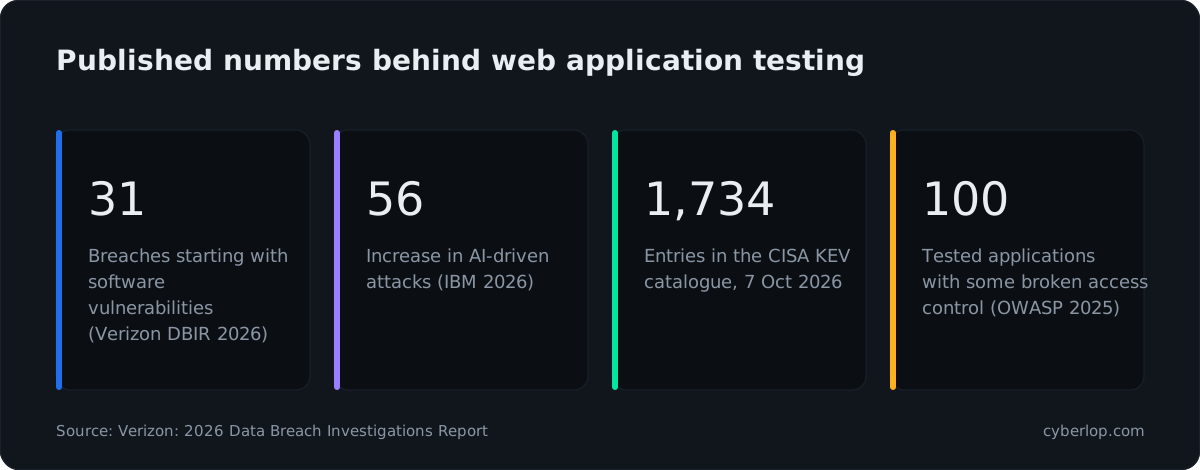
The stakes are real. Verizon's 2026 Data Breach Investigations Report says 31% of breaches now start with software vulnerabilities, "beating stolen passwords as the top way attackers get in". IBM's Cost of a Data Breach Report 2026 puts the global average cost of a breach at $4.99 million, a 12% rise, and reports a 56% increase in AI-driven attacks. The CISA Known Exploited Vulnerabilities catalogue showed 1,734 entries when we read it. And OWASP's Top 10:2025 reports that 100% of the applications tested had some form of broken access control.
How do the alternatives group?
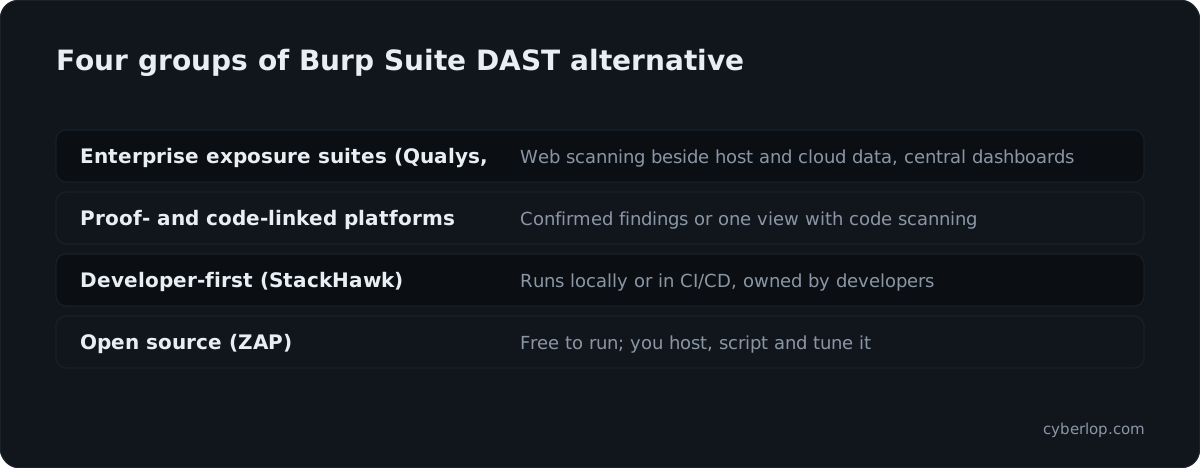
The seven alternatives fall into four groups by how they are delivered: enterprise exposure suites (Qualys, Tenable, Rapid7), proof- and code-linked platforms (Invicti, Veracode), developer-first DAST (StackHawk) and open source (ZAP), and the groups describe style, not quality. Use the groups to shortlist, then test two or three on your own app.
Burp Suite DAST and seven alternatives at a glance
| Tool | Model | Where it runs | CI/CD and pipeline | Notes from the vendor |
|---|---|---|---|---|
| Burp Suite DAST | Enterprise DAST, Burp engine | Cloud, self-hosted, Kubernetes | Seven CI systems listed | Findings reproducible in Burp Suite Professional |
| Invicti | Enterprise DAST platform | Cloud and on-premises | Jenkins, GitHub Actions, GitLab CI/CD, Azure Pipelines, CircleCI | Proof-based scanning |
| Qualys Web Application Scanning | Enterprise suite module | Cloud scanners; appliance for internal apps | See Qualys docs | Scheduled daily, weekly or monthly |
| Tenable Web App Scanning | Exposure platform module | SaaS; or with Tenable Security Center | Docker image for pipelines | Part of Tenable One |
| Rapid7 InsightAppSec | Enterprise DAST, black-box | Cloud and on-premises scan engines | CI/CD and DevOps integrations | Attack Replay |
| Veracode DAST | Platform module | Cloud-native; reaches behind firewalls | CI/CD pipelines | Shown beside SAST and SCA results |
| StackHawk | Developer-first DAST | Locally or in CI/CD | GitHub Actions, Jenkins, GitLab, Azure Pipelines, CircleCI | Warns it is an aggressive scanner |
| ZAP | Open source scanner | You host it | Docker, GitHub Actions, Automation Framework, API | "Free and open source" |
What are the best Burp Suite DAST alternatives in 2026?
No single option wins everywhere. These seven cover the main ways to deliver scheduled scanning, and each is described only from its own vendor's pages. For a wider list, see the best DAST tools in 2026.
Invicti
Invicti is an enterprise DAST platform built around "proof-based scanning": the scanner tries to confirm that an issue is exploitable before it reports it. Its scanner page lists authenticated testing, automatic discovery of REST and SOAP APIs, scheduled scans, CI/CD integration, and both cloud and on-premises deployment. Its platform page also describes correlating DAST findings with SAST to point at the vulnerable code, and tests of REST, SOAP and GraphQL APIs.
Where it fits
Teams that want confirmed findings and a path toward one vendor for DAST, code and supply-chain scanning. Invicti also says Acunetix is now sold as Invicti Web + API; the comparison is in Invicti vs Acunetix.
Check first
Ask which package you would buy for web scanning alone, and whether the extra modules are ones you need.
Qualys Web Application Scanning
Qualys WAS is the web scanning module of the Qualys platform. Its scanning documentation says it scans web applications and REST APIs (via a Swagger file, an OpenAPI 3.0 JSON file or a Postman Collection), and does "basic security testing" of SOAP services. Scans can be scheduled daily, weekly or monthly. The same page says internal applications need "a scanner appliance placed inside your network", while external sites use Qualys's cloud scanners.
Where it fits
Organisations that already run Qualys for hosts and want web findings in the same console, with a scanner appliance for internal apps.
Check first
The docs note that many vulnerabilities only surface in authenticated scans. Test your real sign-in flow, including any single sign-on step, during the trial.
Tenable Web App Scanning
Tenable Web App Scanning is a DAST product inside the Tenable One platform. Tenable's product page lists "XSS, SQL injection, and vulnerable third-party components" among the issues it finds. It also describes mapping of pages, links and forms, scans of APIs and single-page applications, and recurring weekly or monthly scans. It is offered as SaaS or integrated with on-premises Tenable Security Center, with role-based access so teams see only their scan data. Its CI/CD documentation describes a Docker image for pipelines.
Where it fits
Security teams that track web, cloud and host exposure on one set of dashboards, and want web findings next to the rest.
Check first
Read the CI/CD page before you plan to gate builds: it sets out how pipeline scans run, including the limit it states on concurrent scans.
Rapid7 InsightAppSec
InsightAppSec is Rapid7's black-box DAST for web applications and APIs. Rapid7's product page lists 95+ attack types, scan scheduling and blackouts, cloud and on-premises scan engines, compliance and remediation reporting, and CI/CD and DevOps integrations including Jira. It also describes Attack Replay, which lets a developer re-test a vulnerability, and a patch, straight from the report. The documentation covers GraphQL scanning and Jenkins, Azure DevOps, GitHub Actions and GitLab integrations.
Where it fits
Teams already in the Rapid7 Insight platform, and teams where developers should be able to re-test a fix without asking the security team for another scan.
Check first
Scan blackouts help in production-like environments. Confirm they fit your release calendar.
Veracode DAST
Veracode DAST is described as a cloud-native platform for runtime vulnerabilities in web applications and APIs. Veracode's product page says it can scan assets "behind your firewall", plug into CI/CD pipelines, and show scan data "alongside static and software composition analysis findings". It also lets you configure scan depth, speed and accuracy.
Where it fits
Organisations that already use Veracode for SAST or software composition analysis, and want one view across static and dynamic results.
Check first
Ask for a trial on your own sign-in flow and API definitions, not a demo site.
StackHawk
StackHawk is a developer-first DAST platform. Its documentation describes HawkScan, a scanner that "runs locally or in CI/CD", with support for OpenAPI, GraphQL, gRPC, JSON-RPC and SOAP APIs; form-based, OAuth, HTTP and custom-script authentication; and a platform dashboard for findings and teams. The docs also describe LLM and MCP server testing and an "Agentic StackHawk" workflow. For more on this model, read StackHawk alternatives.
Where it fits
Engineering teams that want a scan on every pull request, owned by developers, without a central security console in the way.
Check first
The HawkScan page warns that HawkScan "is an aggressive scanner" and should run only where data changes are acceptable. Point it at a test environment with disposable data.
ZAP
ZAP calls itself "the world's most widely used web app scanner. Free and open source", and is branded "ZAP by Checkmarx" while stating it is an independent open-source project. Its automation page lists six routes, from ZAPit up to the API in daemon mode. Docker packaged scans and GitHub Actions are the quick starts. For anything larger, the page recommends the Automation Framework.
Where it fits
Teams with engineers who will own the setup, scripting and tuning, and who want to avoid licence conversations altogether.
Check first
You host it, schedule it and build the portfolio view yourself. ZAP's authentication documentation says authentication has to be configured by you, so allow time for it.
Also on shortlists
Bright Security describes DAST, an AI pentesting product and a platform called Bright STAR with CI/CD, IDE and Jira integrations. We have not given it a full entry here, but it belongs on a developer-first shortlist next to StackHawk.
Where does Cyberlop fit?
Cyberlop is a different job from a portfolio scheduler: it finds vulnerabilities in web apps and their APIs with black-box, grey-box and white-box pentesting, and reports only what it actually exploited. Each finding carries the request, the response, a screenshot where a person can see it and, in white-box mode, the line of code. Severity and confidence are kept apart, and findings carry CWE and OWASP references.
Three differences matter when you compare it with the tools above:
- Cross-account access and business logic. It checks business-logic flaws and cross-account access: one signed-in account reaching another's data or functions. Read why a scanner with one login misses them.
- Proven fixes. A fix is proven by re-running the exact exploit against the new code, a closed-loop retest, not by a fresh scan.
- Where it runs. Private scanning runs inside your own network so your code does not leave it, and it can run on a schedule or in CI/CD and gate a build.
Agencies and MSSPs can run it under their own brand. Our rule is simple: if we did not break it, we do not report it. For the evidence format, see what a finding looks like. A common pairing is a scheduled scanner for breadth and a proof-first pentest for depth, the combination described in DAST vs SAST vs IAST.
How do you choose a Burp Suite Enterprise alternative?
Choose by six criteria: who runs the scans, where they run, what they sign in to, how much proof each finding carries, how results reach developers, and what happens after the fix. Weight them against your real applications, not a feature list.
Selection criteria and the question to ask
| Criterion | Question to ask the vendor | Why it matters |
|---|---|---|
| Authentication | Can you scan our real sign-in flow, including single sign-on and multi-factor steps? | Unauthenticated scans cannot see most of an application. See authenticated testing. |
| API coverage | Which definitions do you import: OpenAPI, Postman, GraphQL, SOAP, gRPC? | Your API is often the larger surface. See API security testing. |
| Proof | What does a finding contain: request, response, replay, exploit confirmation? | Proof cuts false positives and speeds triage. |
| Deployment | Can scanning run inside our network, and does our code or traffic leave it? | Matters for internal apps and for on-premises policy. |
| Pipeline fit | Can a scan gate a build, and what are the limits on concurrent pipeline scans? | A scan that cannot run beside the build is run less often. |
| Fix verification | How do we confirm a fix: re-test one finding, or rescan everything? | A fix is only closed when the original exploit fails. |
| Reporting | Where do findings go: Jira, ServiceNow, an exposure platform? | Findings nobody sees do not get fixed. |
Which tool for which situation?
- You use Burp Suite Professional already: keep Burp Suite DAST on the shortlist, since findings reproduce in the tool your testers use.
- You want findings confirmed and one vendor for code too: look at Invicti or Veracode DAST.
- You already run a host or exposure platform: Qualys, Tenable or Rapid7 report into the console you have.
- Developers should own the scan: StackHawk, or ZAP if you are happy to run it yourself.
- You need exploit proof and retest more than breadth: add a proof-first pentest alongside a scheduler.
How do you run a two-week bake-off?
Run the same application through two or three tools, with the same accounts, and compare the evidence. A scanner demo on a vendor's test site tells you little about yours.
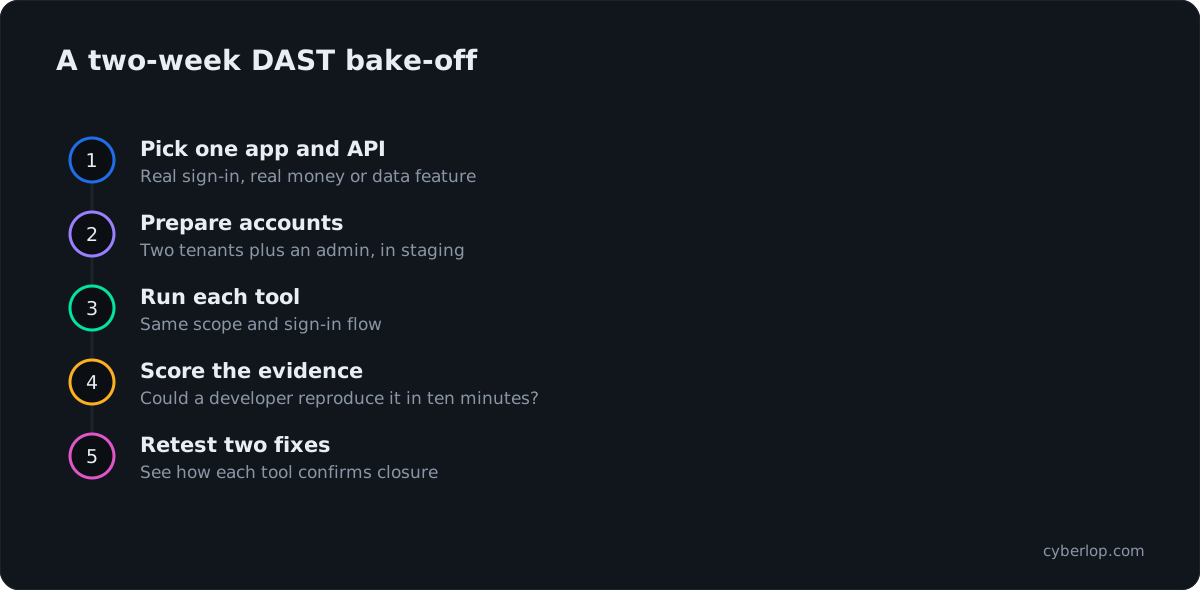
- Pick one real app and one real API. Include a signed-in area and one feature with money or personal data in it.
- Prepare two test accounts in different tenants, plus an admin, in a staging environment with disposable data.
- Write down what you already know is broken (a past pentest finding is ideal) so you can see who finds it.
- Run each tool with the same scope, using the real sign-in flow and the API definition.
- Score the evidence. For each finding, ask whether a developer could reproduce it in ten minutes from the report alone.
- Fix two findings and re-test them to see how each tool confirms closure.
- Test the pipeline: run a scan from your CI system and note how long it takes and what happens on failure.
- Decide with the team that will triage. They will live with the output.
Scoring sheet for the bake-off
| Check | Tool A | Tool B | Tool C |
|---|---|---|---|
| Signed in to the real app | Yes / no | Yes / no | Yes / no |
| Known issue found | Yes / no | Yes / no | Yes / no |
| Findings a developer could reproduce | Count | Count | Count |
| Findings dismissed as false positives | Count | Count | Count |
| Fix confirmed in the tool | Yes / no | Yes / no | Yes / no |
| Pipeline run completed | Yes / no | Yes / no | Yes / no |
What does a scheduled scanner not replace?
A scheduled DAST tool does not replace human judgement on business logic, and it does not by itself prove that a fix works. Scanners are good at known classes such as injection and misconfiguration. They are weaker where the flaw depends on what your product means: a discount that stacks twice, or a report one customer can pull for another.
Plan for three layers: a scheduler for breadth, SAST and dependency checks for code, and periodic proof-first testing for access control and logic. The continuous penetration testing guide explains how to combine them, and exploited, not suspected explains why proof changes triage.
Switching without losing coverage
Run the new tool beside the old one for at least one full release cycle. Export your open findings and map them by URL and weakness class, so you can see what each tool sees and misses. Keep the old scanner until the new one has reproduced your known issues and passed a pipeline run.
Summary: pick for fit, then test
Burp Suite DAST is a strong choice if your team lives in Burp. The seven alternatives win in different places: Invicti on confirmed findings, Qualys and Tenable on platform reach, Rapid7 on re-test from the report, Veracode on a joined-up view with code results, StackHawk on developer workflow and ZAP on being open source. Shortlist two, run the bake-off, and let your own evidence decide. If proof of exploitation and retest are your gap, you can book a pilot of Cyberlop on one app and compare the result with your scheduler's.
Questions people ask
Burp suite enterprise alternatives: FAQs
Is Burp Suite Enterprise Edition the same as Burp Suite DAST?
Yes. PortSwigger renamed Burp Suite Enterprise Edition to Burp Suite DAST, with the change shipping in DAST 2025.5 on 22 May 2025. The company says the licence and user experience remain unchanged, and the scanning engine is the same as Burp Suite Professional's.
What is the best free alternative to Burp Suite DAST?
ZAP is the best-known free option. It describes itself as "free and open source" and offers Docker packaged scans, GitHub Actions and an Automation Framework. You host and tune it yourself, so plan time for sign-in setup and for building your own reporting.
What is the difference between Burp Suite Professional and Burp Suite DAST?
Burp Suite Professional is the toolkit a tester uses by hand. Burp Suite DAST schedules automated scans across many sites for a team. PortSwigger says DAST findings carry request and response evidence that can be reproduced in Professional.
Can I run these scanners in CI/CD?
Yes, each vendor describes pipeline use. Burp Suite DAST lists seven CI systems, StackHawk runs locally or in CI/CD, and Tenable offers a Docker image but limits CI/CD scanning to one scan at a time. Test a real pipeline run during your trial.
Which alternative suits developer teams best?
StackHawk is built for developer-owned scans in pull requests, and ZAP suits engineers who will script it. Enterprise suites suit central security teams reporting across a portfolio. The right choice depends on who triages the findings.
Do I still need a pentest if I run a DAST scanner?
Usually yes. Scanners cover known weakness classes at scale, but flaws in business logic and cross-account access depend on what your product means. A proof-first pentest, with a retest of each fix, covers those.
How long should a DAST evaluation take?
Two weeks is enough for most teams if the scope is fixed on day one. Use one real app, one API, test accounts in separate tenants and a known issue to look for, then score the evidence each tool produces.
Sources
Where the facts come from
- PortSwigger: Burp Suite DAST
- PortSwigger: Meet Burp Suite DAST, a clearer name
- PortSwigger: DAST 2025.5 (formerly Enterprise Edition)
- Invicti: Web vulnerability scanner
- Invicti: Platform overview
- Qualys: Web Application Scanning documentation
- Tenable: Web App Scanning
- Tenable: Web App Scanning CI/CD overview
- Rapid7: InsightAppSec
- Rapid7: InsightAppSec documentation
- Veracode: DAST
- StackHawk: Documentation
- StackHawk: HawkScan
- ZAP: Home
- ZAP: Automation options
- ZAP: Authentication
- Bright Security: Home
- Verizon: 2026 Data Breach Investigations Report
- IBM: Cost of a Data Breach Report 2026
- CISA: Known Exploited Vulnerabilities Catalog
- OWASP: Top 10:2025, A01 Broken Access Control
Keep reading
Related articles
API security testing: a 2026 guide to the OWASP API Top 10
A step-by-step API security testing guide: the OWASP API Top 10 (2023) with test cases, BOLA and BFLA checks, JWT, OAuth, GraphQL and a CI/CD plan.
Best DAST tools 2026: twelve compared and how to choose
Twelve DAST tools compared from vendor docs: authentication, APIs, CI/CD, proof and deployment, plus a decision table and a one-week bake-off.
Burp Suite vs OWASP ZAP in 2026: which one should you use?
Burp Suite vs OWASP ZAP compared from vendor docs: manual testing, CI/CD, logins, APIs, scale, and a six-point way to choose. No prices.

Compare the proof, not the demo
Cyberlop finds vulnerabilities in web apps and APIs with black-box, grey-box and white-box pentesting, and reports only what it exploited, with request, response and the line of code. Ask us to run it on one of your applications.
Or start with a $199 pilot on one application: thirty days, success criteria agreed before day one, credited against the annual if you convert.