
Home / Blog / Stackhawk alternatives
Compare
StackHawk alternatives: 9 options compared and how to choose
StackHawk alternatives fall into four types: developer-first DAST, enterprise scanners, open source and white-box pentesting. Here is what each does, from its own site.
Cyberlop Labs · Updated · 13 min read
StackHawk alternatives are other tools that test a running web app or API: Bright Security, Snyk API & Web and Escape for developers, Invicti, Burp Suite DAST and Detectify for broader scanning, ZAP and Aikido for lower-effort starts, and Cyberlop for white-box pentesting. Choose by owner, sign-in, API inputs and proof.
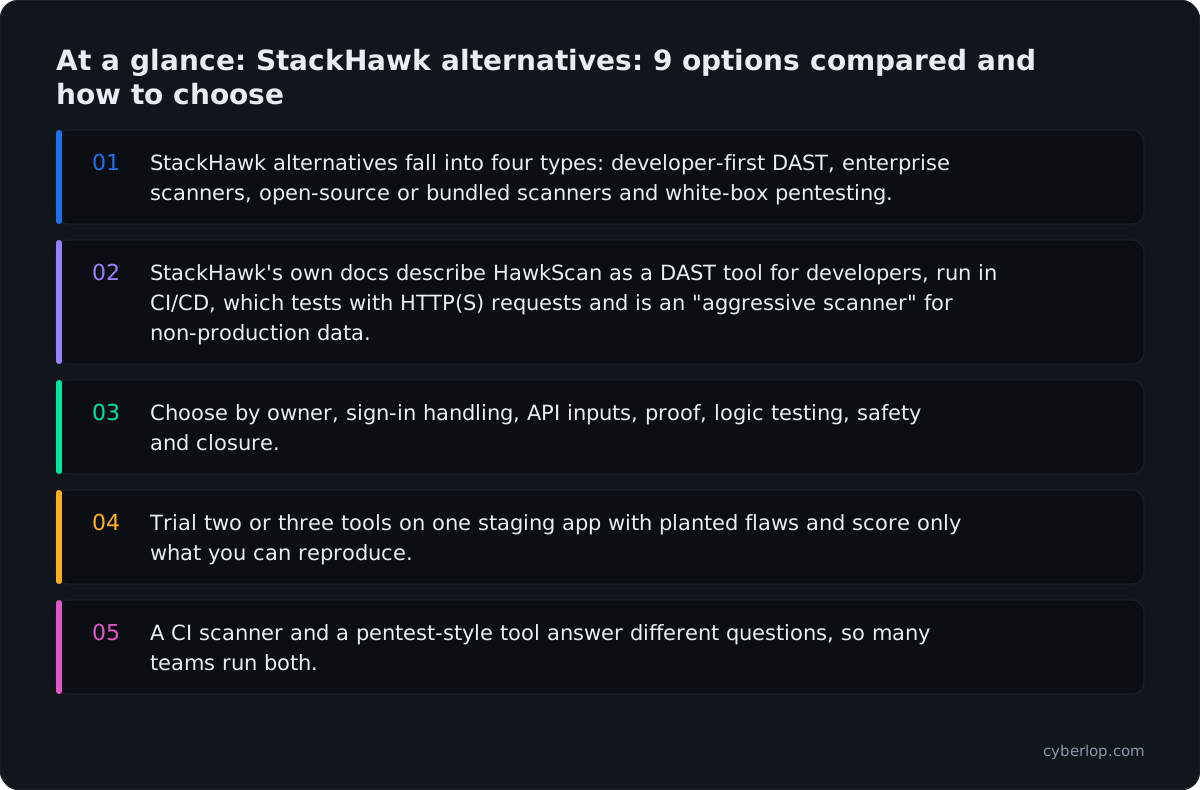
- StackHawk alternatives fall into four types: developer-first DAST, enterprise scanners, open-source or bundled scanners and white-box pentesting.
- StackHawk's own docs describe HawkScan as a DAST tool for developers, run in CI/CD, which tests with HTTP(S) requests and is an "aggressive scanner" for non-production data.
- Choose by owner, sign-in handling, API inputs, proof, logic testing, safety and closure.
- Trial two or three tools on one staging app with planted flaws and score only what you can reproduce.
- A CI scanner and a pentest-style tool answer different questions, so many teams run both.
StackHawk alternatives are the other tools that test a running web app or API for vulnerabilities, and the right one depends on how you ship code. StackHawk is a developer-first DAST tool that runs in CI/CD. The main alternatives are Bright Security, Snyk API & Web and Escape for developer-led teams. Invicti, Burp Suite DAST and Detectify suit broader scanning. ZAP and Aikido are lower-effort starts. Cyberlop fits where findings must point to code.
DAST (dynamic application security testing) means testing a running application from the outside, by sending it requests, instead of reading its source. This guide uses only what each vendor publishes on its own website or docs, read on 7 October 2026. It gives no prices (see each vendor's pricing page) and no ranking, and it says where each option wins.
What is StackHawk, and what do you actually get?
StackHawk is a vendor of developer-focused DAST. Its documentation describes HawkScan as "a dynamic application security testing (DAST) tool built for developers", made of the HawkScan scanner and the StackHawk Platform. Knowing which part you use helps you judge what an alternative would have to replace.
What StackHawk's own pages say
- Where it runs: the docs say the scanner "can run anywhere" and name your laptop, a server, Kubernetes or a delivery pipeline, as a Docker container or through the Hawk CLI.
- How it tests: HawkScan is described as "connecting to your application and testing it with HTTP(S) requests". It "will crawl your application for routes, then probe each route for vulnerabilities".
- What it looks for: the product page lists "Authorization and authentication flaws (BOLA, BFLA, broken access control)", "Business logic vulnerabilities", "API-specific risks", "Injection attacks" and "LLM security risks".
- Where it fits: StackHawk says it works "from testing locally to reviewing PRs and breaking builds", and its docs list GitHub Actions, GitLab, Jenkins, Azure Pipelines, CircleCI, Bitbucket Pipelines and others.
- Fixing: each finding carries "code-level context and AI-powered remediation guidance", and the home page now describes an AI coding agent workflow of Find, Fix and Verify with agents such as Claude Code, Cursor and GitHub Copilot.
How does HawkScan handle APIs and logins?
The configuration docs list API specification support for OpenAPI, GraphQL, SOAP, gRPC and JSON-RPC. For sign-in, the authenticated scanning docs describe OAuth with scripting, cookie or token injection, and form-based login, with a testPath and logged-in indicators to confirm the scanner is still authenticated. Scripts can be written in JavaScript or Kotlin for harder flows.
StackHawk at a glance
The table below restates StackHawk's own wording, so you can compare it with the alternatives.
| Question | What StackHawk's site says |
|---|---|
| Approach | Runtime DAST against a live app, "in pre-production environments or against production endpoints" |
| Who it is for | Developers; positioned as "purpose-built for modern development workflows" |
| Inputs | A running app and a stackhawk.yml file; API specs in OpenAPI, GraphQL, SOAP, gRPC or JSON-RPC |
| Sign-in | OAuth with scripting, token or cookie injection, form login, custom scripts |
| CI/CD | GitHub Actions, GitLab, Jenkins, Azure Pipelines, CircleCI, Bitbucket Pipelines and more |
| Output | Findings with code-level context and AI-powered remediation guidance |
| Caution in the docs | HawkScan is described as "an aggressive scanner"; run it only where data changes are acceptable |
That last row matters for planning. StackHawk's docs say the scanner will try to create, update and delete data, so you point it at a test or staging environment. That is a sensible rule for any active scanner, and you should ask every alternative the same question.
Why do teams look for StackHawk alternatives?
Teams look for StackHawk alternatives because their needs outgrow, or differ from, a developer-run scanner in CI. StackHawk is well matched to a team that wants every pull request tested. Other situations push buyers elsewhere.
Reasons that come from your own situation
- You need a finding to point at a line of code. StackHawk says it tests through HTTP(S) requests and adds code-level context to findings. If you want a tool that reads your source while it tests the running app, look at white-box options.
- You want a human-style pentest, not only scans. A CI scanner repeats known checks well. A pentest chases business logic and chains of small flaws. The two answer different questions.
- You already pay for a wider platform. If your static, dependency and container tools sit with one vendor, a DAST module from the same vendor may reduce tool sprawl.
- You need an enterprise estate view. Thousands of sites, role-based access control, audit trails and single sign-on for the security team are a different job from a developer pipeline.
- You want a free start. An open-source scanner costs engineering time instead of licence fees. Count that time honestly.
- You need external attack surface coverage. A CI tool tests what you point it at. Finding forgotten subdomains is a separate capability.
None of these says StackHawk is the wrong tool. They say the question "which tool?" starts with "which job?". The same logic runs through our guides to the best DAST tools and API security testing tools.
Why does runtime testing matter in 2026?
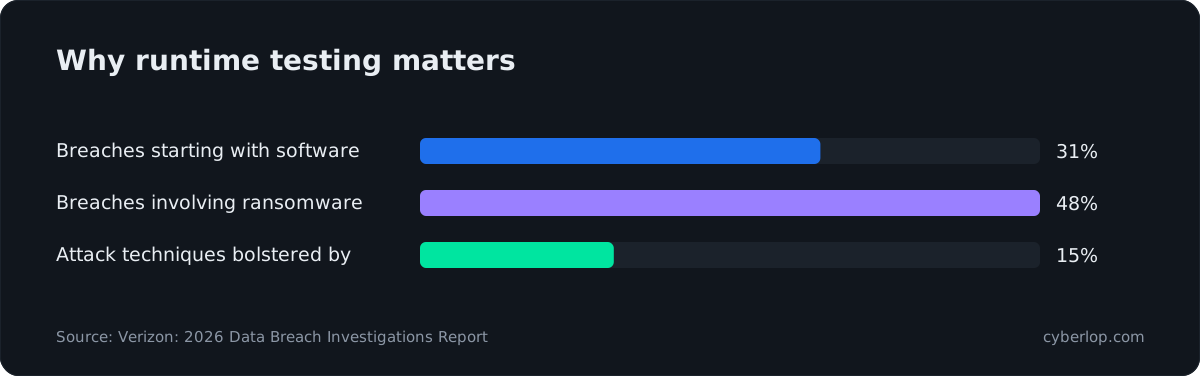
Runtime testing matters because attackers reach software through running applications and their flaws. The Verizon 2026 Data Breach Investigations Report reports that "31% of breaches now start with software vulnerabilities", ahead of stolen passwords as the top way in, covering data collected between 1 November 2024 and 31 October 2025.
The same page says 48% of all breaches now involve ransomware and 15% of attack techniques are bolstered by generative AI. Treat these as context, not as proof that any one tool works. They explain why teams want testing that proves a flaw is reachable, not only that a pattern exists.
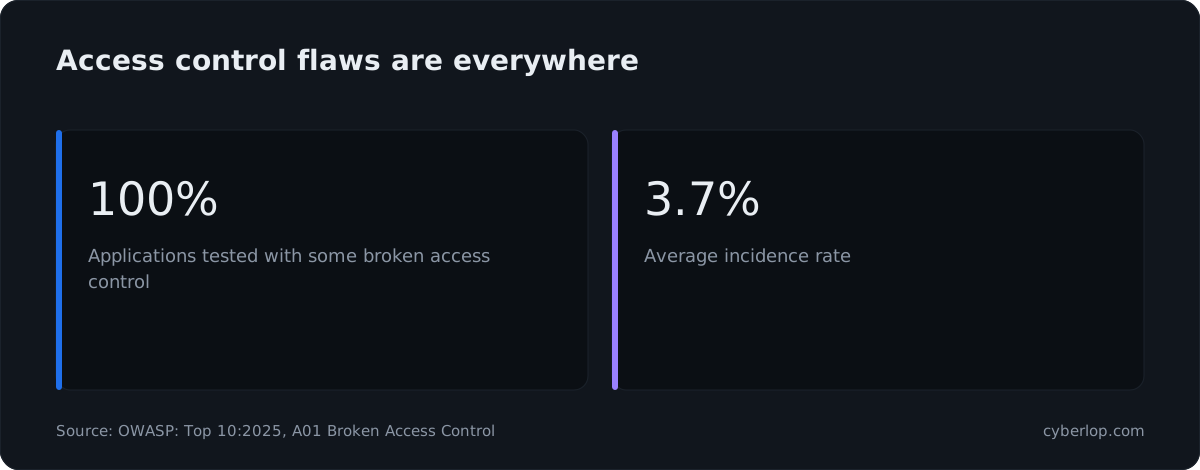
Access control is the sharpest example. OWASP Top 10:2025, A01 states that 100% of the applications tested showed some form of broken access control, with an average incidence rate of 3.74% and 1,839,701 occurrences in the contributed data. Those are flaws about who may do what, and they depend on your own rules, which makes them hard for a generic scanner to judge.
What does the OWASP API list add?
The OWASP API Security Top 10 (2023) names Broken Object Level Authorization (API1), Broken Authentication (API2), Broken Object Property Level Authorization (API3), Broken Function Level Authorization (API5) and Unrestricted Access to Sensitive Business Flows (API6) among its ten risks. Four of those five concern permission and flow logic. When you compare tools, ask how each one tests them. See also BOLA and business-logic flaws.
The CISA Known Exploited Vulnerabilities Catalog held 1,734 entries when we read it on 7 October 2026. Each is a vulnerability CISA lists as exploited in the wild, so continuous checks against known weaknesses still earn their place. A CI scanner is good at that kind of repeatable check.
What types of StackHawk alternative are there?
There are four types of StackHawk alternative: developer-first DAST, established enterprise scanners, open-source and bundled scanners, and white-box pentesting. They differ in who runs them, where they run and what a finding looks like.
Four types, by how the tool is run
| Type | Typical owner | Strength | Question to ask |
|---|---|---|---|
| Developer-first DAST | Engineering team | Fast feedback in pull requests | Does it handle our sign-in and our API specs? |
| Established enterprise scanners | Security team | Estate-wide scheduling, roles, reporting | Who maintains scan configuration at scale? |
| Open source and bundled scanners | Engineers who like to tune | Low licence cost, or part of an existing platform | How much setup and noise reduction do we own? |
| White-box pentesting | Product and security together | Findings tied to code, proof of exploit | What is its scope, and how is a fix verified? |
Which are the best StackHawk alternatives?
The best StackHawk alternative is the one that matches your owner, your pipeline and the kind of flaw you fear most. Each entry below uses only what the vendor says on its own site. The order is by type, not by merit.
Developer-first DAST
Bright Security
Bright Security lists Bright STAR ("Security Testing & Auto Remediation"), Bright DAST, Bright MCP and a Bright Security Agent for GitHub. Its home page says it targets "web applications, APIs, business logic, and LLMs" and names connections to VS Code, IntelliJ, Jira, GitHub and GitLab. It suits a team that wants the same developer-led pattern as StackHawk with a different vendor and a remediation focus. Ask for a trial on your own sign-in flow.
Snyk API & Web
Snyk says it acquired Probely and joined its "best-of-breed DAST technology" to its SAST, SCA, container and IaC engines, as Snyk API & Web. Snyk describes it as aimed at securing "the APIs that connect applications and Large Language Models (LLMs)". Teams already on Snyk can add DAST in the same account as SAST and software composition analysis. Our Aikido vs Snyk guide covers the wider platform question.
Escape
Escape describes an AI-powered offensive security platform with attack surface management, "Business-Logic-Aware DAST" that evaluates "workflows, access control, and multi-step processes rather than just payload injection", and agentic AI pentesting. It also lists GraphQL testing, CI/CD integration and compliance automation. It suits API-heavy teams that want logic-aware testing and will trial it against a seeded flaw. The vendor's own percentages are claims to reproduce on your app, not facts to rely on.
Established and enterprise scanners
Invicti
Invicti calls itself an application security platform and emphasises "proof-based scanning" to validate findings. Its home page lists DAST, SAST, SCA, IaC, secrets and container scanning, plus API discovery and an ASPM layer that deduplicates findings. Its DAST page says "On-Prem and On-Demand deployment options available". Security teams that manage many sites and want confirmed findings across a portfolio are the natural buyers. Read Invicti vs Acunetix if you are weighing the vendor's family of products.
Burp Suite DAST
PortSwigger says Burp Suite DAST plugs into CI "as a step", runs "on every pull request" and can "gate merges by severity". It describes session-aware scanning for areas behind a login, API coverage for Postman Collections, OpenAPI, SOAP and GraphQL, and enterprise features including role-based access control, site groups, audit trails and SAML single sign-on across "thousands of sites". Teams that already rely on Burp for manual work get the scanning side at scale. See Burp Suite vs ZAP.
Detectify
Detectify lists Application Scanning ("deep, authenticated" DAST), API Scanning for REST and GraphQL, and Surface Monitoring that discovers external assets such as domains and subdomains. It also describes research from "400+ elite ethical hackers" feeding its tests. It fits teams that care about external attack surface as much as the app they build. Our Detectify alternatives page goes further.
Open source and bundled
ZAP
ZAP's site calls it "the world's most widely used web app scanner. Free and open source." It is shown as "by Checkmarx" while also stating that "ZAP is an independent Open Source project". Its docs list Docker packaged scans, GitHub Actions, an Automation Framework "recommended for most non-trivial automation" and an API and daemon mode. Plan for your own engineers to own configuration, scan tuning and result triage. The trade is licence fees against your own time.
Aikido
Aikido says its DAST "uses a subset of safe OWASP ZAP scans" and adds its own de-noising and de-duplication. It lists authenticated testing, REST and GraphQL API scanning, daily scans once configured, and says the scanner "avoids destructive tests". It suits small teams that want DAST as one module of a wider security platform. Ask how a non-destructive scan compares with an active one on your app, and decide which you need.
White-box pentesting
Cyberlop
Cyberlop finds vulnerabilities in web apps and their APIs with black-box, grey-box and white-box pentesting. In white-box mode it reads your code while testing the running app, so a finding can point to the file and line. It reports what it actually exploited, with the request, the response, a screenshot where a person can see it and the line of code. It also checks business-logic flaws and cross-account access, where one signed-in account reaches another's data or functions.
It can run on a schedule or in CI/CD and gate a build, and it can run inside your own network so your code does not leave it. A fix is proven by re-running the exact exploit against the new code. Choose it when you want proof and code pointers, not only pattern matches. See how it works and the evidence it produces.
Side-by-side comparison
This table compares the options on the dimensions buyers ask about most, using each vendor's own wording.
| Option | Type | What the site emphasises | Where it fits best |
|---|---|---|---|
| StackHawk | Developer-first DAST | HawkScan in CI/CD, pull request testing, AI-powered remediation guidance | Teams that want every pull request tested |
| Bright Security | Developer-first DAST | Bright DAST, auto remediation, web, APIs, business logic and LLMs | Developer-led teams wanting remediation help |
| Snyk API & Web | Platform DAST | Probely DAST joined to SAST, SCA, container and IaC engines | Teams already standardised on Snyk |
| Escape | Logic-aware DAST and AI pentest | Workflows, access control, GraphQL, attack surface | API-heavy products |
| Invicti | Enterprise platform | Proof-based scanning, ASPM, on-prem or on-demand | Security teams with many sites |
| Burp Suite DAST | Enterprise DAST | CI step, session-aware scans, role-based access control, site groups | Teams that already use Burp |
| Detectify | External surface and app scanning | Application and API scanning, Surface Monitoring | Teams with a wide external footprint |
| ZAP | Open source | Free, automation options, community project | Engineers who will own tuning |
| Aikido | Bundled DAST | Safe ZAP-based scans, de-noising, daily runs | Small teams wanting one platform |
| Cyberlop | White-box, grey-box and black-box pentesting | Proof of exploit, line of code, closed-loop retest | Teams that need findings tied to code |
How do you choose a StackHawk alternative?
Choose by writing down your top three needs, then testing each shortlisted tool on the same app with the same accounts. The seven criteria below turn vague preferences into things you can check.
Seven criteria
- Owner. Who will read the findings every week: an engineer in the pull request, or a security analyst in a console?
- Sign-in handling. Can it keep a session alive on your real flow, including OAuth or multi-step login? Bring your hardest case.
- API inputs. Does it read your OpenAPI specification, GraphQL schema or gRPC descriptors, or does it need traffic?
- Proof. Does a finding include the request, the response and steps to reproduce? Every false positive costs developer time.
- Logic and access control. How does it test cross-account access and business flows? Ask for a live example on a seeded flaw.
- Safety. Is it active or non-destructive, and where can it run? StackHawk and Aikido say very different things here, and both are reasonable.
- Closure. How does the tool show a fix worked? A rescan and a replay of the original exploit are different evidence. See closed-loop retest.
Which option for which need?
| If you mainly need | Look first at | Why |
|---|---|---|
| Pull request feedback from developers | StackHawk, Bright Security, Snyk API & Web | Built around CI and developer workflow |
| One scanner across hundreds of sites | Invicti, Burp Suite DAST | Estate features and reporting |
| The lowest licence cost, with time to tune | ZAP | Free and open source, with automation options |
| A security module inside a wider platform | Aikido, Snyk API & Web | Same account as other scanners |
| External surface and forgotten assets | Detectify, Escape | Surface monitoring is core |
| Findings with proof and a line of code | Cyberlop | White-box mode reads code while testing the running app |
You may need two tools. A CI scanner gives frequent, cheap feedback. A pentest-style tool gives depth on logic flaws a scanner can miss. The relationship is covered in DAST vs SAST vs IAST and continuous penetration testing.
How do you trial two or three tools fairly?
Trial them on one real staging app, with the same accounts, the same scope and the same scoring. A fair trial takes a week, not a quarter, and it replaces opinion with evidence.
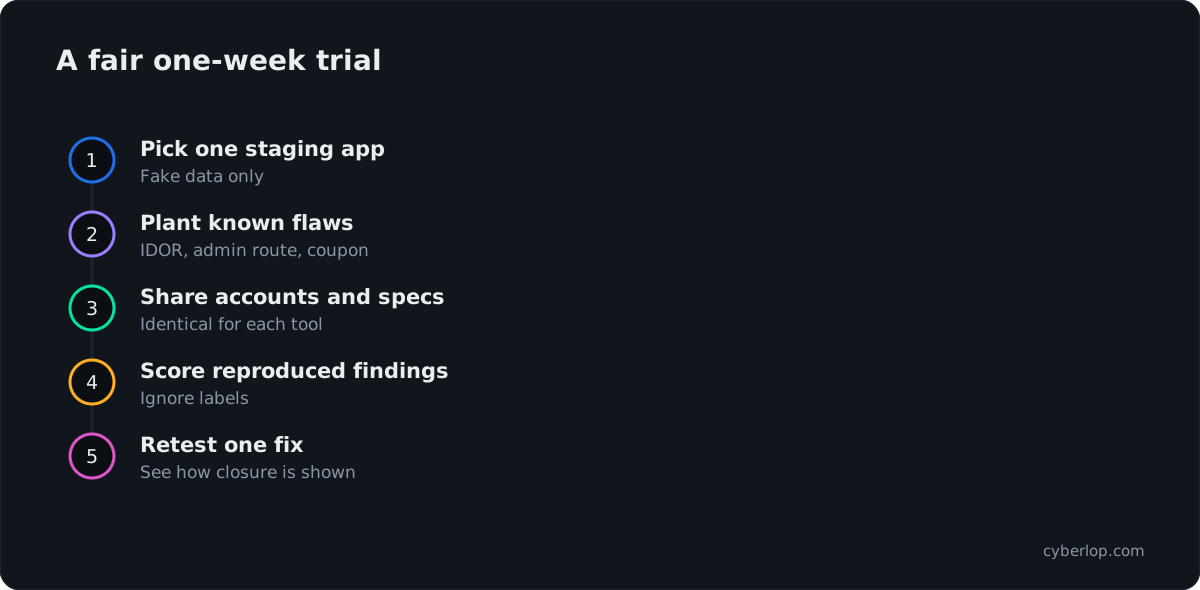
- Pick one staging app that holds fake data, because active scanners write to it.
- Plant three known flaws, such as an IDOR, a missing check on an admin route and a coupon that applies twice.
- Give every tool the same test accounts and the same API spec.
- Score each finding as reproduced, not reproduced or noise. Ignore severity labels until you have reproduced it.
- Fix one flaw and see how each tool shows it closed.
- Record setup hours as well as findings, because setup is a cost.
What to record
Keep a simple table of planted flaws found, noise per scan, minutes to configure sign-in and minutes to read a finding. Ask the vendor to show you in the trial what its site says it can do. Anything it cannot reproduce on your app stays a claim.
What mistakes do buyers make when replacing a DAST tool?
The common mistakes are comparing feature lists instead of results, ignoring who will operate the tool and expecting one scanner to cover everything.
Comparing logos instead of results
Vendor pages describe the same strengths in similar words: proof, low noise, developer-friendly. Only a trial on your app separates them.
Forgetting where scans run
An active scanner can create and delete data. StackHawk says so plainly in its docs. If your only environment is production, choose a tool built for that, or add a staging copy first.
Treating a scanner as a pentest
A scanner repeats known checks. A pentest follows your logic. See the web application penetration testing guide and our note on black, grey and white box testing.
So, which StackHawk alternative is right?
If developers own security and pull requests are where you test, StackHawk, Bright Security and Snyk API & Web belong on your shortlist. If a security team runs a large estate, add Invicti and Burp Suite DAST. If you want to tune it yourself, try ZAP. If you need findings that point to the file and line, with proof of exploit, add Cyberlop. Run the one-week trial before you commit to any of them.
Related reading: vulnerability scanners for startups and API security testing.
Questions people ask
Stackhawk alternatives: FAQs
What are the best StackHawk alternatives?
The main StackHawk alternatives are Bright Security, Snyk API & Web and Escape for developer-led teams, Invicti, Burp Suite DAST and Detectify for wider scanning, ZAP and Aikido for lower-effort starts, and Cyberlop for white-box pentesting with proof. Pick by owner, pipeline and the flaws you fear.
What is StackHawk?
StackHawk is a vendor of developer-focused DAST. Its docs describe HawkScan as a DAST tool built for developers that runs on a laptop, a server, Kubernetes or in a delivery pipeline, with the StackHawk Platform for findings.
Is StackHawk based on ZAP?
StackHawk's pages that we read do not say so, so we do not claim it. Aikido states that its DAST uses a subset of safe OWASP ZAP scans. Ask any vendor what engine sits underneath.
Is there a free alternative to StackHawk?
ZAP describes itself as free and open source, with Docker packaged scans, GitHub Actions and an Automation Framework. The cost is the time your team spends on setup, tuning and triage.
Can a DAST tool replace a penetration test?
Not on its own. A DAST tool repeats checks against a running app on a schedule or in CI. A pentest, or a white-box tool such as Cyberlop, follows business logic and proves what it exploited. Many teams use both.
How do I test a DAST tool fairly?
Use one staging app, the same test accounts, the same scope and three planted flaws. Score only findings you can reproduce, record setup time, and fix one flaw to see how each tool shows closure.
Which tool works best in pull requests?
StackHawk, Burp Suite DAST and Bright Security all describe CI and pull request use on their own sites. Which works best for you depends on your sign-in flow and API inputs, so trial it.
Where does Cyberlop fit next to StackHawk?
Cyberlop finds vulnerabilities in web apps and APIs with black-box, grey-box and white-box pentesting. In white-box mode a finding can point to the file and line. Many teams could run a CI scanner alongside it.
Sources
Where the facts come from
- StackHawk: home page
- StackHawk: product
- StackHawk docs: HawkScan overview
- StackHawk docs: authenticated scanning
- StackHawk docs: HawkScan configuration
- StackHawk docs: home
- Bright Security: home page
- Snyk: the future of DAST
- Escape: home page
- Invicti: home page
- Invicti: DAST
- PortSwigger: Burp Suite DAST
- Detectify: home page
- ZAP: home page
- ZAP: automation docs
- Aikido: DAST and surface monitoring
- Verizon: 2026 Data Breach Investigations Report
- OWASP: Top 10:2025, A01 Broken Access Control
- OWASP: API Security Top 10 2023
- CISA: Known Exploited Vulnerabilities Catalog
- IBM: Cost of a Data Breach Report 2026
Keep reading
Related articles
Aikido vs Snyk in 2026: coverage compared and how to choose
Aikido vs Snyk in 2026: SAST, SCA, DAST, containers, IaC and AI pentesting per each vendor's docs, what neither replaces, and a four-week trial.
API security testing: a 2026 guide to the OWASP API Top 10
A step-by-step API security testing guide: the OWASP API Top 10 (2023) with test cases, BOLA and BFLA checks, JWT, OAuth, GraphQL and a CI/CD plan.
Best API security testing tools in 2026: nine options and how to choose
Best API security testing tools in 2026, compared from vendor docs: DAST, open source, contract-first, runtime, plus a one-week bake-off.

Want findings that point to code?
Cyberlop finds vulnerabilities in your web app and APIs with black-box, grey-box and white-box testing, and reports only what it exploited, with the request, response and line of code. Ask us to run it on one of your applications.
Or start with a $199 pilot on one application: thirty days, success criteria agreed before day one, credited against the annual if you convert.