
Intruder is a cloud platform for exposure management: vulnerability scanning, attack surface monitoring, cloud checks and AI pentesting. Alternatives fall into five groups: infrastructure scanners (Nessus, InsightVM, OpenVAS), web and API scanners (Burp Suite DAST, Detectify), hosted toolboxes, open source (ZAP, Nuclei) and exploit-confirmed testing. Choose by what you must cover and prove.
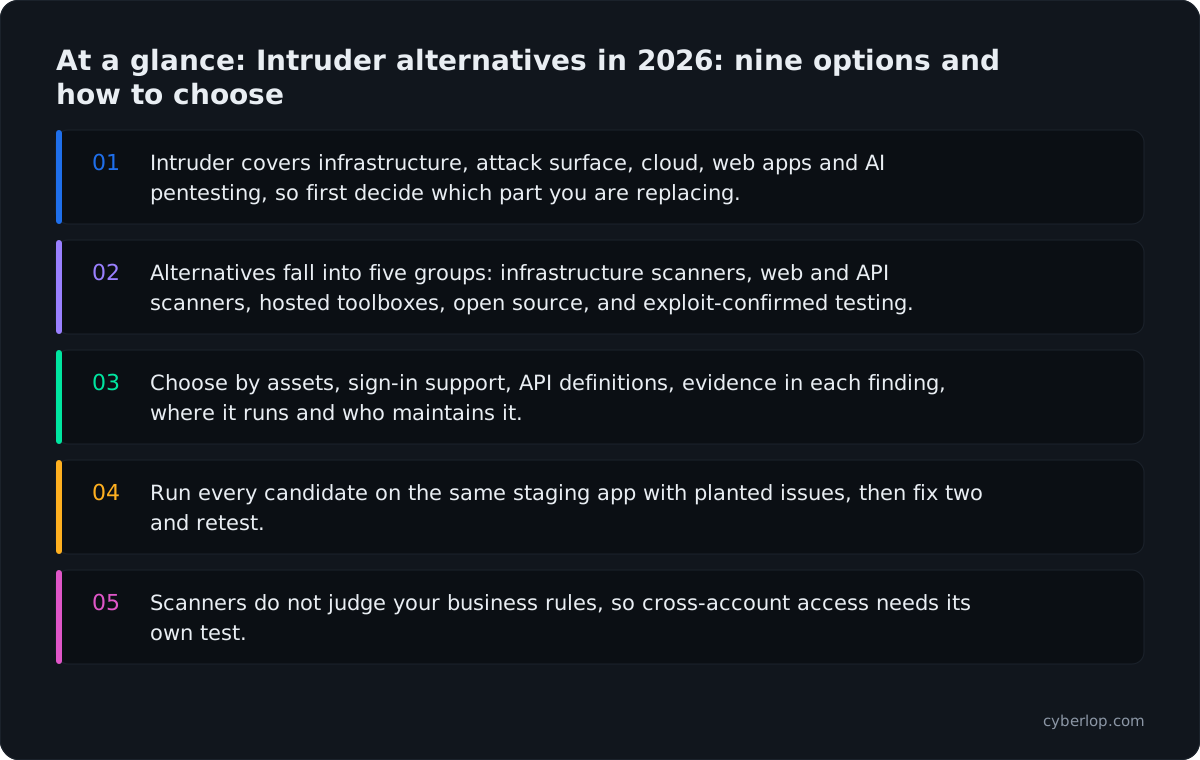
- Intruder covers infrastructure, attack surface, cloud, web apps and AI pentesting, so first decide which part you are replacing.
- Alternatives fall into five groups: infrastructure scanners, web and API scanners, hosted toolboxes, open source, and exploit-confirmed testing.
- Choose by assets, sign-in support, API definitions, evidence in each finding, where it runs and who maintains it.
- Run every candidate on the same staging app with planted issues, then fix two and retest.
- Scanners do not judge your business rules, so cross-account access needs its own test.
Intruder alternatives in 2026 fall into five groups: other infrastructure vulnerability scanners, scanners aimed at web apps and APIs, attack surface tools, open-source scanners you run yourself, and testing that proves a flaw by exploiting it. The right pick depends on what you need to cover, not on which tool has the longest feature list.
Intruder is, in its own words, "a single platform for AI pentesting, attack surface monitoring, cloud security and vulnerability management". This guide compares nine alternatives using only what each vendor publishes on its own site, docs or GitHub page, read on 7 October 2026. It names no prices (see each vendor's pricing page) and does not claim that one product beats another.
What is Intruder, and what does it cover?
Intruder is a cloud-delivered exposure management platform. Its home page lists five jobs: AI pentesting, attack surface monitoring, cloud security, vulnerability management and application security. Knowing that spread is the first step, because an alternative may need to match all of it or only one part.
What the product does, per the vendor
The table below restates the Intruder home page and the vendor's pages on its network vulnerability scanner and attack surface management.
| Area | What Intruder says |
|---|---|
| Infrastructure scanning | Scans internet-facing systems, "web applications, ports, and any assets reachable from the internet"; "140,000+ infrastructure checks"; recurring scans at flexible intervals. |
| Internal scanning | An agent-based approach: software on each Windows, Linux or macOS device you want scanned. The vendor states that it cannot assess "internal network devices like printers, routers, and switches". |
| Web applications | Dynamic testing of web apps and single-page apps, "including authenticated scanning behind login pages"; "over 75 application checks"; dedicated API testing. |
| Attack surface | Subdomain discovery, change detection that scans new assets, and cloud connectors for AWS, Google Cloud, Cloudflare and Azure. |
| Cloud and containers | Agentless scanning across AWS, Azure and Google Cloud for misconfigurations; container image scanning with registry integration. |
| AI pentesting | "White-box web application pentesting" connected to GitHub, GitLab, Azure DevOps or Bitbucket Cloud; "No lead times or scoping"; same-day reports; unlimited retesting. |
Where Intruder fits well
Intruder fits teams that want one cloud service watching their internet-facing estate and re-scanning when something changes. The vendor says emerging threat scans start "within hours of new critical vulnerabilities going public". It lists integrations with AWS, Google Cloud, GitHub, GitLab, Jira, Azure DevOps, Slack and Microsoft Teams. Compliance mentions include SOC 2, ISO 27001, PCI DSS, HIPAA and DORA.
Why do teams look for Intruder alternatives?
Teams look for alternatives when the job changes, not because a scanner has failed. Five triggers come up most often, and each one points to a different kind of replacement.
Five common triggers
1. You need to scan inside the network
Intruder's internal scanning is agent-based, and the vendor says it does not assess printers, routers or switches. If your estate is mostly office and datacentre equipment, compare scanners built for that, such as Nessus, InsightVM or OpenVAS below.
2. You want deeper web-app and API testing
A crawl-and-check scanner finds known classes of issue. If you need a tool tuned for authenticated, multi-step application flows, compare dedicated DAST such as Burp Suite DAST or Detectify's application scanning.
3. You want to own and tune the engine
Open-source scanners let you read the checks, write your own and run everything on your own hardware. ZAP and Nuclei are the usual starting points.
4. You buy for many clients
Agencies and managed providers need multi-client reporting and their own branding. HostedScan names MSPs and MSSPs as target users, and agencies and MSSPs can run Cyberlop under their own brand.
5. You need proof of exploitation, not a scan result
Scanners report what they detect. Some buyers, or their auditors, want each finding shown by a request, a response and a screenshot. That is a different kind of test, covered in the penetration-testing group below.
Why does scanner choice matter in 2026?
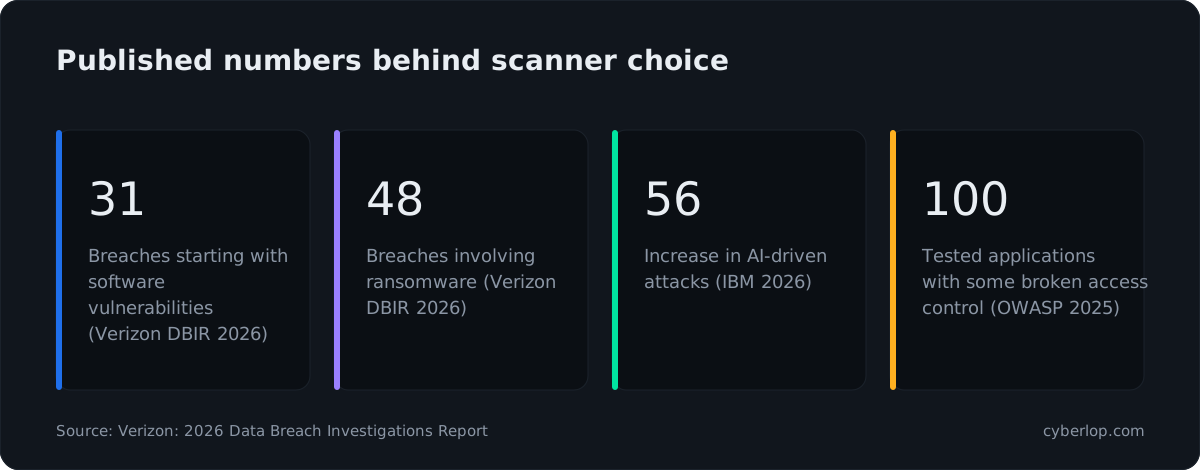
It matters because exposed software flaws are now the leading way into organisations. The Verizon 2026 Data Breach Investigations Report reports that 31% of breaches now start with a software vulnerability, ahead of stolen passwords as the top way in. The same report says ransomware is involved in 48% of breaches.
Attackers also move faster. IBM's 2026 Cost of a Data Breach report cites a 56% increase in AI-driven attacks. CISA's Known Exploited Vulnerabilities catalog held 1,734 entries on 7 October 2026. The newest, a Citrix NetScaler flaw, was added three days earlier.
At application level, the OWASP Top 10:2025 keeps Broken Access Control at number one, having found some form of it in 100% of the applications tested. That flaw is about who may reach what. A scanner that checks patch levels and known signatures cannot judge your rules, so keep that in mind as you read the groups below. See the Knowledge Hub on broken access control and the KEV catalogue.
Which kinds of Intruder alternative exist?
There are five kinds, and they answer different questions. Pick the kind before you pick the product.
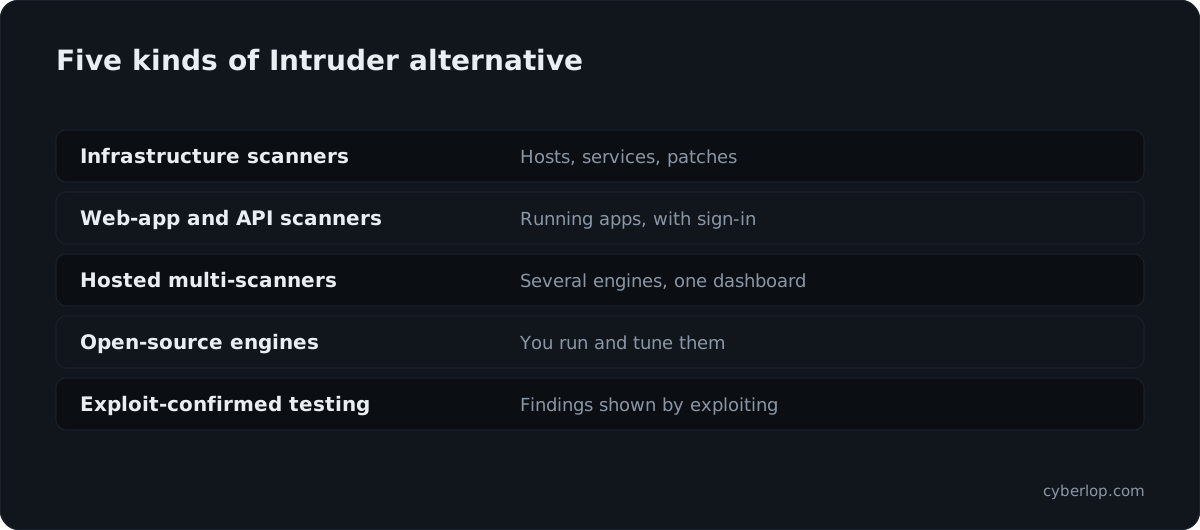
- Infrastructure scanners (Nessus, InsightVM, OpenVAS): hosts, services, patches, configuration.
- Web-app and API scanners (Burp Suite DAST, Detectify, Pentest-Tools.com): running applications, with sign-in.
- Hosted multi-scanner services (HostedScan): several open-source engines behind one dashboard.
- Open-source engines (ZAP, Nuclei, OpenVAS): you run and tune them.
- Exploit-confirmed testing (Cyberlop, Pentest-Tools.com's exploit tools, Intruder's own AI pentesting): findings shown by exploiting them.
For the wider field of web and API scanners, see our guide to the best DAST tools. For tools that test like a pentester, see the best AI pentesting tools.
Which are the best Intruder alternatives in 2026?
Nine are worth a look, grouped by the job they do. The order is by fit for the reader, not by merit, and each entry says where the tool genuinely wins and who it suits.
Infrastructure and network vulnerability scanners
Nessus (Tenable)
Nessus is, per Tenable's product page, a vulnerability assessment solution sold as Nessus Professional and Nessus Expert. It covers operating systems, devices and applications, the external attack surface, and configuration and compliance audits. Tenable cites "117 K+ CVEs" and "319 K+ plugins" with "100+ new plugins released weekly". You can deploy it on a range of platforms, "including Raspberry Pi".
It wins on breadth across hosts and devices, backed by a long-established plugin library, and fits teams that run their own scanner on internal and external networks. See also the vendor's Web App Scanning, which states it provides dynamic testing (DAST) and does not perform static code analysis.
InsightVM (Rapid7)
InsightVM is, per Rapid7's page, vulnerability management now connected into the Exposure Command platform. It covers on-premises infrastructure, cloud environments and containerised applications, with agent-based and agentless scanning engines, and supports remediation projects and workflows.
Its strength is remediation tracking across a large estate. Organisations that already use Rapid7 tooling, or want vulnerability management tied into one exposure view, will feel at home.
OpenVAS (Greenbone)
Greenbone describes OpenVAS as "the World's Most Widely Used Open-Source Vulnerability Management System", with a free community edition (OPENVAS FREE) and commercial editions. It tests desktops, servers, appliances and components such as routers or VoIP devices. The vendor's enterprise feed is "a collection of over 100,000 vulnerability tests". Deployment options are hardware appliances, virtual machines and cloud services.
The draw is an open-source core with a commercial path and coverage of network devices. Expect to run and maintain the scanner yourself.
Web-app, API and hosted scanners
Burp Suite DAST (PortSwigger)
Burp Suite DAST is an enterprise DAST platform "built on the same scanning engine" as Burp Suite Professional. It uses a Chromium crawler for JavaScript single-page apps, carries authenticated state across a scan, and supports Postman Collections, OpenAPI, SOAP and GraphQL. Pipelines can start scans from Jenkins, GitHub Actions, GitLab CI or Azure DevOps. You can use it as a hosted service, host it yourself on Windows or Linux, or deploy it on Kubernetes.
Application depth and self-hosting are its edge, and security teams that already trust Burp for manual work get scheduled scanning on the same engine. Compare it with ZAP in Burp Suite vs OWASP ZAP.
Detectify
Detectify "combines continuous attack surface discovery with deep application security testing". Its Surface Monitoring maps external assets; Application Scanning does authenticated DAST; API Scanning uses payload-based testing. It cites research by "400+ elite ethical hackers", and lists internal scanning and PCI ASV scanning. It is the closest in shape to Intruder; our Detectify alternatives guide covers it in more depth.
Detectify's edge is researcher-sourced checks that are not tied to public CVEs. Pick it if you want an attack surface view and application scanning in one product.
Pentest-Tools.com
Pentest-Tools.com calls itself "a cloud-based autonomous penetration testing and vulnerability scanning platform". It offers a website scanner, network scanner, API scanner, cloud scanner and Kubernetes scanner, plus exploit tools for SQL injection and cross-site scripting. It captures screenshots and request/response pairs as evidence, supports authenticated scanning and internal testing via VPN, and produces reports aimed at frameworks such as SOC 2 and ISO 27001.
It mixes scanning with safe exploitation in one toolbox, which pentesters, consultancies and small security teams can pick from job by job.
HostedScan Security
HostedScan bundles six engines: Greenbone OpenVAS, Tenable Nessus, OWASP ZAP, Nuclei, Nmap and SSLyze, for websites, servers, networks and APIs. It lists MSPs and MSSPs among its target users and offers APIs and webhooks.
The appeal is several engines in one hosted dashboard, with little set-up, for small IT teams and managed providers.
Open-source scanners you run yourself
ZAP and Nuclei
ZAP describes itself as "The world's most widely used web app scanner. Free and open source", with automation options and a marketplace of add-ons. The site says it is now maintained by Checkmarx while keeping independent open-source governance. Nuclei is a scanner driven by YAML templates under the MIT licence, covering HTTP, DNS, TCP, SSL, WHOIS, JavaScript, code and WebSocket, and designed for CI pipelines.
Both give you transparency and control, and both assume you have engineering time to configure, tune and triage. For a wider look, see open-source AI pentesting tools.
Exploit-confirmed testing
Cyberlop
Cyberlop finds vulnerabilities in web apps and their APIs with black-box, grey-box and white-box pentesting. In white-box mode it reads your code while testing the running app, so a finding can point to the file and line. It reports what it actually exploited: each finding carries the request, the response, a screenshot where a person can see it, and the line of code. Severity and confidence are kept apart, and findings carry CWE and OWASP references.
It also checks business-logic flaws and cross-account access, meaning one signed-in account reaching another's data or functions. A fix is proven by re-running the exact exploit against the new code. It can run inside your own network, on a schedule or in CI/CD, and agencies and MSSPs can run it under their own brand.
It is not the answer for everything: it tests web apps and APIs. It does not replace scanning hosts, devices or cloud configuration, a job for tools such as Nessus, InsightVM or Intruder's infrastructure scanner.
How do the alternatives compare side by side?
The table shows what each vendor says it covers. "Not stated" means the vendor page we read did not describe it, not that the tool cannot do it, so check the vendor before you decide.
Comparison of scope, from each vendor's own pages
| Tool | Hosts and network | Web apps | APIs | Deployment | Proof by exploiting |
|---|---|---|---|---|---|
| Intruder | External and agent-based internal | Authenticated DAST | Dedicated testing | Cloud service | AI pentesting product |
| Nessus | Yes | Web scanning | Not stated | Self-run | Not stated |
| InsightVM | Yes | Not stated | Not stated | Agent and agentless | Not stated |
| OpenVAS | Yes, incl. devices | Not stated | Not stated | Appliance, VM, cloud | Not stated |
| Burp Suite DAST | Not stated | Yes | OpenAPI, SOAP, GraphQL | Cloud, self-hosted, Kubernetes | Not stated |
| Detectify | Attack surface | Authenticated DAST | Yes | Cloud service | "Prove what is actually exploitable" |
| Pentest-Tools.com | Network scanner | Yes | Yes | Cloud service | Exploit tools |
| HostedScan | Yes | Yes (ZAP) | Yes | Hosted | Not stated |
| ZAP / Nuclei | Nuclei protocols | Yes | Not stated | Self-run | Not stated |
| Cyberlop | Out of scope | Yes | Yes | Can run inside your network | Reports what it exploited |
How do you choose an Intruder alternative?
Choose by the thing you must be able to answer after the scan, not by the feature count. Start from your assets, then your accounts, then the evidence your team or auditor will accept.
Seven criteria that separate the options
1. What are you protecting?
List hosts, devices, cloud accounts, web apps and APIs. Infrastructure scanners cover the first three; DAST and exploit-confirmed testing cover the last two. Most teams need two kinds of tool, and that is normal.
2. Can it sign in to your application?
Most of an application sits behind a login. Ask each vendor to scan with a test account on your staging copy, including your single sign-on and multi-factor steps. Read authenticated scanning before you start.
3. Does it understand your API definitions?
If you ship an OpenAPI or GraphQL schema, check that the tool reads it. Our API security testing guide lists the checks worth running.
4. What does a finding contain?
A finding with a request, a response and reproduction steps can be fixed quickly. A line saying "possible issue" cannot. Compare how each tool handles false positives and whether it offers a proof of exploit.
5. Where does it run, and where does your data go?
Cloud services are quick to start. Self-hosted and in-network options keep code and traffic inside your boundary. Check this against your customer contracts and your DPDP Act or other regulatory duties.
6. How does it fit your pipeline?
To gate a build, confirm CI/CD support in the vendor's docs rather than the sales deck, then run the tool on a pull request.
7. Who maintains it?
Open-source tools cost engineering time instead of licence fees. Count the hours for tuning, upgrades and triage. Paid products shift that time to the vendor; compare their pricing pages.
Which tool for which need?
Use this table as a starting shortlist, then test two or three on your own app.
| If you need… | Look at | Why, per the vendor |
|---|---|---|
| Internal and device scanning | Nessus, InsightVM, OpenVAS | Built around hosts, devices and configuration audits |
| Authenticated web-app scanning at scale | Burp Suite DAST, Detectify | Session-aware crawling; authenticated DAST |
| A mixed toolbox with evidence capture | Pentest-Tools.com | Scanners plus exploit tools and screenshots |
| Several free engines behind one dashboard | HostedScan | Bundles OpenVAS, Nessus, ZAP, Nuclei, Nmap, SSLyze |
| Full control and no licence | ZAP, Nuclei, OpenVAS | Open source; you run them |
| Cross-account and business-logic testing with code-level findings | Cyberlop | Exploit-confirmed findings, white-box line of code |
| Stay with one vendor | Intruder | Attack surface, cloud, vulnerability management and AI pentesting together |
How do you run a fair side-by-side trial?
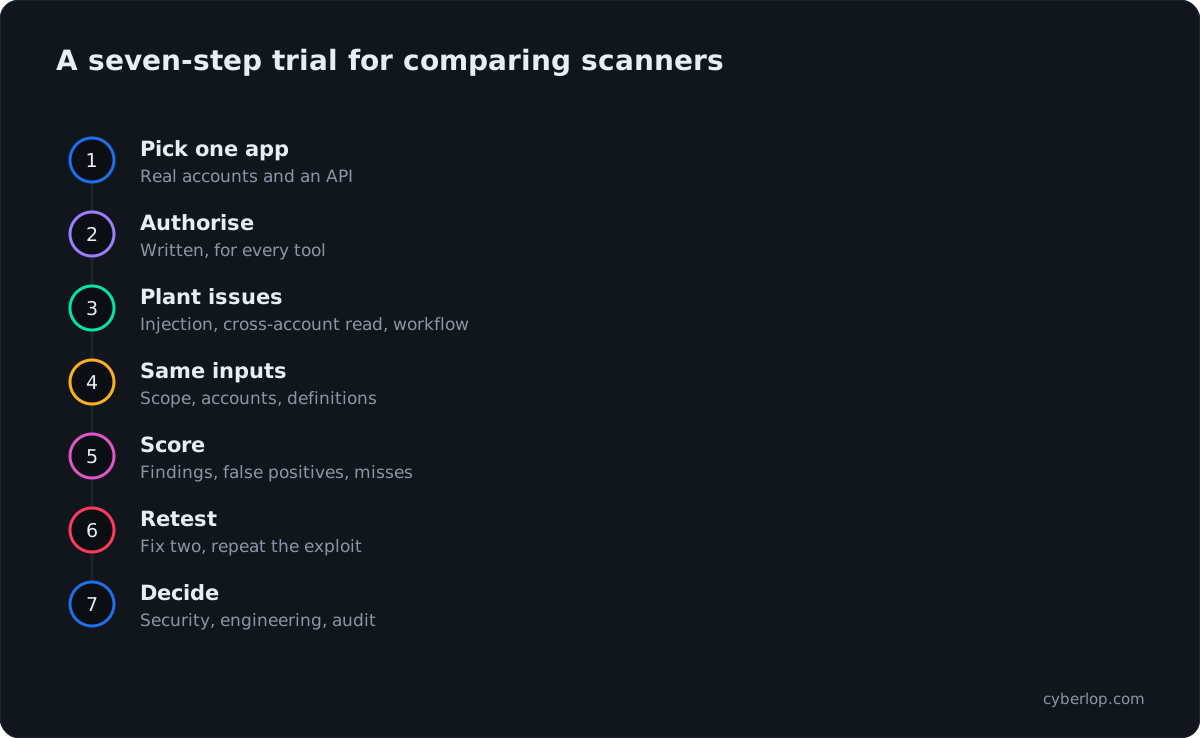
Give every tool the same inputs on the same application, and score the results against issues you already know about. A trial takes about two weeks and removes most of the guesswork.
- Pick one application with real accounts and an API. A staging copy with test data is fine.
- Get written authorisation for each tool, including open-source ones, and tell your hosting provider if it asks.
- Plant three known issues: one injection, one cross-account read (one test user opening another's record) and one broken workflow.
- Give each tool the same scope, accounts and API definitions.
- Score real findings, false positives and misses, and how long triage took.
- Fix two findings and retest. Note whether the tool re-runs the exact exploit or only re-scans.
- Decide with engineering, security and audit in the room, and write down the reason.
Run it again after a major release. A tool that fits at ten endpoints may not at five hundred.
Where does Cyberlop fit among Intruder alternatives?
Cyberlop fits when the question is "can someone reach what they should not in our application, and can we prove the fix?". It is one option among several here, and it sits beside an infrastructure scanner, not instead of one.
It suits three cases. First, your main risk is in the application layer: a coupon applied twice, or one customer's invoice opened by another. These are business-logic flaws and cross-account access problems. Second, you need evidence your auditor or customer can read, for SOC 2 or ISO 27001. Third, you want a closed-loop retest, where the exact exploit is re-run against the new code.
Read how to read a finding and exploited, not suspected to see what that evidence looks like, and what Cyberlop does not do. Agencies can see the partner programme.
Can you keep Intruder and add another tool?
Yes. A vulnerability management scanner watches the estate; an application test goes deep on one app. Keeping Intruder for exposure and cloud checks while adding an application-layer test is a common shape.
A simple layered set-up
| Layer | Question it answers | Cadence |
|---|---|---|
| Attack surface and infrastructure | What is exposed, and is it patched? | Continuous or weekly |
| Web-app and API scanning | Do known weakness classes exist in the running app? | Every release or nightly |
| Exploit-confirmed testing | Can one account reach another's data, and does the fix hold? | Per major change, plus a scheduled run |
For a view of how a continuous model sits with an annual test, read continuous penetration testing. For startups choosing a first scanner, see best vulnerability scanners for startups.
What should you do this week?
Write down your assets in one list, mark which are hosts and which are applications, and shortlist two tools for each group. Then book the trial above. Nothing here needs a purchase to start, since the open-source tools are free to run.
Questions people ask
Intruder alternatives: FAQs
What are the best Intruder alternatives in 2026?
It depends on the job. For hosts and devices, look at Nessus, InsightVM or OpenVAS. For authenticated web apps and APIs, look at Burp Suite DAST or Detectify. For a toolbox with exploit tools, look at Pentest-Tools.com. For free engines, look at ZAP, Nuclei or HostedScan. For cross-account and business-logic testing, add Cyberlop.
What is Intruder used for?
Intruder is a cloud platform for exposure management. Its site lists AI pentesting, attack surface monitoring, cloud security, vulnerability management and application security. Teams use it to scan internet-facing systems, watch for new assets, and re-scan when something changes.
Is there a free alternative to Intruder?
Yes, in part. ZAP, Nuclei and Greenbone's OPENVAS FREE are open source. HostedScan bundles several engines in a hosted service. Free tools cost engineering time for set-up, tuning and triage, so count that time before you call them free. See each vendor's pricing page for paid plans.
Does Intruder scan inside my network?
Yes, through an agent. The vendor says internal scanning needs software on each Windows, Linux or macOS device, and that it cannot assess internal network devices such as printers, routers and switches. If you need device coverage, compare Nessus, InsightVM or OpenVAS.
Can a vulnerability scanner replace a penetration test?
Not on its own. A scanner reports what it detects against known checks. A penetration test confirms a flaw by exploiting it, and covers rules specific to your app, such as who may open whose invoice. Many teams run both, and some tools blend the two. See our guide to continuous penetration testing.
How do I compare Intruder with its alternatives fairly?
Give each tool the same application, accounts and API definitions. Plant a few known issues, score findings and false positives, then fix two and retest. Use only the vendor's own docs for feature claims, and ask for a trial on staging.
Can Cyberlop replace Intruder?
Not for everything. Cyberlop tests web apps and their APIs and reports what it exploited. It does not scan hosts, devices or cloud configuration. Teams often keep an infrastructure or exposure scanner and add application-layer testing next to it.
Do I need written permission to run these tools?
Yes. Scanning or testing a system you do not own, or have no written authority over, can be illegal. Get written permission for each tool and each target, and use a staging copy with test data where you can.
Sources
Where the facts come from
- Intruder: home page
- Intruder: network vulnerability scanner
- Intruder: attack surface management
- Intruder: AI pentesting
- Tenable: Nessus
- Tenable: Web App Scanning
- Rapid7: InsightVM
- Greenbone: OpenVAS
- PortSwigger: Burp Suite DAST
- Detectify: home page
- Pentest-Tools.com: home page
- HostedScan Security: home page
- ZAP: home page
- ProjectDiscovery: Nuclei repository
- Verizon: 2026 Data Breach Investigations Report
- IBM: Cost of a Data Breach Report 2026
- CISA: Known Exploited Vulnerabilities catalog
- OWASP: Top 10:2025, A01 Broken Access Control
Keep reading
Related articles
API security testing: a 2026 guide to the OWASP API Top 10
A step-by-step API security testing guide: the OWASP API Top 10 (2023) with test cases, BOLA and BFLA checks, JWT, OAuth, GraphQL and a CI/CD plan.
Best AI pentesting tools in 2026: ten compared, and how to choose
Ten AI pentesting tools compared from vendors' own sites, with a scoring sheet, a table by category and a plan for a fair trial on your own app.
Best DAST tools 2026: twelve compared and how to choose
Twelve DAST tools compared from vendor docs: authentication, APIs, CI/CD, proof and deployment, plus a decision table and a one-week bake-off.

Test one app, compare the proof
Cyberlop finds vulnerabilities in web apps and their APIs with black-box, grey-box and white-box pentesting, and reports only what it exploited, with request, response and the line of code. Ask us to run it on one of your applications.
Or start with a $199 pilot on one application: thirty days, success criteria agreed before day one, credited against the annual if you convert.