
Home / Blog / Detectify alternatives
Compare
Detectify alternatives in 2026: 8 options compared by need
Detectify combines external attack surface monitoring with payload-based scanning. Here are the alternatives worth testing, who each suits, and how to choose.
Cyberlop Labs · Updated · 12 min read
Detectify alternatives in 2026 include Intruder (infrastructure plus web), Invicti and Burp Suite DAST (large portfolios), StackHawk (CI), Escape (business logic and APIs), ZAP (free), ProjectDiscovery (open source) and Cyberlop (exploit-proven findings with code lines). Choose by the job you need done, then trial two tools on one real app.
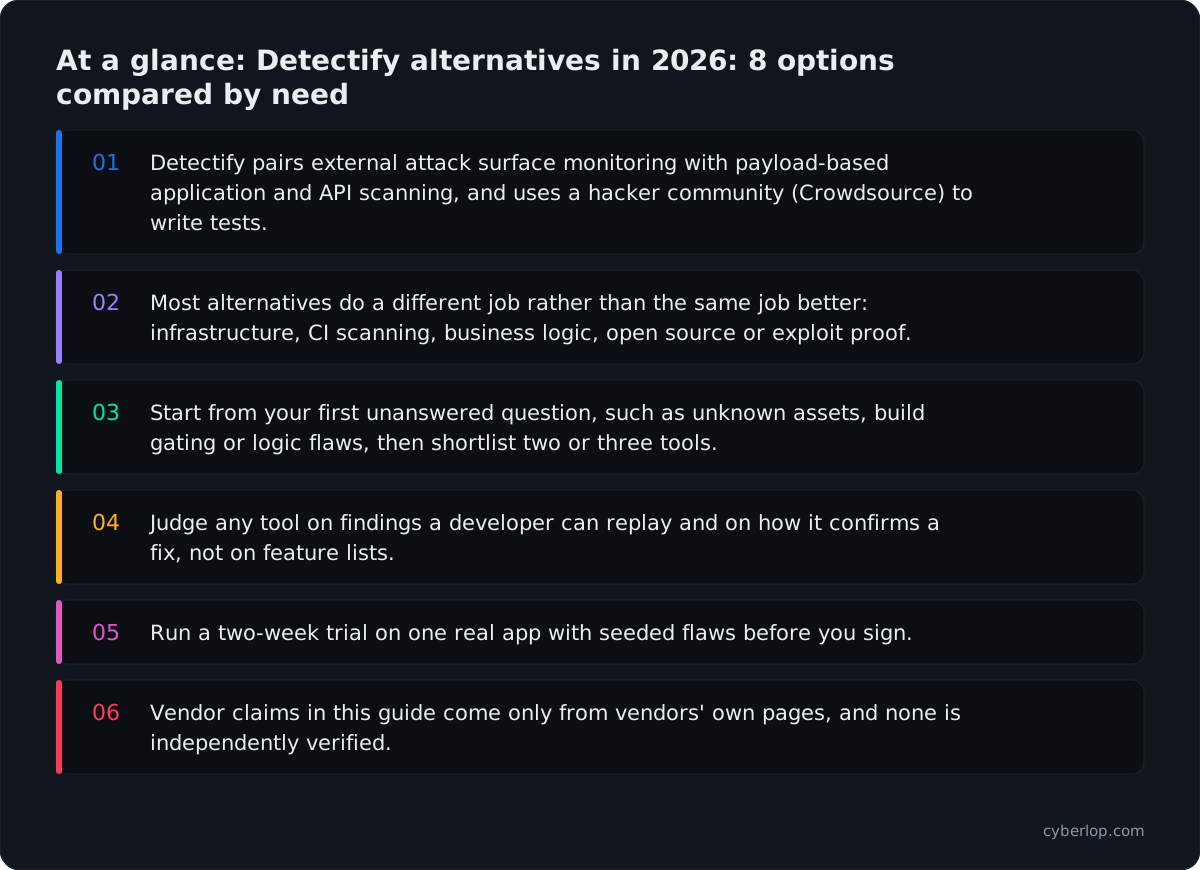
- Detectify pairs external attack surface monitoring with payload-based application and API scanning, and uses a hacker community (Crowdsource) to write tests.
- Most alternatives do a different job rather than the same job better: infrastructure, CI scanning, business logic, open source or exploit proof.
- Start from your first unanswered question, such as unknown assets, build gating or logic flaws, then shortlist two or three tools.
- Judge any tool on findings a developer can replay and on how it confirms a fix, not on feature lists.
- Run a two-week trial on one real app with seeded flaws before you sign.
- Vendor claims in this guide come only from vendors' own pages, and none is independently verified.
The best Detectify alternatives in 2026 depend on what you need from it: Intruder for external infrastructure plus web apps, Invicti or Burp Suite DAST for large portfolios, StackHawk for scans inside CI, Escape for business-logic and API depth, ZAP for a free option, and Cyberlop when you want exploit proof tied to a line of code. Detectify is a web security scanner that combines external attack surface monitoring with payload-based application scanning. This guide uses each vendor's own pages and shows where each tool genuinely fits.
What is Detectify and what does it do?
Detectify is an application security product that, in its own words, is "Application security built and trusted by hackers." It combines continuous discovery of your external assets with DAST-style testing of the applications it finds. (Detectify home page, read 7 October 2026.)
Before you replace a tool, know exactly what it does for you today. That makes any comparison fair, and it shows which of its jobs you still need covered.
What products does Detectify list?
Detectify's home page lists several products under one platform. The four most relevant to this comparison are below.
Surface Monitoring
Detectify says Surface Monitoring "continuously discovers and maps every asset" across your external attack surface and runs payload-based tests on all of them. It maps domains, subdomains, IPs, technologies, ports and protocols, and says new assets are scanned the moment they appear (Detectify: Surface Monitoring). The home page also cites "600+ subdomain takeover discovery methods". See attack surface and subdomain takeover if the terms are new.
Application Scanning
Detectify describes Application Scanning as "deep, authenticated DAST testing at scale", with advanced crawling and dynamic fuzzing (Detectify: Application Scanning). Its help centre lists articles on scanning behind a login and on recorded logins (Detectify support).
API Scanning
Detectify says API Scanning "covers REST and GraphQL" and tests APIs "using 100% payload-based techniques and our dynamic fuzzing engine" (Detectify: API Scanning).
Internal Scanning
Detectify lists Internal Scanning as a way to "extend coverage beyond the perimeter to internal systems and services" (Detectify: Internal Scanning). The page is brief, so ask Detectify for current deployment details.
The home page also lists PCI ASV Scanning, an MCP Server for AI agents and a developer API for the attack surface data (Detectify developer docs).
How do Crowdsource and Alfred AI work?
Detectify's distinctive idea is that ethical hackers write many of its tests. Crowdsource researchers "find vulnerabilities in widely used systems, such as a CMS, framework, or library" and submit a proof of concept. Once accepted internally, it is "built into the scanner so all customers get access to this" (Detectify: Crowdsource).
Detectify also describes Alfred AI as "our LLM agent chain that turns new CVE research into live scanner tests" (Detectify: Alfred AI). Detectify's own claim is that "99% of vulnerabilities we find aren't covered by a CVE"; that is a vendor figure, not an independent one.
This is a real strength: fast coverage of newly disclosed CVEs in third-party software, on assets you may have forgotten you own. Keep that in mind when you read the alternatives below, because most of them do something different, not the same thing better.
Why do teams look for Detectify alternatives?
Teams usually look beyond Detectify because their question changed, not because the tool failed. A scanner that finds exposed assets and known weaknesses answers one question. These are the questions that send buyers shopping:
- "Can it run on every pull request?" Developer-led teams want scans as a step in CI/CD that can fail a build.
- "Does it understand our business rules?" A scan that sends payloads can miss a coupon applied twice or one account reading another's invoice. See business-logic flaws and cross-account access.
- "Can the finding point at our code?" Black-box tools see the running app. Engineers often want the file and line.
- "Can it run inside our network?" Some buyers need the scanner or the code to stay in their own environment.
- "Does it cover our internal and infrastructure assets as well as web?" Some teams want one platform for both.
- "Do we need a free or open-source option for part of the estate?"
Detectify may answer several of these today. Its pages are the place to confirm, so put each bullet to Detectify as a question in your evaluation. Third-party review sites also publish user opinions, but this guide takes vendor facts only from vendors' own pages.
What are the best Detectify alternatives in 2026?
Eight options cover most buying needs. The table summarises each vendor's own description; the sections after it explain who each suits.
Detectify alternatives at a glance. Descriptions paraphrase each vendor's own pages, read 7 October 2026.
| Tool | How the vendor describes it | Suits you if |
|---|---|---|
| Intruder | "A single platform for AI pentesting, attack surface monitoring, cloud security and vulnerability management." | You want external surface, infrastructure and web apps in one place |
| Invicti | DAST with proof-based validation, plus SAST, SCA and more in one platform | You run a large portfolio and want one vendor for several scan types |
| Burp Suite DAST | "The same scanning engine your pentesters trust in Burp Suite Professional", across a portfolio | Your pentesters already use Burp and you want scheduled scans at scale |
| StackHawk | Tests your running app inside the developer and agent loop | Developers own security and you want scans in CI |
| Escape | Business-logic-aware DAST, AI pentesting and attack surface management | Your risk is in workflows, access control and APIs |
| ZAP | "Free and open source" web app scanner | You have engineers to run and tune it and want no licence |
| ProjectDiscovery | Maker of Nuclei and other open-source tools, plus a cloud platform and an AI pentesting product | Your team likes open-source building blocks and templates |
| Cyberlop | Black-box, grey-box and white-box pentesting that reports only what it exploited | You want proof, a line of code and a retest that replays the exploit |
Order here is by who they suit, not by merit. Details below. For a wider list of scanners, see our best DAST tools guide.
Which alternative fits which need?
Intruder: external infrastructure and web apps together
Intruder says its platform covers external attack surface, continuous scanning of "infrastructure, apps and cloud environments", agentless cloud scanning across AWS, Azure and Google Cloud, and continuous DAST for web apps, single-page apps and underlying infrastructure, including "authenticated scanning behind login pages" (Intruder). It lists 15+ integrations including GitHub, Jira, Slack and Microsoft Teams.
Pick it if you want infrastructure and web coverage in one console, with ticketing built in. Our Intruder alternatives guide covers the reverse question.
Invicti: proof-based DAST inside a wider platform
Invicti lists DAST, SAST and SCA, plus IaC, secrets, container and API security testing, unified in one view (Invicti). It describes its DAST as proof-based validation and quotes a Miercom confirmation of accuracy; treat that as the vendor's claim and ask for the report. It also names an agentic pentesting product, Octo.
Larger teams that want several scan types and prioritisation from one vendor are its natural buyers. If you are also weighing Acunetix, see Acunetix alternatives.
Burp Suite DAST: pentester engine, run at scale
PortSwigger says Burp Suite DAST runs "the same scanning engine your pentesters trust in Burp Suite Professional" across a whole portfolio. It describes session-aware authenticated scanning, a Chromium crawler for JavaScript single-page apps, API coverage including OpenAPI, Postman Collections, SOAP and GraphQL, and CI steps that "gate merges by severity". Deployment options listed are Cloud, self-hosted and Kubernetes (PortSwigger: Burp Suite DAST).
Security teams with Burp experience get scheduled, role-controlled scanning across many sites. See Burp Suite vs ZAP.
StackHawk: scanning in the developer loop
StackHawk says it "integrates into the agent loop" to test your running app, find what is exploitable and fix it. Its documentation covers authenticated scanning (form-based, OAuth, scripts), CI guides for GitHub Actions, GitLab and Jenkins, and OpenAPI, GraphQL, gRPC, JSON-RPC and SOAP configuration, all driven by a YAML file (StackHawk; StackHawk docs).
It suits developer-owned security where the scan is a build step. Read StackHawk alternatives for the other direction.
Escape: business logic and APIs
Escape lists "business-logic-aware DAST" for testing "workflows, access control, and multi-step processes", an AI pentesting product that "learns your business, proves exploitability, and delivers reports", and attack surface management. It names OAuth, SSO and multi-tenant authentication scenarios, and integrations with AI coding tools such as Cursor, Claude Code and Gemini (Escape).
It suits teams whose main risk sits in API and workflow behaviour. Our API security testing tools guide compares more options.
ZAP: free, open source, bring your own effort
ZAP describes itself as "the world's most widely used web app scanner. Free and open source", an independent project with automation options and community add-ons (ZAP). There is no licence cost on its site, but your team supplies setup, tuning, hosting and triage time.
Engineers who want control and will maintain the setup get the most from it. Many teams use it beside a commercial tool.
ProjectDiscovery: open-source building blocks
ProjectDiscovery says it is "built by the team behind nuclei, subfinder, httpx" and maintains "20+ open-source tools", with a cloud platform and an AI pentesting product named Neo. Its pages say findings include proof-of-concept evidence (ProjectDiscovery).
Teams that like composable tooling and template-driven checks can fold the output into their own workflow.
Where does Cyberlop fit among Detectify alternatives?
Cyberlop is a different kind of option, not a drop-in replacement for external attack surface monitoring. It finds vulnerabilities in web apps and their APIs with black-box, grey-box and white-box pentesting.
- Proof, not suspicion. It reports what it actually exploited. Each finding carries the request, the response, a screenshot where a person can see it, and the line of code. If we did not break it, we do not report it. See exploited, not suspected and proof of exploit.
- Code-aware. In white-box mode it reads your code while testing the running app, so a finding can point to the file and line.
- Logic and access. It checks business-logic flaws and cross-account access: one signed-in account reaching another's data or functions.
- Fix proof. A fix is proven by re-running the exact exploit against the new code, a closed-loop retest, not by a fresh scan.
- Where it runs. It can run inside your own network (private scanning), on a schedule or in CI/CD, and agencies can run it under their own brand.
It does not claim to replace a monitor that discovers forgotten subdomains. Many teams would pair an external-surface tool with application testing. See our AI pentesting tools guide and the compare page.
How do you choose a Detectify alternative?
Choose by the job you need done, then test on your own app. Use these criteria in order; most buyers can eliminate half the list after the first two.
What criteria should you score?
1. Scope: external surface, web apps, APIs or all three
Write down what you must cover. A tool built to map assets differs from one built to test a login-protected workflow. Attack surface discovery and application testing are two jobs.
2. Authentication and access
Ask how the tool handles login, SSO, multi-factor prompts and several accounts. Authenticated scanning decides whether it reaches most of your app.
3. Proof and noise
Ask what a finding contains, and how the vendor handles a false positive. A request-and-response a developer can replay saves hours.
4. Developer fit
Check CI/CD support, ticketing integrations and whether findings reach the person who fixes them. See continuous penetration testing.
5. Data handling and deployment
Ask where scans run, where results are stored and whether code leaves your network. Privacy needs can rule options in or out.
Which tools to shortlist for common situations. Based on vendor pages read 7 October 2026.
| Your situation | Look first at | Why |
|---|---|---|
| Unknown subdomains and forgotten assets | Detectify, Intruder, ProjectDiscovery | Their pages list asset discovery and monitoring |
| Scans must gate pull requests | StackHawk, Burp Suite DAST, Cyberlop | Each describes CI use |
| Many sites, role-based control | Burp Suite DAST, Invicti | Portfolio features are described on their pages |
| Workflow and access-control flaws | Escape, Cyberlop | Both describe logic or access testing |
| Finding must name the code | Cyberlop in white-box mode | It reads the code while testing the running app |
| No budget for licences | ZAP, ProjectDiscovery open-source tools | Both publish free, open-source tools |
What should you ask every vendor?
Ten questions for any scanner or pentest vendor
- What exactly is in scope: domains, apps, APIs, internal hosts?
- Can it handle our login, including SSO and several accounts?
- What does one finding contain, and can a developer replay it?
- How do you tell a real issue from a guess?
- How do you confirm a fix, a fresh scan or the exact test replayed?
- Where do scans run and where are results stored?
- Can it run in CI and fail a build?
- Which tickets, chat and cloud tools does it connect to?
- What does it not cover? Ask for it in writing.
- Can we trial it on our own app before signing?
Why does exploit-confirmed testing matter in 2026?
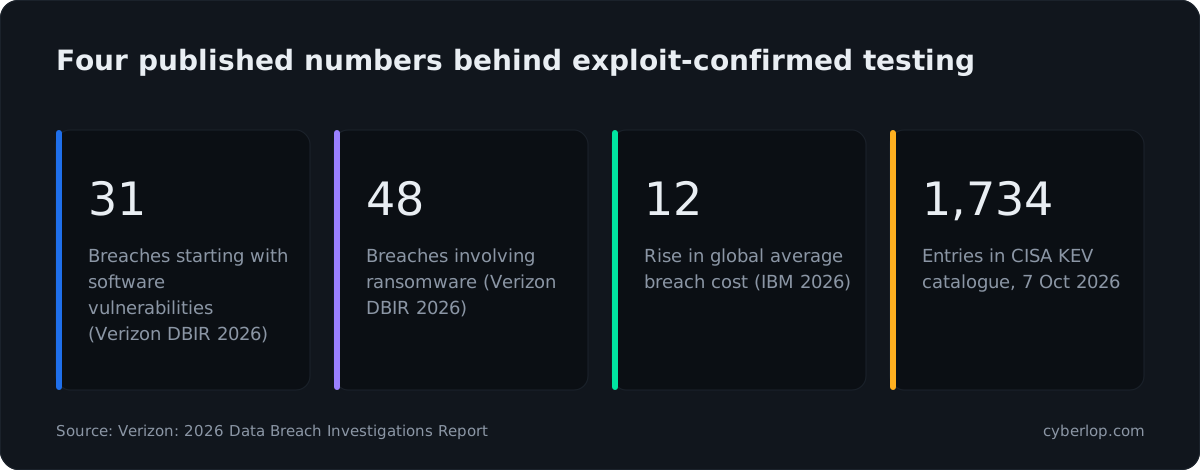
Exploiting software flaws is now a leading way in. The Verizon 2026 Data Breach Investigations Report says 31% of breaches now start with software vulnerabilities, replacing stolen passwords as the leading vector (Verizon DBIR, 2026). The same report says 48% of breaches involve ransomware.
IBM's Cost of a Data Breach Report 2026 puts the global average breach cost up 12% year on year, a record high (IBM, 2026). CISA's Known Exploited Vulnerabilities catalogue listed 1,734 entries when we read it on 7 October 2026 (CISA KEV).
What do these numbers mean for tool choice? Known, exploited weaknesses and access-control flaws are where attackers go. The OWASP Top 10:2025 puts Broken Access Control first (OWASP, 2025). A scanner that matches known signatures helps with the first; the second often needs tests with several accounts. See broken access control.
What does no scanner replace?
No scanner replaces a penetration test of how your own app behaves. Scanners are good at repeating checks cheaply; a pentest finds what depends on your rules. The two answer different questions, as DAST vs SAST vs IAST explains, and black, grey and white box testing explains what extra access buys.
Whatever you pick, judge it on proof. Our read a finding guide shows what good evidence looks like, and our evidence page shows ours.
How do you trial a Detectify alternative in two weeks?
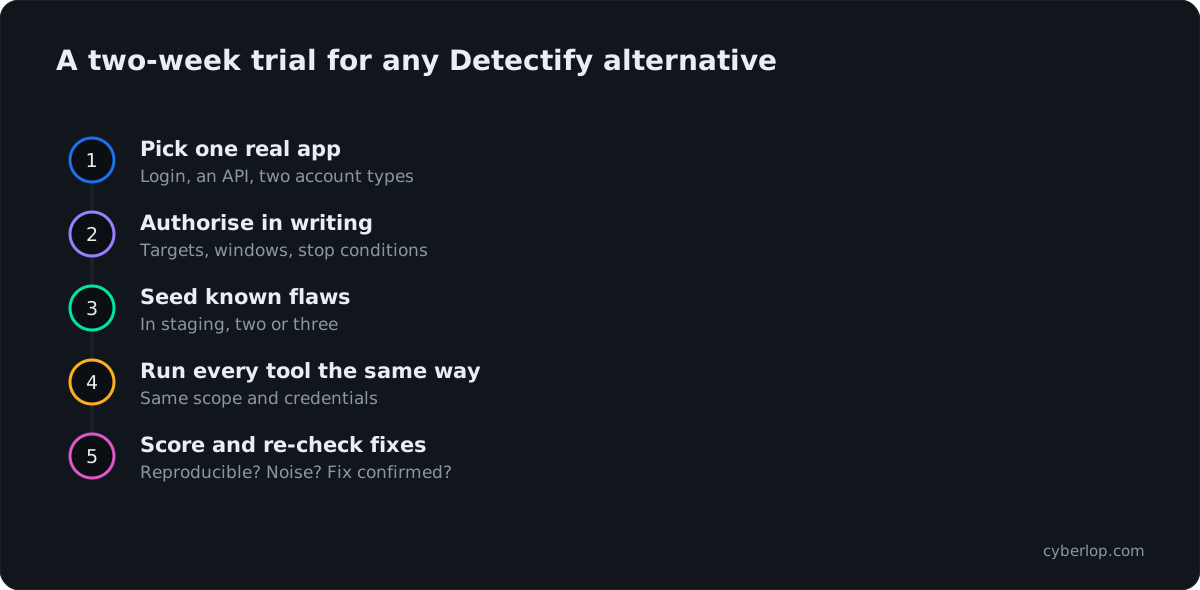
Run every candidate on the same application, with the same accounts, and compare what each reports. A fair trial takes two weeks and one person's part-time attention.
- Pick one real app. Choose one with login, an API and at least two account types.
- Get written authorisation. Name the targets, windows and stop conditions.
- Seed known issues in staging. Plant two or three flaws you know about, for example one account reading another's record.
- Run each tool the same way. Same scope, same credentials, same week.
- Score each finding. Real, duplicate, guess or noise? Could a developer reproduce it from the report?
- Fix two issues and re-check. Note how each tool confirms the fix.
- Count the work. Hours spent on setup and triage matter as much as findings.
- Decide with the numbers. Write the decision and the reasons down.
Scorecard for a two-week trial. Adapt the rows to your scope.
| Trial measure | How to record it | Good sign |
|---|---|---|
| Coverage of seeded flaws | Found or missed, per planted flaw | Finds the ones you planted |
| Reproducibility | Can a developer replay it? | Request and response included |
| Noise | Share of findings you discard | Low and explained |
| Fix confirmation | How a fix is checked | Same test replayed |
| Effort | Hours of setup and triage | Fits one person part-time |
What mistakes do teams make when switching?
Three repeat. Teams compare feature lists instead of findings on their own app. They treat an external monitor and an application tester as interchangeable. And they switch tools without keeping a record of what the old one caught, so they cannot tell what was lost.
Keep the old tool running through the trial, export its findings, and only retire it when the replacement has matched or beaten it on your own scope. For a broader scan of the market, see best DAST tools and best AI pentesting tools.
Which Detectify alternative should you pick?
Pick the tool that matches your first unanswered question. If it is "what do we own on the internet?", stay with an attack-surface monitor and compare Intruder or ProjectDiscovery. If it is "will this block a build?", look at StackHawk or Burp Suite DAST. If it is "does the logic hold?", test Escape or Cyberlop. If it is "no budget", start with ZAP. Run the two-week trial before you sign, and keep what works.
Questions people ask
Detectify alternatives: FAQs
What is Detectify used for?
Detectify is used to discover and monitor an organisation's external assets and to scan web applications and APIs for vulnerabilities. Its site lists Surface Monitoring, Application Scanning, API Scanning and Internal Scanning, and describes tests written with a community of ethical hackers.
What is the best alternative to Detectify?
There is no single best one. Intruder suits infrastructure plus web, StackHawk suits CI use, Escape suits business-logic and API testing, Burp Suite DAST and Invicti suit large portfolios, and ZAP is free. Match the tool to your first unanswered question.
Is there a free alternative to Detectify?
ZAP describes itself as free and open source, and ProjectDiscovery maintains open-source tools such as Nuclei. Free tools cost engineering time for setup, tuning and triage, so count that time in your comparison.
Detectify vs Intruder: what is the difference?
Both appear in attack surface and vulnerability scanning. On its own site Intruder describes a platform covering external surface, cloud, infrastructure, web apps and APIs with 15+ integrations. Detectify centres on attack surface monitoring and DAST with Crowdsource tests. Trial both on your scope.
Does Detectify scan APIs?
Yes. Detectify says API Scanning covers REST and GraphQL using payload-based techniques and its dynamic fuzzing engine. Ask Detectify how it handles your authentication scheme and API specification before you buy.
What is the difference between attack surface monitoring and DAST?
Attack surface monitoring finds and watches the assets you expose, such as domains, subdomains and ports. DAST tests a running application by sending requests and reading responses. Many platforms offer both, and they answer different questions.
Can a scanner replace a penetration test?
Usually not. A scanner repeats known checks cheaply. A penetration test tries to exploit how your own application behaves, including business rules and access between accounts. Many teams run a scanner continuously and a pentest at set points.
How long should I trial a Detectify alternative?
Two weeks on one real application is enough. Use the same scope and accounts for each tool, plant a few known flaws in staging, and score reproducibility, noise, fix confirmation and effort.
Sources
Where the facts come from
- Detectify: home page
- Detectify: Surface Monitoring
- Detectify: Application Scanning
- Detectify: API Scanning
- Detectify: Internal Scanning
- Detectify: Crowdsource
- Detectify: Alfred AI
- Detectify: developer documentation
- Detectify: support
- Intruder: home page
- Invicti: home page
- PortSwigger: Burp Suite DAST
- StackHawk: home page
- StackHawk: documentation
- Escape: home page
- ZAP: home page
- ProjectDiscovery: home page
- Verizon: 2026 Data Breach Investigations Report
- IBM: Cost of a Data Breach Report 2026
- CISA: Known Exploited Vulnerabilities catalog
- OWASP: Top 10:2025
Keep reading
Related articles
Acunetix alternatives in 2026: nine options and how to choose
Acunetix alternatives compared from vendor docs: suites, developer-first DAST, open source and attack surface tools, plus how to switch safely.
Best AI pentesting tools in 2026: ten compared, and how to choose
Ten AI pentesting tools compared from vendors' own sites, with a scoring sheet, a table by category and a plan for a fair trial on your own app.
Best API security testing tools in 2026: nine options and how to choose
Best API security testing tools in 2026, compared from vendor docs: DAST, open source, contract-first, runtime, plus a one-week bake-off.

Need proof, not a long list?
Cyberlop finds vulnerabilities in web apps and their APIs and reports only what it exploited, with the request, the response and the line of code. Ask us to run it on one of your applications.
Or start with a $199 pilot on one application: thirty days, success criteria agreed before day one, credited against the annual if you convert.