
Veracode vs Checkmarx is a choice between two application security platforms that both cover SAST, SCA and DAST. Veracode lists Risk Manager, Package Firewall and PTaaS; Checkmarx One adds Checkmarx Fusion and AI supply-chain scanning. Test both on your own repositories, then add a pentest for proof of exploitable flaws.
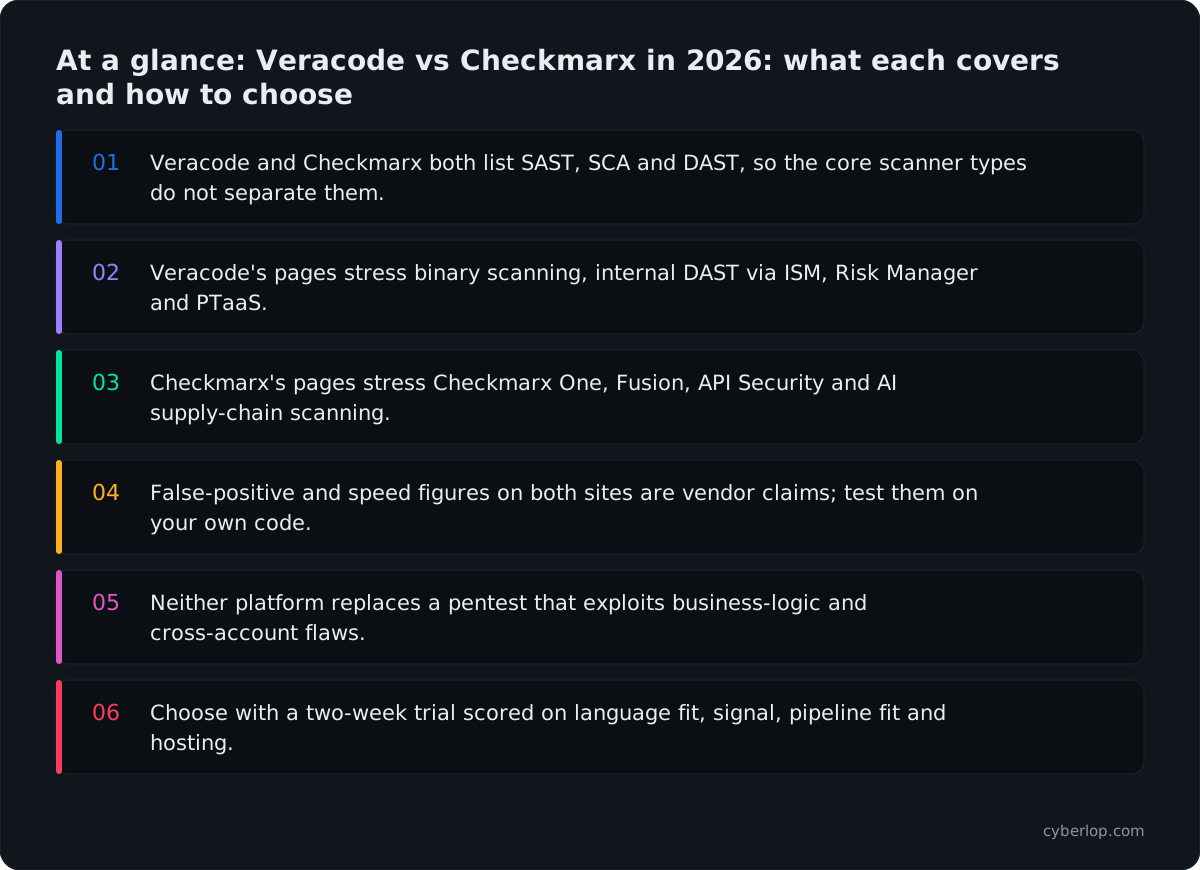
- Veracode and Checkmarx both list SAST, SCA and DAST, so the core scanner types do not separate them.
- Veracode's pages stress binary scanning, internal DAST via ISM, Risk Manager and PTaaS.
- Checkmarx's pages stress Checkmarx One, Fusion, API Security and AI supply-chain scanning.
- False-positive and speed figures on both sites are vendor claims; test them on your own code.
- Neither platform replaces a pentest that exploits business-logic and cross-account flaws.
- Choose with a two-week trial scored on language fit, signal, pipeline fit and hosting.
Veracode vs Checkmarx is a choice between two broad application security platforms that both cover static analysis (SAST), software composition analysis (SCA) and dynamic testing (DAST) in one place. Veracode leads its site with a risk manager, SAST, DAST, SCA, a package firewall and AI-assisted fixes. Checkmarx leads with Checkmarx One, a single platform with a hybrid scanning engine called Checkmarx Fusion. Neither is a pentest. The right pick depends on your languages, pipeline, hosting needs and who triages the findings.
An application security platform is a suite that scans your own code, your open-source dependencies and your running application, then collects the results in one place. This guide uses only what each vendor publishes on its own website and documentation, read on 7 October 2026. It names no prices (see each vendor's pricing page) and it does not say either product is better than the other. Product names are written as each vendor writes them.
What is the difference between Veracode and Checkmarx?
Both vendors sell a platform that covers code, dependencies and the running app. The difference is mostly in emphasis and packaging, and in what each leads with on its own website.
Veracode's product page lists Risk Manager (its ASPM), SAST, DAST, SCA, Package Firewall, Fix, Container/IaC scanning, eLearning, Security Labs, PTaaS and Software Supply Chain Intelligence. Checkmarx describes Checkmarx One as "the unified AI-powered application security platform" and lists SAST, SCA, DAST, API Security, IaC Security, Container Security, Secrets Detection, Malicious Package Protection and Repository Health, plus ASPM and AI supply-chain features.
So the headline answer is that the two overlap on the core scanner types. The questions that separate them for your team are narrower: which languages and frameworks you build in, how the scanners sit in your CI, whether you need scanning behind a firewall, and how much triage work you want the platform to take on.
Side-by-side summary from the vendors' own pages
The table lists capability names exactly as each vendor shows them. A tick means the vendor lists it on a product page; it says nothing about depth or quality.
| Capability | Veracode | Checkmarx |
|---|---|---|
| SAST | SAST (Static Analysis) | SAST (source code scanning) |
| SCA | SCA, with SBOM in CycloneDX and SPDX | SCA, plus Malicious Package Protection |
| DAST for web apps and APIs | DAST (Dynamic Analysis) | DAST, and "DAST for AI" under runtime security |
| API security | APIs covered inside DAST | API Security listed as its own capability |
| Infrastructure as code and containers | Container/IaC | IaC Security and Container Security |
| Secrets detection | Secret scanning in its docs | Secrets Detection |
| Package or supply-chain protection | Package Firewall | Malicious Package Protection, Software Supply Chain Security |
| Posture management (ASPM) | Risk Manager | ASPM |
| AI-assisted remediation | Veracode Fix | Triage & Remediation Assist Agent, Developer Assist Agent |
| AI and LLM inventory | Not shown on the pages read | AI-BOM, LLM scanner; MCP scanner listed as "coming soon" |
| Manual pentesting service | PTaaS | Not shown on the pages read |
| Developer training | eLearning, Security Labs | Codebashing in its docs index |
How do Veracode and Checkmarx handle SAST?
SAST reads your code without running it and flags patterns that look like flaws, such as an unsanitised query or a hard-coded secret. Both vendors treat it as the centre of their platform.
Side by side on SAST
Veracode SAST
Veracode says its SAST covers "100+ languages and frameworks, including legacy, mobile, and modern cloud-native stacks". It supports scanning in the IDE and in CI/CD builds, so that "policy violating flaws" can be kept out of product builds. It also states that it can scan binaries, which matters when you hold third-party or legacy code without the source.
Checkmarx SAST
Checkmarx describes SAST as combining "deterministic rules" with AI reasoning inside Checkmarx Fusion, its "hybrid scanning engine". Its platform page names PHP, Python, C# and C++ among the supported languages and says the platform plugs into the IDE (VS Code, JetBrains and Visual Studio) and the CI/CD pipeline. Its home page also makes a vendor claim of "2.5x Higher F1 Score than Average SAST Tools". That is the vendor's own figure and we have not tested it, so ask for the method behind it.
What to test in a SAST trial
Language lists look similar on paper, so test your own repositories. Count how many findings your team can fix in a sprint, how many are false positives, and how long a scan takes on your biggest repo. Check how each tool handles your internal frameworks, since static analysis rules only find what they know about.
Which is better for DAST, Veracode or Checkmarx?
We cannot rank the two on DAST from public pages, because they publish very different amounts of detail. DAST tests a running web application or API from the outside, so it finds flaws that only show up at runtime, such as a missing check on a server response.
Veracode's DAST page describes finding runtime vulnerabilities "in your web applications and APIs from a single platform". It states a "<5% false positive rate" and says you can "scan hundreds of assets across environments, including those behind your firewall". Its docs add that internal applications need Internal Scanning Management (ISM), and that you can write Selenium-based crawl scripts to steer the scanner through specific features. Authenticated and unauthenticated scans are both supported.
Checkmarx lists DAST among the Checkmarx One capabilities and also "DAST for AI" under runtime security, and its documentation index has a DAST section. The pages we could read give less detail on authentication and internal scanning, so those are questions for the vendor.
Both false-positive figures are vendor statements, not independent measurements. Treat them as claims to test, ideally by planting a few known flaws in a staging app before the trial. Our best DAST tools guide covers dedicated scanners if runtime depth is your main need.
How do they compare on SCA and software supply chain?
SCA inventories the open-source libraries in your app and matches them to known vulnerabilities and licences. It matters because a large share of a modern application is code you did not write.
Veracode says its SCA can "pinpoint where your code interacts with risks in libraries and components", lists Reachability Analysis, and can "generate and scan an SBOM" in CycloneDX and SPDX formats. Veracode also has a Package Firewall, which it says stops vulnerabilities, malware and policy violations before they reach your pipelines.
Checkmarx lists SCA, Malicious Package Protection, Repository Health and Software Supply Chain Security. It also adds AI supply-chain items: an AI-BOM (an inventory of AI components) and an LLM scanner.
If you are already asked for an SBOM by customers, check the export formats and how often the inventory refreshes. The software supply chain risk is real: the OWASP Top 10:2025 now has its own category, A03 Software Supply Chain Failures.
How do Veracode and Checkmarx fit into CI/CD and hosting?
Both support CI/CD and IDE use, and both describe a cloud platform. Hosting is where you should ask direct questions rather than rely on a product page.
Questions to put to each vendor
The table gives the details the vendors publish and the gaps you should close in a call. A "Check" cell means the pages we read did not settle the point.
| Topic | Veracode (per its site) | Checkmarx (per its site) |
|---|---|---|
| Platform model | Cloud-native architecture stated on its DAST page | "Cloud-native platform" stated on its platform page |
| Scanning behind a firewall | DAST for internal apps via Internal Scanning Management (docs) | Check |
| On-premises option | Check | Its product listing mentions "On-prem SAST"; check scope |
| IDE | IDE plugins (docs) | VS Code, JetBrains, Visual Studio |
| CI/CD and automation | Pipeline integration, Veracode APIs and CLI | Pipeline integration; integrations section in docs |
| Binary scanning | Stated for SAST | Check |
| Importing other tools' results | Risk Manager lists "50+ Integrations" | ASPM correlates findings across its scanners; check third-party import |
Hosting and data handling
Ask where scans run, what leaves your network (source, binaries, metadata) and which region stores results. If your code cannot leave your own environment, say so on the first call and get the answer in writing. Regulated teams should also ask how results are retained and deleted.
Pipeline fit
Ask how a failed policy gate is expressed in your CI system, what a developer sees on a pull request, and how long a scan adds to a build. Gating a build only works when scans are quick and the output is trusted. A gate that blocks on noise gets switched off within a month.
What about ASPM, AI fixes and triage?
Application security posture management (ASPM) gathers findings from several scanners and ranks them by risk and owner. Both vendors sell it, and both now add AI to cut the time spent on triage and fixing.
Veracode's Risk Manager says it unifies "security findings from multiple sources", applies "automated investigation and prioritization", and helps teams "track risk back to the origin and owner". Veracode Fix is described as "AI-powered remediation across both first-party code and open-source dependencies", delivering fix guidance and pull requests in the IDE, CLI and CI/CD pipeline.
Checkmarx says Checkmarx One "correlates findings across scanners and enriches them with business context" for a single view based on exploitability. Its Assist agents include a Developer Assist Agent in the IDE and a Triage & Remediation Assist Agent that ranks by attackability and offers "merge-ready fixes". Its site also quotes triage dropping from 3.5 hours to 20 minutes, a figure from the vendor that we have not verified.
AI-written fixes still need a person to review them and a test to prove they worked. See our guide to vibe coding security for why generated code deserves the same scrutiny as any other, and our note on MCP security if the assist agents will connect to your tools.
Who is Veracode best for, and who is Checkmarx best for?
There is no single winner. The summaries below describe what each vendor's own materials emphasise and the kind of team that often matches them.
Veracode tends to suit teams that
- hold legacy or third-party code and want binary scanning as well as source scanning;
- need DAST for internal apps behind a firewall inside the same platform;
- want a pentest-as-a-service option and training (eLearning, Security Labs) from one supplier;
- already run several scanners and want Risk Manager to pull them into one list.
Checkmarx tends to suit teams that
- want one cloud platform with scanner results correlated by exploitability;
- work in IDEs such as VS Code, JetBrains or Visual Studio and want AI assist agents there;
- need AI supply-chain visibility, such as an AI-BOM or LLM scanning, as they ship AI features;
- want API Security and Secrets Detection named as separate capabilities.
A small team with a single web app may find either platform larger than it needs. Our DAST guide and DAST vs SAST vs IAST explain lighter options.
What do Veracode and Checkmarx not replace?
A scanner platform reports what its rules and checks suspect. A penetration test tries to exploit a flaw to show it is real. The two answer different questions, and the threat data explains why teams still want both.
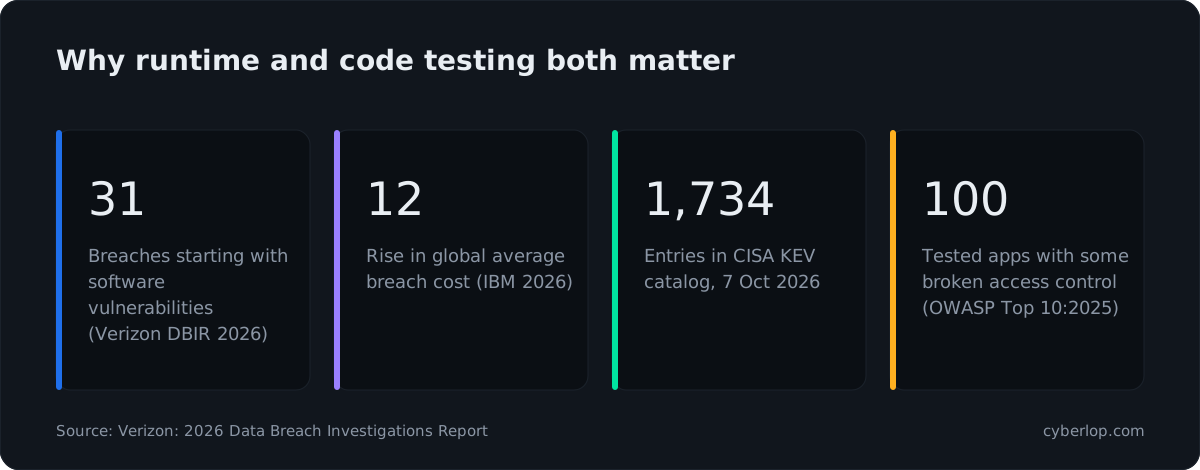
Verizon's 2026 Data Breach Investigations Report reports that 31% of breaches now begin with a software vulnerability, which puts them ahead of stolen passwords as the most common way in. IBM's Cost of a Data Breach Report 2026 reports a global average breach cost of $4.99M, up 12% on last year and the highest on record.
The CISA Known Exploited Vulnerabilities catalog showed 1,734 entries when we read it on 7 October 2026. And OWASP's Top 10:2025 says 100% of the applications tested had some form of broken access control.
Two gaps a pentest still covers
Business-logic and cross-account flaws
Broken access control and business-logic flaws depend on what your app means by "mine" and "yours". A coupon that stacks twice or one account reading another's invoice looks like normal code to a rule-based scanner. These usually need a tester, human or automated, who understands the workflow.
Proof and retest
A platform ranks findings by risk. A pentest shows the request, the response and the effect. After a fix, the strongest check is to replay the same exploit against the new code, which is what the closed-loop retest idea means.
Where does Cyberlop fit?
Cyberlop is not a replacement for either platform, and it is not in the same category. It is a pentest that sits next to a scanner platform. It finds vulnerabilities in web apps and their APIs with black-box, grey-box and white-box testing.
In white-box mode it reads your code while testing the running app, so a finding can point to the file and line. It reports only what it exploited: each finding carries the request, the response, a screenshot where a person can see it, and the line of code. Severity and confidence are kept apart, and findings carry CWE and OWASP references.
It also checks business-logic flaws and cross-account access, can run on a schedule or in CI/CD and gate a build, and can run inside your own network so code does not leave it. See how it works, the evidence page and private scanning. Use the platform for breadth and the pentest for the flaws a scanner cannot judge.
How should you read vendor claims on accuracy and speed?
Treat every accuracy, speed and time-saved figure on a vendor page as a hypothesis to test. Both sites publish such figures, and neither can tell you how your code will behave.
Veracode states a "<5% false positive rate" for DAST and says pipeline integration can be set up "within 10 minutes". Checkmarx states a "2.5x Higher F1 Score than Average SAST Tools" and a fall in critical triage from 3.5 hours to 20 minutes. These are the vendors' own statements, and the pages we read do not give the test method, so we have not repeated them as findings.
How to test a benchmark
Three questions for any benchmark
Ask which applications and languages were tested, who ran the test, and whether the same rules were applied to every tool. A figure measured on a deliberately vulnerable demo app says little about a ten-year-old monolith with custom frameworks.
Measure it yourself
Plant flaws you already know about, run each tool, and count what it finds, what it invents and what it misses. Keep the same note for false negatives as for false positives, because a quiet scanner is not always a clean app. For context on triage cost, see the vulnerability management entry and our VAPT checklist.
How do you choose between Veracode and Checkmarx?
Choose by running both on the same code and scoring the same criteria. A feature list will not settle it, since the two vendors cover the same scanner types.
Decision criteria
Score each row from one to five for each vendor, and weight the rows by what hurts your team most.
| Criterion | What to ask or measure | Why it matters |
|---|---|---|
| Language fit | Scan your three largest repos; note unsupported frameworks | Unsupported code is silent risk |
| Signal quality | Count real, false and missed issues against planted flaws | Noise burns developer time |
| Pipeline fit | Time added to a build; pull request experience | Slow gates get switched off |
| Hosting | What leaves your network; region; on-prem scope | Contracts and regulators |
| Runtime testing | Authenticated scans, API definitions, internal apps | DAST depth varies by tool |
| Supply chain | SBOM formats, malicious-package blocking | Customers ask for SBOMs |
| Triage and fixes | Who reviews AI fixes; how owners are assigned | Backlog is the real cost |
| Proof gap | Which flaws still need a pentest | Access and logic flaws |
A two-week trial plan
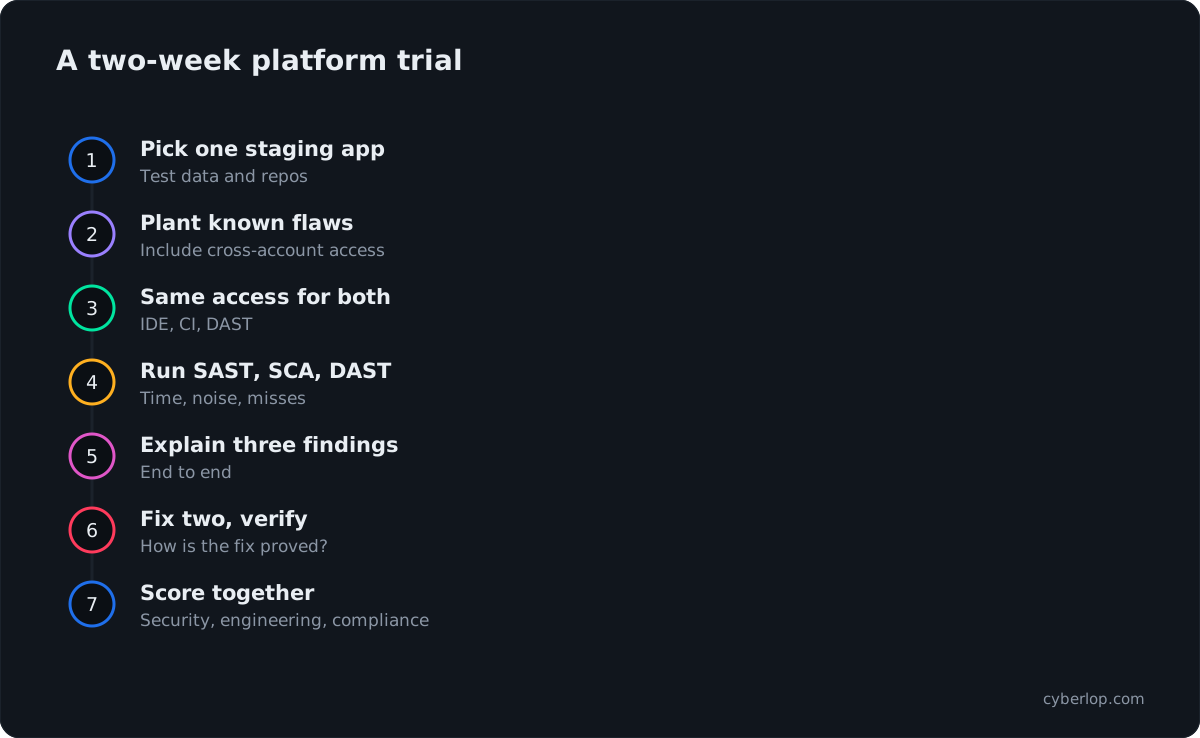
- Pick one staging app and its repositories, with test data and a backup.
- Plant a few known flaws, including one cross-account access issue.
- Set up the same IDE, CI and DAST access for both vendors.
- Run SAST, SCA and DAST and record time, noise and misses.
- Ask each vendor to explain three findings end to end.
- Fix two findings and see how the fix is verified.
- Score the criteria together: security, engineering and compliance.
If you need a wider market view, read our best AI pentesting tools guide, continuous penetration testing and the compare hub.
Questions people ask
Veracode vs checkmarx: FAQs
Is Veracode or Checkmarx better?
Neither is better in every case. Both list SAST, SCA and DAST, so the choice turns on your languages, pipeline, hosting needs and how much triage work you want automated. A trial on your own repositories gives a fairer answer than any feature list.
Do Veracode and Checkmarx both offer DAST?
Yes. Veracode lists DAST (Dynamic Analysis) for web applications and APIs, with internal apps handled through Internal Scanning Management. Checkmarx lists DAST among Checkmarx One capabilities, plus DAST for AI. Compare depth with your own authenticated app.
Can Veracode scan code without the source?
Veracode states that its SAST supports binary scanning, so third-party or legacy code can be scanned when source is not available. Ask how binary results compare with source results for your languages.
What is Checkmarx Fusion?
Checkmarx describes Checkmarx Fusion as a hybrid scanning engine that combines deterministic rules with AI reasoning, to find vulnerabilities and rank them by exploitability. It is part of Checkmarx One.
Is Checkmarx cloud or on-premises?
Checkmarx describes Checkmarx One as a cloud-native platform, and its product listing mentions on-prem SAST. The pages we read did not set out every deployment option, so confirm scope and data handling with the vendor.
Do these platforms replace penetration testing?
No. Platforms scan code, dependencies and running apps for suspected flaws. A pentest exploits a flaw to prove it, and is better at business-logic and cross-account problems. Most teams use both.
Do the vendors publish prices?
This guide quotes no prices. See each vendor's pricing page or ask for a quote, and compare like for like: scanner types, number of apps, developers and any scanning limits.
How long should a trial take?
Two weeks on one staging app is usually enough. Plant known flaws, give both tools the same access, and score the noise, the misses, the pipeline fit and the quality of the fix guidance.
Sources
Where the facts come from
- Veracode: products
- Veracode: documentation
- Veracode: Dynamic Analysis docs
- Veracode: Static Analysis (SAST)
- Veracode: Software Composition Analysis
- Veracode: DAST
- Veracode: Fix
- Veracode: Risk Manager
- Checkmarx: home page
- Checkmarx: Checkmarx One
- Checkmarx: application security platform
- Checkmarx: documentation
- Verizon: 2026 Data Breach Investigations Report
- IBM: Cost of a Data Breach Report 2026
- CISA: Known Exploited Vulnerabilities catalog
- OWASP: Top 10:2025, A01 Broken Access Control
- OWASP: Top 10:2025
Keep reading
Related articles
Best AI pentesting tools in 2026: ten compared, and how to choose
Ten AI pentesting tools compared from vendors' own sites, with a scoring sheet, a table by category and a plan for a fair trial on your own app.
Best DAST tools 2026: twelve compared and how to choose
Twelve DAST tools compared from vendor docs: authentication, APIs, CI/CD, proof and deployment, plus a decision table and a one-week bake-off.
Continuous penetration testing: how to run it alongside your annual pentest
What continuous penetration testing really means, how it compares with annual pentests, DAST and PTaaS, and how to run both in your pipeline.

Add proof beside your platform
Whichever platform you pick, Cyberlop adds pentesting that reports what it actually exploited, with the request, the response and the line of code. Ask us to run it on one of your applications.
Or start with a $199 pilot on one application: thirty days, success criteria agreed before day one, credited against the annual if you convert.