
Home / Blog / Best api security testing tools 2026
Compare
Best API security testing tools in 2026: nine options and how to choose
API security testing tools fall into five groups, from developer-run DAST to discovery platforms. This guide compares nine using only what each vendor publishes, and shows how to choose.
Cyberlop Labs · Updated · 12 min read
The best API security testing tools in 2026 depend on the question you need answered. StackHawk and Escape suit developer pipelines, Burp Suite suits central teams and testers, ZAP is free and open source, 42Crunch works from the OpenAPI contract, and Salt, Traceable and Wallarm focus on discovery and runtime. Run a bake-off on one staging API first.
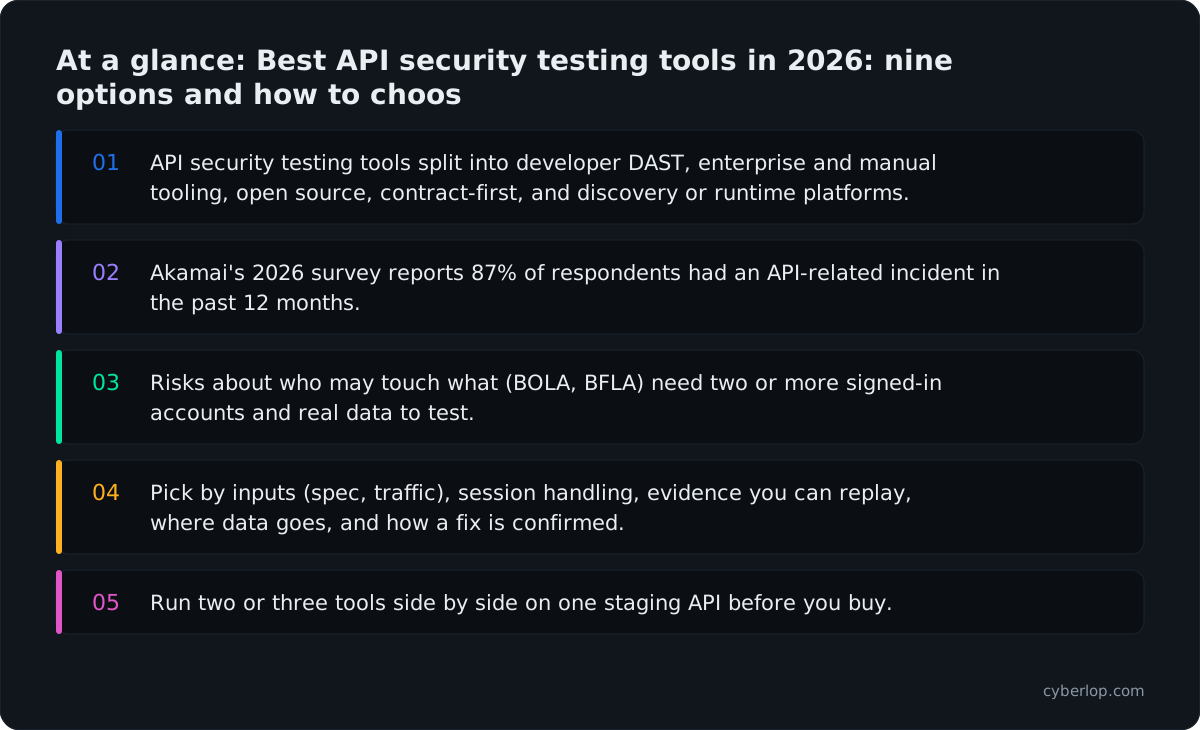
- API security testing tools split into developer DAST, enterprise and manual tooling, open source, contract-first, and discovery or runtime platforms.
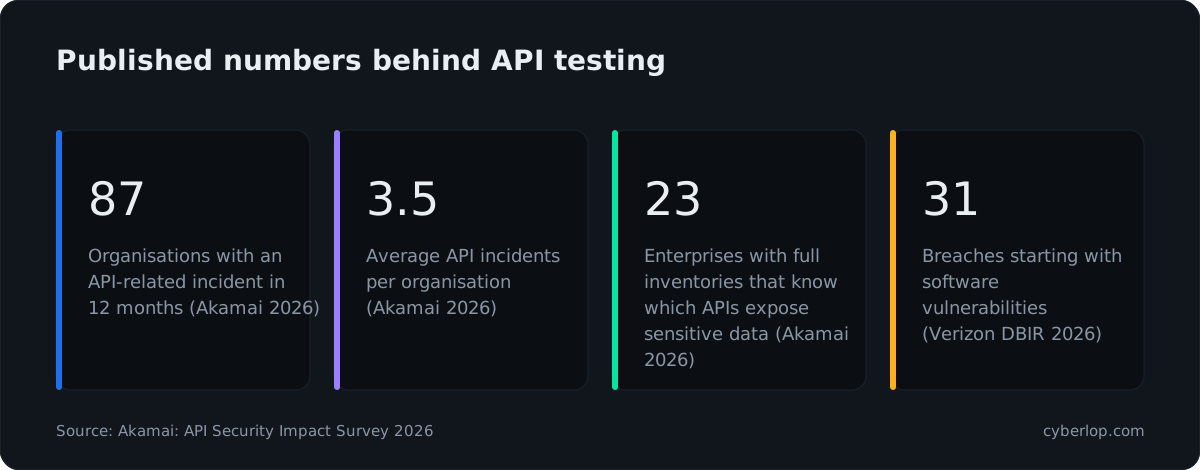
- Akamai's 2026 survey reports 87% of respondents had an API-related incident in the past 12 months.
- Risks about who may touch what (BOLA, BFLA) need two or more signed-in accounts and real data to test.
- Pick by inputs (spec, traffic), session handling, evidence you can replay, where data goes, and how a fix is confirmed.
- Run two or three tools side by side on one staging API before you buy.
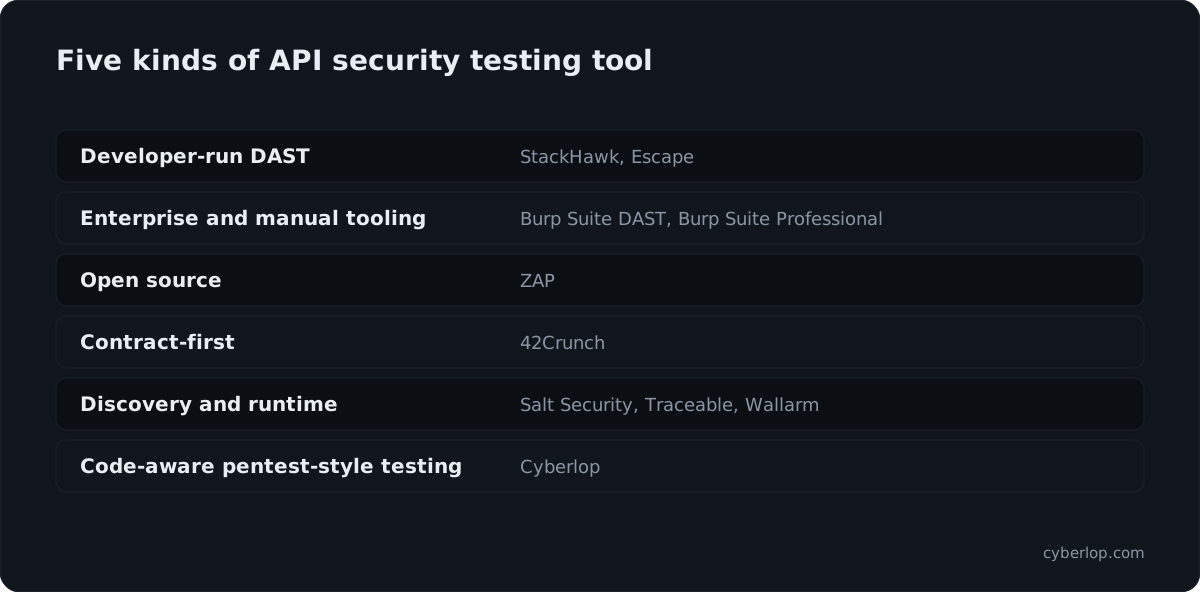
The best API security testing tools in 2026 depend on what you need to prove: developer-run DAST in CI (StackHawk, Escape), enterprise or manual pentester tooling (Burp Suite DAST, Burp Suite Professional), a free scanner (ZAP), contract-first checks (42Crunch), discovery and runtime platforms (Salt Security, Traceable, Wallarm), or code-aware pentest-style testing. No single product covers every layer, so most teams pair two.
API security testing is the practice of sending requests to an API, or reading its contract, to find flaws such as broken object level authorization, weak authentication and unsafe business flows before an attacker does. This guide compares nine options using only what each vendor publishes on its own site or docs, read on 7 October 2026. It names no prices (see each vendor's pricing page) and does not rank one product above another.
What is API security testing, and what are the four ways to do it?
API security testing checks an application programming interface for vulnerabilities, using its contract, live traffic or direct requests. The API is the part of your product that other software, and your own front end, talks to, so a flaw there is usually a data flaw.
The OWASP API Security Top 10 (2023 edition) is the common yardstick. Its first risk, API1:2023, is Broken Object Level Authorization, and it also lists Broken Authentication, Broken Function Level Authorization and Unrestricted Access to Sensitive Business Flows. Most tools below say they map to that list in some way, but they get there differently.
The four approaches
1. Contract-time checks
These read the OpenAPI specification and flag weak definitions before any code runs. They are fast and cheap to repeat, but they only see what the contract declares.
2. Dynamic testing (DAST)
DAST sends requests to a running API and watches the responses. It finds flaws the contract hides, such as an endpoint that ignores its own authorisation rules. It needs a reachable environment and working credentials.
3. Manual and pentest-style testing
A person, or an engine acting like one, chains steps and judges business-logic flaws that a rule-based scanner cannot name. See AI penetration testing for what that can and cannot do in 2026.
4. Discovery and runtime
These watch real traffic to list what exists, including shadow APIs, and to spot abuse. They answer "what do we have?" rather than "is it exploitable?". Many vendors now blend this with testing.
Why does API security testing matter in 2026?
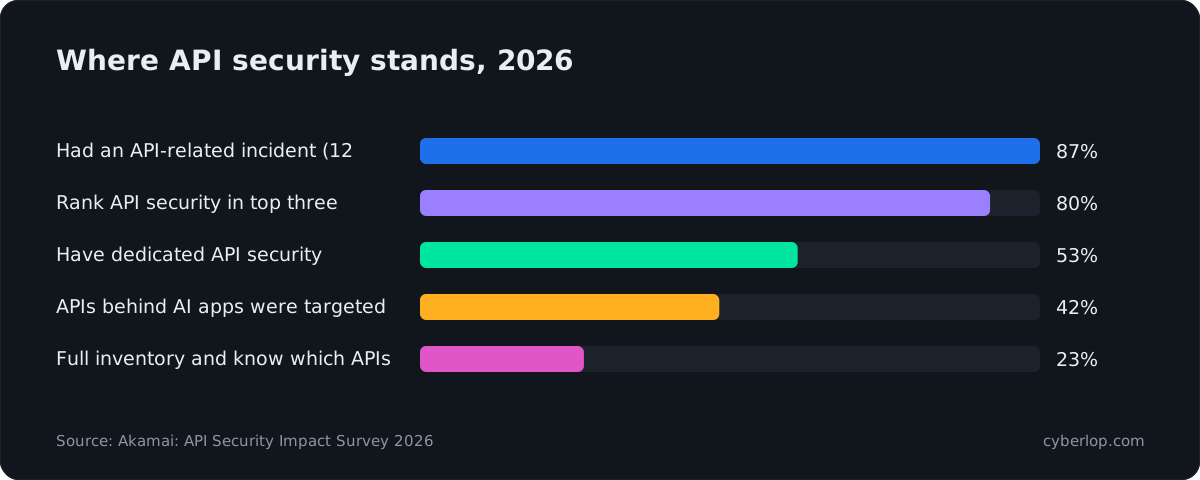
Because that is where the reported incidents are. Akamai's API Security Impact Survey, published 28 April 2026, surveyed 1,840 security professionals across 10 countries. It reports that 87% had an API-related security incident in the past 12 months, up from 76% in 2022, with an average of 3.5 incidents per organisation.
The same survey found that only 23% of enterprises with full API inventories know which APIs expose sensitive data, down from 40% in 2022. That gap is why discovery and testing are now bought together. A tool cannot test an API it has never seen.
The wider picture points the same way. The Verizon 2026 Data Breach Investigations Report finds that software vulnerabilities start 31% of breaches, now ahead of stolen passwords as the way in. The CISA Known Exploited Vulnerabilities catalogue listed 1,734 entries when read on 7 October 2026. See the KEV catalogue entry for what that list means.
Which are the best API security testing tools in 2026?
Nine are covered here, grouped by how each vendor describes the product, in an order chosen for readers rather than for any ranking. The table gives the quick view, and the sections after it give the detail with quotes you can check.
Quick comparison of what each vendor says
| Tool | Main job (vendor's words, short) | Needs a running API | Runs in CI | Free or open source stated |
|---|---|---|---|---|
| StackHawk | Developer-first DAST (HawkScan) | Yes | Yes | See vendor |
| Escape | Business-logic-aware DAST, AI pentesting | Yes | Yes | GraphQL Armor is open source |
| Burp Suite DAST | Automated scanning at scale, first-class API coverage | Yes | Yes | Not stated |
| Burp Suite Professional | Manual testing toolkit with an advanced scanner | Yes | See vendor | Not stated |
| ZAP | Web app and API scanner with automation | Yes | Yes | Free and open source |
| 42Crunch | Contract-driven audit, scan and runtime protection | For the scan step | Yes | See vendor |
| Salt Security | Discovery, posture, runtime protection | Not a scanner | Not stated | Not stated |
| Traceable | Discovery, testing and protection | Uses live traffic | Yes | Not stated |
| Wallarm | Inline API protection and discovery | Not a scanner | Not stated | Open-source edge option |
"Not stated" means the vendor pages we read do not say. It is not a claim that the feature is missing.
Developer-run DAST in the pipeline
StackHawk
StackHawk's documentation says HawkScan can "read your app's OpenAPI specification" and lists configuration for GraphQL, gRPC, SOAP, JSON-RPC and MCP server testing. It integrates with GitHub Actions, GitLab, Jenkins, CircleCI, Azure Pipelines and Bitbucket, and "can run anywhere - your laptop, a server, Kubernetes, or in your software delivery pipeline."
Its business logic testing page describes cross-account checks for BOLA and BFLA. The stated conditions are an OpenAPI spec, at least two dedicated test accounts and a staging environment with representative data. Best fit: a team where developers own scanning and the API has a spec. See our StackHawk alternatives guide for the wider field.
Escape
Escape's home page lists "Business-logic-aware DAST" that tests "workflows, access control, and multi-step processes", plus AI pentesting and attack surface management. It says it is "Built for modern auth: OAuth, SSO, multi-tenant" and that you can "Trigger scans on every push". It also offers GraphQL Armor, an open-source tool for GraphQL.
Best fit: teams with GraphQL or heavy login flows that want scheduled scans and discovery in one product. The vendor's own docs and demo should confirm which protocols and private-network options apply to you.
Enterprise and pentester-grade tooling
Burp Suite DAST
PortSwigger's Burp Suite DAST page describes "First-class API coverage": "Scan APIs defined by Postman Collections, OpenAPI, SOAP, and GraphQL". It lists "Native authentication for Basic, Bearer Token, API Key, and OAuth 2.0 Client Credentials", and integrations with Amazon API Gateway, Azure API Management and Google Apigee. Scans can be scheduled, triggered from CI/CD (Jenkins, GitHub Actions, GitLab CI, Azure DevOps, Bitbucket Pipelines, CircleCI, TeamCity) or run on demand.
Best fit: a security team scanning many APIs on a schedule, especially behind a gateway. See best DAST tools and Burp Suite vs ZAP.
Burp Suite Professional
The Professional page says "Balance powerful automation with granular control in Burp" and features "Authenticated API Scanning" and the BApp store of user-created extensions. It is positioned for hands-on security testers.
Reach for it when one person is doing a manual API test and needs to see and change each request. It is a tool for a tester, not a pipeline gate on its own.
Open source
ZAP
ZAP calls itself "The world's most widely used web app scanner. Free and open source." Its OpenAPI add-on can "spider and import OpenAPI (Swagger) definitions, versions 1.2, 2.0, 3.0, and 3.1", from a file or a URL, and supports the Automation Framework. The ZAP API lets developers "automate pentesting and security regression testing of the application in the CI/CD pipeline".
The docs also tell you to point ZAP only at targets you have explicit permission to test. Best fit: teams that have engineering time but no licence budget. You build and maintain the pipeline yourself.
Contract-first
42Crunch
42Crunch's site describes "Static and dynamic testing against the contract, mapped to the OWASP API Top 10" and "300+ automated API security checks". It says "Tests are generated straight from the OpenAPI definition and run in the pipeline", and separately offers "API Runtime Protection" as a "positive-security firewall assembled from the contract". Its API Scan is described as testing "the running API with simulated traffic".
It works best where a team already keeps a good OpenAPI definition and wants it enforced in CI. The model depends on the contract being accurate, so undocumented endpoints need another method.
Discovery and runtime platforms
Salt Security
Salt's home page describes three functions: discovery ("automatically discovers every agent, MCP server and API across your environment"), posture management ("misconfigurations, excessive permissions, and exposed credentials") and runtime protection ("Real-time detection of abuse, anomalous behavior, and active attacks"). Its pages we read do not describe a pentest-style test run.
Best fit: a large estate where the first problem is knowing what exists and spotting abuse. Pair it with a testing tool that proves exploitability.
Traceable
Traceable's testing page says it tests "in real-time based on live traffic" and gives "Extensive coverage for the OWASP API top 10", including business logic vulnerabilities such as BOLA. It adds that it "never generates tests for APIs that are inactive for a long time". Its home page groups the platform into posture management, security testing and protection.
The trade-off: tests follow what traffic actually exercises, so an API nobody calls is never tested. That suits teams who care most about live paths.
Wallarm
Wallarm describes inline protection that blocks "OWASP API Top 10, abuse, and account takeover" across REST, GraphQL, gRPC, SOAP and WebSocket, with "Three Deploy Modes" including a self-managed open-source edge. It is a protection and discovery product, so treat it as a complement to testing, not a replacement.
Pick it when you need inline blocking and want to choose where traffic is inspected.
Code-aware pentest-style testing
Cyberlop
Cyberlop finds vulnerabilities in web apps and their APIs with black-box, grey-box and white-box pentesting. In white-box mode it reads your code while testing the running app, so a finding can point to the file and line. It reports what it actually exploited, with the request, the response, a screenshot where a person can see it and the line of code.
It checks business-logic flaws and cross-account access, and a fix is proven by re-running the exact exploit against the new code in a closed-loop retest. It can run on a schedule or in CI/CD and gate a build, and private scanning keeps code inside your network. Best fit: teams that want proof per finding and a code line for the developer.
What does each OWASP API risk ask of a tool?
Each API risk needs different inputs, so match the tool to the risks you worry about most. The table below is our reading of the OWASP list, not a vendor claim. Ask each vendor to show how it covers the rows you care about.
OWASP API Security Top 10 (2023) and what a test needs
| Risk | What a test needs | Where a pure contract check falls short |
|---|---|---|
| API1 Broken Object Level Authorization | Two or more accounts and real object IDs | Contract does not say who owns which object |
| API2 Broken Authentication | Working login flows and token handling | Partly visible in the contract |
| API3 Broken Object Property Level Authorization | Responses and writes compared per account | Extra fields are often undocumented |
| API4 Unrestricted Resource Consumption | Safe load and limit probes | Limits are rarely in the contract |
| API5 Broken Function Level Authorization | A low-privilege and an admin account | Roles seldom described per route |
| API6 Unrestricted Access to Sensitive Business Flows | A person or engine that understands the flow | Flows span many calls |
| API7 Server Side Request Forgery | Out-of-band callbacks | URL parameters can be spotted |
| API8 Security Misconfiguration | Header, CORS and error checks on live responses | Some checks possible |
| API9 Improper Inventory Management | Discovery from traffic or gateways | Cannot see undocumented versions |
| API10 Unsafe Consumption of APIs | Review of third-party calls | Needs code or traffic |
The pattern is plain. Risks about who may touch what (API1, API3, API5) need two or more signed-in accounts and real data. For the test method, see broken object level authorization, the IDOR checklist and API security testing.
How do you choose an API security testing tool?
Choose by the question you need answered, then by who will run it, then by where it must run. Work through these seven criteria before any demo.
Seven criteria
1. What inputs do you have?
If you keep an OpenAPI definition, contract-first and spec-driven tools work well. If you do not, look at tools that learn from traffic or crawl. StackHawk's docs, for instance, state that the multi-account tests need an OpenAPI spec.
2. Can it hold a session?
A scanner that cannot hold a session returns a clean report and a false sense of safety. Ask for a demo with your login flow, your token refresh and two accounts. See authenticated testing.
3. Does it test authorisation across accounts?
BOLA and BFLA top the OWASP list. Ask the vendor to show one account reading another's object, and how the result is reported.
4. What counts as evidence?
A request and response a developer can replay beats a risk score. See proof of exploit and false positives.
5. Where does it run, and where does your data go?
Some products are SaaS, some run in your network. Ask where specs, tokens, traffic and results are stored.
6. How does it fit CI/CD?
Check build gating, pull-request comments and ticket tools. Read continuous penetration testing for how scheduled testing and a yearly pentest differ.
7. How does a fix get confirmed?
A re-scan says a symptom is gone. A replay of the original exploit says the hole is closed.
Which tool for which situation?
| If your situation is | Consider | Why |
|---|---|---|
| Developers own security checks in CI | StackHawk, Escape | Both state CI/CD workflows |
| A central team scans many APIs behind gateways | Burp Suite DAST | Gateway integrations and scheduling are listed |
| One tester doing a manual API test | Burp Suite Professional | Built for hands-on testers |
| No licence budget, engineering time available | ZAP | Free and open source, with an automation framework |
| A strong OpenAPI culture | 42Crunch | Tests are generated from the contract |
| Unknown or sprawling API estate | Salt Security, Traceable, Wallarm | Discovery and runtime focus |
| Proof and a code line per finding | Cyberlop | Reports only what it exploited; white-box mode reads code |
Most mature programmes combine two rows, for example a pipeline scanner for every pull request and pentest-style testing before a release. See DAST vs SAST vs IAST and best AI pentesting tools.
How do you compare API security testing tools in a week?
Run two or three on the same staging API with the same inputs and score what comes out. Written authorisation comes first, because every tool here sends real requests.
- Pick one API. Use a staging copy with real accounts and data you can lose.
- Get written authorisation. Cover each tool, environment and the test window.
- Give every tool the same inputs. The same spec, accounts and base URL.
- Plant three known flaws. One account reading another's object, a low-privilege account calling an admin route, and a skipped workflow step.
- Run and record. Note setup time, session drops, findings and false positives.
- Fix two findings. Check whether each tool confirms the fix by replay or by re-scan.
- Ask the developers. Which output would they act on first?
What to record in the scorecard
- Minutes from sign-up to first authenticated scan.
- Planted flaws found, missed and falsely reported.
- Whether each finding had evidence a developer could replay.
- Where specs, tokens and results are stored.
What if you are an agency or MSSP?
Look at multi-client reporting and branding before features. Cyberlop lets agencies and MSSPs run it under their own brand; see the agencies page. For the category, read about white-label pentesting.
So which API security testing tool should you pick?
Start from the flaws you fear most. If they are authorisation flaws, insist on a tool that tests with two or more accounts, and ask for evidence you can replay. If you cannot list your APIs, start with discovery. If developers own the pipeline, pick a CI scanner and add pentest-style testing before big releases. Whatever you shortlist, run the bake-off first, and see how Cyberlop works and the evidence it produces.
Questions people ask
Best api security testing tools 2026: FAQs
What is API security testing?
API security testing checks an API for vulnerabilities such as broken authorisation, weak authentication and unsafe business flows. It uses the API contract, live traffic or direct requests, and is usually measured against the OWASP API Security Top 10 (2023).
What is the best API security testing tool in 2026?
There is no single best tool. Developer-run DAST such as StackHawk or Escape suits pipelines, Burp Suite DAST suits central teams scanning many APIs, ZAP suits teams with engineering time, and 42Crunch suits contract-first teams. Match the tool to your inputs and the risks you fear most.
Is there a free API security testing tool?
ZAP describes itself as 'Free and open source' and can import OpenAPI definitions and run in CI through its Automation Framework. Escape also publishes GraphQL Armor as open source. Free tools still cost engineering time to set up and maintain.
What is the difference between API security testing and API runtime protection?
Testing looks for flaws before attackers do, usually in staging. Runtime protection watches or blocks live traffic. Salt Security and Wallarm describe runtime protection, while StackHawk and Burp Suite DAST describe testing. Many teams use both.
Do I need an OpenAPI spec to test an API?
Not always, but some tools expect one. StackHawk's multi-account tests state that an OpenAPI spec is required, and 42Crunch generates tests from the OpenAPI definition. Traceable describes tests driven by live traffic instead.
How do you test for broken object level authorization in an API?
Sign in with two accounts, record the object IDs one account owns, then request those objects with the other account's token. If the second account can read or change them, the API has a BOLA flaw. See the BOLA guide on this site for steps.
Can AI replace manual API pentesting?
Not entirely. AI-led tools can run more scenarios and chain steps, but you should still ask for evidence you can replay. Check what each tool exploited, not what it suspected.
How often should APIs be tested?
Test on every meaningful change in CI, run a deeper pentest-style test before major releases, and retest after fixes. The OWASP list changes slowly, but your own API changes with every release.
Sources
Where the facts come from
- OWASP: API Security Top 10 2023
- Akamai: API Security Impact Survey 2026 (press release)
- Verizon: 2026 Data Breach Investigations Report
- CISA: Known Exploited Vulnerabilities catalog
- StackHawk: HawkScan documentation
- StackHawk: business logic testing
- Escape: home page
- PortSwigger: Burp Suite DAST
- PortSwigger: Burp Suite Professional
- ZAP: home page
- ZAP: OpenAPI add-on
- ZAP: API documentation
- 42Crunch: home page
- Salt Security: home page
- Traceable: home page
- Traceable: API security testing
- Wallarm: home page
Keep reading
Related articles
AI penetration testing in 2026: what it can and cannot do
AI penetration testing in 2026: what it does well, where it fails, how accurate it is, and questions to ask before you trust a tool.
API security testing: a 2026 guide to the OWASP API Top 10
A step-by-step API security testing guide: the OWASP API Top 10 (2023) with test cases, BOLA and BFLA checks, JWT, OAuth, GraphQL and a CI/CD plan.
Best AI pentesting tools in 2026: ten compared, and how to choose
Ten AI pentesting tools compared from vendors' own sites, with a scoring sheet, a table by category and a plan for a fair trial on your own app.

See API findings with proof
Cyberlop finds vulnerabilities in web apps and their APIs with black-box, grey-box and white-box pentesting, and reports only what it exploited, with the request, the response and the line of code. Ask us to run it on one of your applications.
Or start with a $199 pilot on one application: thirty days, success criteria agreed before day one, credited against the annual if you convert.