
Home / Blog / Beagle security alternatives
Compare
Beagle Security alternatives: what to use instead, and how to choose
Beagle Security is an agentic pentesting platform for web apps, APIs and GraphQL. This guide compares eight other options from vendor sources and shows how to choose.
Cyberlop Labs · Updated · 13 min read
Beagle Security alternatives fall into four groups: people-plus-automation platforms such as Astra Security, DAST engines such as Burp Suite DAST and Invicti, pipeline-first tools such as StackHawk and Escape, and free ZAP. Pick by the question you cannot answer today, then trial two tools on one app with seeded flaws.
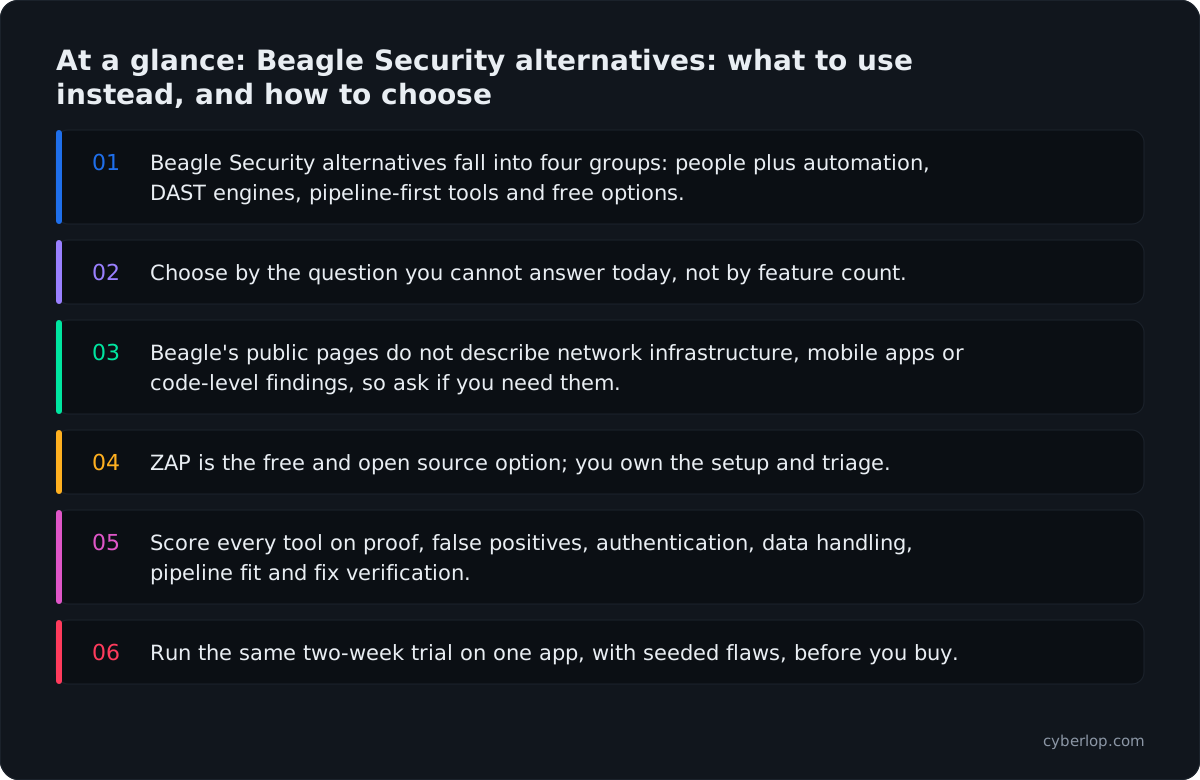
- Beagle Security alternatives fall into four groups: people plus automation, DAST engines, pipeline-first tools and free options.
- Choose by the question you cannot answer today, not by feature count.
- Beagle's public pages do not describe network infrastructure, mobile apps or code-level findings, so ask if you need them.
- ZAP is the free and open source option; you own the setup and triage.
- Score every tool on proof, false positives, authentication, data handling, pipeline fit and fix verification.
- Run the same two-week trial on one app, with seeded flaws, before you buy.
Beagle Security alternatives fall into four groups: other agentic or human-led pentest platforms, DAST engines such as Burp Suite DAST and Invicti, pipeline-first scanners such as StackHawk and Escape, and free tools such as ZAP. The right one depends on what you need to find and prove, not on feature count. This guide compares nine options using only what each vendor publishes on its own site, read on 7 October 2026.
Beagle Security is a web application security testing platform that describes itself as "The agentic AI pentesting platform for your web apps, APIs & GraphQL". Teams look for alternatives for ordinary reasons: they also need network or infrastructure scanning, a human tester, a self-run open source option, or findings that point to a line of code. None of those is a flaw in Beagle. They are different jobs.
What is Beagle Security, per the vendor?
Beagle Security's home page positions the product as automated penetration testing for web apps, APIs and GraphQL, with a separate WordPress testing page. It lists solutions for SaaS, fintech, healthcare, education and e-commerce, and says the company is "ISO 27001 certified". The vendor says its model is trained on "350K+ penetration test workflows". Pricing sits on the vendor's pricing page; this guide names none.
What does Beagle Security test, and how?
The vendor describes "agentic AI penetration tests" that combine automated scanning with analysis meant to reduce false positives. It says results typically arrive "within 48-72hrs" and that you can "configure a penetration test in minutes". Three capabilities do most of the work in its own description.
Authenticated testing
The web application page says the platform handles "multi-factor auth, magic links" and other login flows, and the features page lists "2FA & captcha enabled login forms". Testing behind a login is where most of a business application lives, so this matters. See our short guide to authenticated scans for what to check.
Business logic recording
Beagle says you can "capture exact user flows and business logic" and "teach our AI by recording your business logic". The idea is that a recorded workflow tells the tool which paths matter. The vendor does not publish how much of the logic testing is generated and how much replays what you recorded, so ask for a demonstration on your own flow. A business logic flaw is a mistake in what the app allows, such as a coupon applied twice, not a bug in a single input.
APIs and GraphQL
The API page says Beagle supports "Postman and Swagger/OpenAPI" formats and lists OAuth, JWT and API key authentication. It says the product looks at vulnerabilities "between the links" of connected APIs. For enterprise accounts the vendor describes a listener script that discovers endpoints. See OpenAPI specification and API pentesting for background.
How does Beagle fit into pipelines, reports and private networks?
The DevSecOps page names Jenkins, GitHub Actions, Azure Pipelines, GitLab, CircleCI, Bitbucket, Bamboo and others, and says testing can be triggered with each build. Findings can go to Jira and Azure Boards, and the vendor also lists Slack and Zapier. Reports come as PDF, JSON, XML or CSV, with compliance reports for HIPAA and PCI DSS and white-labelled report options. A scheduled test can run daily, weekly, monthly or on a custom schedule.
For internal apps the vendor offers Cosmog, which it calls a private tunnel. Its page says you install a lightweight client on an internal machine and the connection is outbound only, with no inbound connections required. It names HR portals, finance dashboards, staging environments and internal APIs as typical uses.
How is it sold, in structure?
The pricing page describes a 14-day free trial with Advanced-plan features, then a free plan with one lite test a month plus SSL and domain monitoring. Paid tiers are Essential, Advanced and Enterprise, and the vendor says it prices by "the number of tests you run, not the number of applications". API and GraphQL testing, business logic recording and compliance reports sit in Advanced. Cosmog, API discovery and SSO sit in Enterprise. That gating is worth knowing before you build a trial plan.
What the pages read do not state
The pages we read describe web applications, APIs, GraphQL and WordPress. They do not describe network infrastructure testing, mobile app testing, or reading your source code to point at a file and line. That is not a limit of the product; it is a gap in what is public. If any of those matter, ask the vendor.
| What you want to know | What the vendor says | Where we read it |
|---|---|---|
| What it is | "The agentic AI pentesting platform for your web apps, APIs & GraphQL" | Home page |
| Authenticated testing | Multi-factor auth, magic links, 2FA and captcha login forms | Web application and features pages |
| Business logic | Record flows; the AI learns your application logic | Home and web application pages |
| API formats | Postman and Swagger/OpenAPI; OAuth, JWT, API keys | API security testing page |
| Pipelines | Jenkins, GitHub Actions, Azure Pipelines, GitLab, CircleCI and others | DevSecOps page |
| Private apps | Cosmog private tunnel, outbound connection only | Cosmog page |
| Proof | "Proof of exploit" showing payload details | Features page |
| Typical turnaround | Results "within 48-72hrs" | Home page |
| Not described on pages read | Network infrastructure, mobile apps, source-code-level findings | Gap in public pages |
Why do teams look for Beagle Security alternatives?
Teams usually look because a need sits next to what the product describes, not because it fails at its own job. Six reasons come up most often when people shortlist tools.
- A human in the loop. Some buyers or auditors want a named tester to review the work, or a hybrid of automation and people.
- Wider scope. You want hosts, ports, cloud settings or an external attack surface checked in the same place as web apps.
- Code-aware findings. Engineers want a finding to point to the file and line that needs the fix.
- A self-run or open source tool. A team wants to own the scanner, its configuration and its data path.
- Different packaging. A per-test model suits some teams and a per-asset or per-engagement model suits others. Compare the vendors' pricing pages side by side.
- Vendor stack fit. You already run an AppSec platform and want testing to sit inside it.
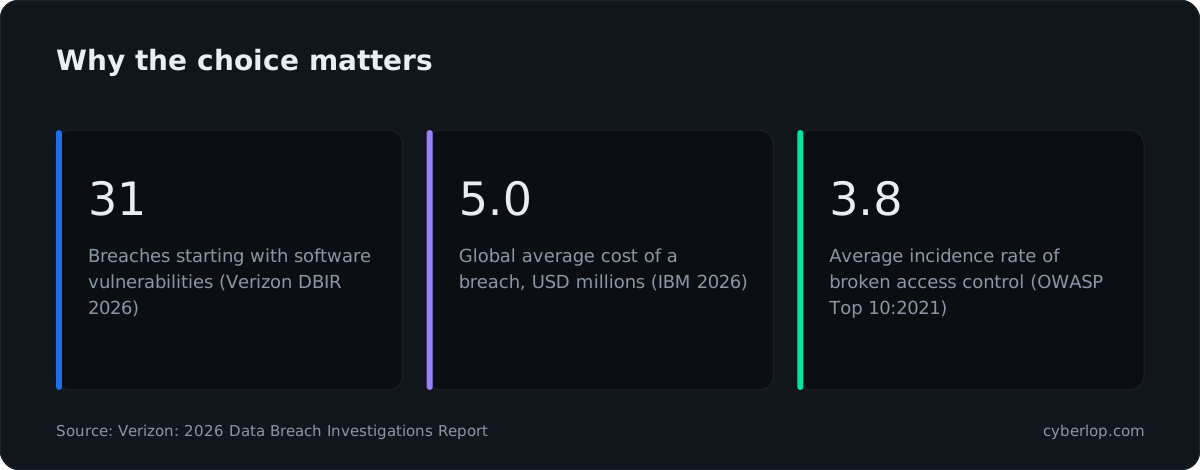
Published figures set the stakes. The Verizon 2026 Data Breach Investigations Report finds that software vulnerabilities start 31% of breaches, now ahead of stolen passwords as the way in. The IBM Cost of a Data Breach Report 2026 puts the global average cost of a breach at $4.99 million, a 12% increase over last year. Access flaws are common too: OWASP lists Broken Access Control first, with an average incidence rate of 3.81% and 318,487 occurrences in its dataset. The CISA Known Exploited Vulnerabilities catalog showed 1,734 entries when we read it on 7 October 2026.
What are the best Beagle Security alternatives in 2026?
The nine tools below are grouped by the job they do best. Inside each group the order is alphabetical, and the groups follow the reader's likely question, not a ranking. For wider lists see our guides to the best AI pentesting tools and the best DAST tools.
Overview table
This table summarises what each vendor's own pages say. "Not stated" means the pages we read did not cover it, not that the product lacks it.
| Tool | Best described as | What the vendor emphasises | Suits |
|---|---|---|---|
| Astra Security | PTaaS plus scanner | Continuous pentesting that combines automated scanning with human expertise; DAST scanner, API and cloud scanners | Teams wanting people and automation in one portal |
| Burp Suite DAST | Enterprise DAST | Scanning engine from Burp Suite Professional; Chromium crawler; request and response evidence | Teams that want a pentester-grade scanner at scale |
| Escape | Business-logic-aware DAST and agentic pentest | Workflows and access control; OAuth, SSO, multi-tenant; CI/CD gates | Teams with API-heavy, multi-tenant apps |
| Intruder | Continuous scanning platform | Infrastructure, web apps, APIs and cloud in one platform; attack surface monitoring | Teams needing network and cloud coverage too |
| Invicti | AppSec platform with proof-based DAST | Six engines (DAST, SAST, SCA, IaC, Secrets, Container); 110+ integrations | Larger programmes wanting one platform |
| Pentest-Tools.com | Toolkit with reporting | Website, API and network scanners; safe exploitation; branded reports | MSPs and small security teams |
| StackHawk | Pipeline-first testing | Runtime testing in CI/CD; discovery from source code; BOLA and BFLA | Developer-led teams shipping often |
| ZAP | Free, open source scanner | Automation Framework, Docker, GitHub Actions, API and daemon mode | Teams that can run and tune their own tool |
| Cyberlop | Pentest-style testing | Black-box, grey-box and white-box testing; findings with proof; closed-loop retest | Teams needing logic and cross-account depth, with code-level findings |
If you want people plus automation
Astra Security
Astra describes "continuous penetration testing" across applications, APIs and cloud, combining automated scanning with human expertise. Its pages list a pentest service with real-time collaboration, a DAST scanner with authenticated scanning, an API security product that looks for shadow and undocumented APIs, and a cloud scanner. It mentions Jira, Slack and CI/CD integrations. Pick it when you want a person to validate findings. See our Astra Security alternatives guide for the other direction.
Intruder
Intruder calls itself a continuous scanning platform covering external infrastructure, internal networks, web applications, APIs, container images and cloud configurations. Its DAST lists "75+" web application checks, and it names attack surface monitoring and an AI-powered pentesting offering with same-day reporting. It integrates with GitHub, GitLab, Jira, Azure DevOps and Slack, among others. It answers a different gap: network and cloud coverage rather than application depth. More in Intruder alternatives.
If you want a DAST engine
Burp Suite DAST
PortSwigger says the product uses the scanning engine from Burp Suite Professional, with a Chromium-based crawler for JavaScript-heavy apps. It maintains authenticated state through a scan, supports Postman Collections, OpenAPI, SOAP and GraphQL, and names Jenkins, GitHub Actions, GitLab CI and Azure DevOps. Every finding carries request and response evidence. Deployment can be managed cloud, self-hosted installers or Kubernetes with Helm. The pull is familiarity if your testers already trust Burp for manual work. See Burp Suite vs ZAP.
Invicti
Invicti describes a platform with six engines: DAST, SAST, SCA, IaC, Secrets and Container. It says DAST uses proof-based validation, lists 110+ integrations including GitHub, Jenkins, Azure DevOps, Jira and ServiceNow, and describes an agentic pentesting tool that delivers audit-ready reports "in under 24 hours". It suits larger programmes that want testing, code and dependency findings in one place.
If you want pipeline-first testing
StackHawk
StackHawk says it maps applications and APIs from source code, generates OpenAPI specifications, and runs runtime tests in CI/CD workflows. Its site lists "authorization and authentication flaws (BOLA, BFLA, broken access control)", GraphQL, gRPC and LLM applications, with "code-level context" for developers. It suits developer-led teams that want a failing check on a pull request. See StackHawk alternatives.
Escape
Escape describes business-logic-aware DAST that tests workflows, access control and multi-step processes, with support for OAuth, SSO and multi-tenant apps. It also lists attack surface management, an agentic pentest product that provides proof of exploitability with screenshots and execution logs, and CI/CD gates. It suits teams with API-heavy, multi-tenant applications. Its closest overlap with Beagle is the agentic pentest pitch, so trial them on the same flow.
If you want a free or flexible tool
ZAP
ZAP calls itself "The world's most widely used web app scanner. Free and open source." Its automation page lists the Automation Framework, Docker packaged scans, GitHub Actions and API or daemon mode. You supply the setup, tuning and triage. It asks for an engineer with time to run it, and it makes a good baseline against which to judge any paid tool.
Pentest-Tools.com
Pentest-Tools.com lists a Website Scanner, API Scanner, Network Scanner and reconnaissance tools. It says it uses "safe exploitation to confirm what an attacker could actually reach", supports authenticated scanning and internal scanning through VPN tunnelling, and offers branded reports. It names MSPs and MSSPs among its audiences. It suits small teams that want one login for many tools.
How do the options compare on what matters?
Use this table to find the questions to ask, not to declare a winner. Each cell reflects the vendor's own pages as read on 7 October 2026. Where a cell says "Not stated", ask in a trial.
Capability snapshot
| Need | Beagle Security | Burp Suite DAST | StackHawk | Escape | Cyberlop |
|---|---|---|---|---|---|
| Runs in CI/CD | Yes, per build | Yes, pull-request gates | Yes, runs in CI/CD | Yes, CI/CD gates | Yes, scheduled or gating a build |
| Authenticated testing | MFA, magic links, 2FA | Keeps authenticated state | Tests auth flaws; login handling not stated | OAuth, SSO, multi-tenant | Signed-in accounts, cross-account access |
| Proof with a finding | "Proof of exploit" | Request and response | Says it surfaces exploitable issues | Screenshots, execution logs | Request, response, screenshot |
| Points to code | Not stated | Not stated | Code-level context | Not stated | File and line in white-box mode |
| Internal or private apps | Cosmog tunnel | Self-hosted option | Runs in your CI infrastructure | Not stated | Private scanning inside your network |
| API inputs | Postman, OpenAPI | Postman, OpenAPI, SOAP, GraphQL | Generates OpenAPI; GraphQL, gRPC | APIs and GraphQL listed | Web apps and their APIs |
| Proves the fix | Retest and schedules listed | Not stated | Not stated | Not stated | Re-runs the exact exploit |
Which tool answers which question?
Pick by the question you cannot answer today. A scanner tells you what looks wrong. A pentest-style tool tells you what you could actually do to the app and where to fix it.
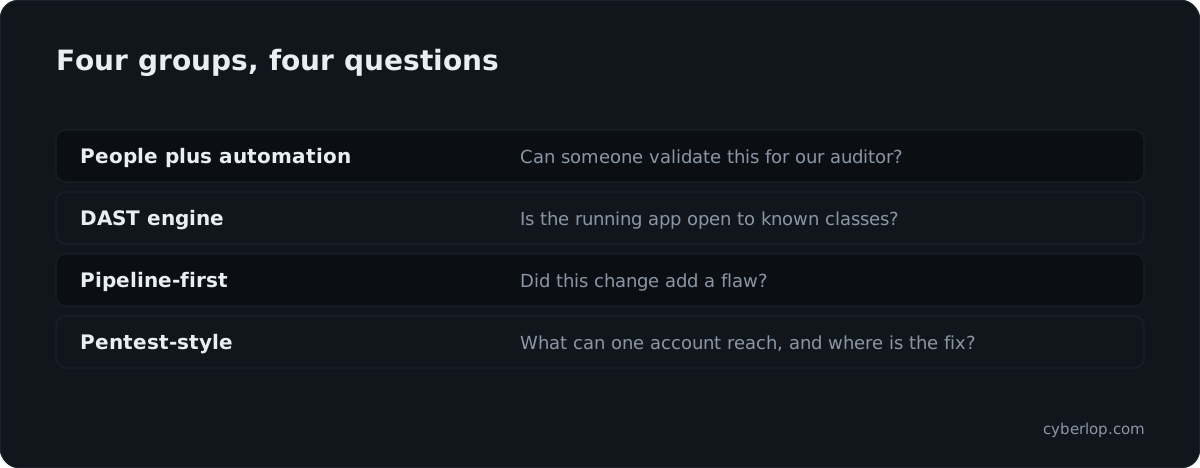
| If your question is | Look first at | Why |
|---|---|---|
| "Can a person validate this for our auditor?" | Astra Security, Pentest-Tools.com | Both describe human expertise or reporting aimed at that need |
| "What else do we expose beyond web apps?" | Intruder, Pentest-Tools.com | Network, cloud and attack surface scope are listed |
| "Will a pull request fail when it adds a flaw?" | StackHawk, Burp Suite DAST, Escape | Each describes CI/CD gating |
| "Can we do this for free?" | ZAP | Free and open source, with automation options |
| "Does one account reach another account's data?" | Cyberlop, Escape, StackHawk | Cross-account access, multi-tenant logic and BOLA are named |
| "Where in the code is the fix?" | Cyberlop, StackHawk | White-box file and line; code-level context |
How do you choose a Beagle Security alternative?
Choose with seven written criteria, then score each tool against them on one real app. This keeps the decision on evidence rather than on a demo. Our AI pentesting buyer's guide covers the same ground for the wider market.
The seven criteria
1. Proof of exploit
Ask what a finding contains. Look for the request, the response and a way to reproduce it. A proof of exploit turns an argument into a fix ticket.
2. False positives
Vendors publish their own rates, and none are comparable. Count in your trial how many findings your team closes as "not real". See false positive rate.
3. Authentication and roles
Give every tool two accounts with different permissions and ask it to cross the line. Broken access control and cross-account access are the flaws scanners miss most.
4. Business logic
Seed one flaw such as a discount applied twice and see which tool finds it without hints. Compare a recorded flow with one the tool works out itself.
5. Where the data goes
Ask where your code, traffic and findings are stored. If the app is internal, check for a tunnel, an agent or private scanning inside your network.
6. Pipeline fit
Check that the tool can run on a schedule or in CI/CD and gate a build with a security gate that your developers accept.
7. Fix verification
Ask how you know a fix worked. A fresh scan that finds nothing is weaker than closed-loop retest, which re-runs the exact exploit.
Where does Cyberlop fit?
Cyberlop is one option in the pentest-style group. It finds vulnerabilities in web apps and their APIs with black-box, grey-box and white-box pentesting. In white-box mode it reads your code while testing the running app, so a finding can point to the file and line. It reports what it actually exploited: each finding carries the request, the response, a screenshot where a person can see it, and the line of code.
It keeps severity and confidence apart, attaches CWE and OWASP references, and checks business-logic flaws and cross-account access. A fix is proven by re-running the exact exploit against the new code. It can run inside your own network, on a schedule or in CI/CD, and agencies can run it under their own brand. If you need a named human tester, network scanning or a free tool, the options above describe those. Read how to read a finding and see the evidence.
How do you run a fair trial of two tools?
Run the same two-week trial on one application, with the same accounts and the same seeded flaws, for every tool. It keeps the comparison fair enough to defend in a budget review. Keep the scope in writing, as described in pentest scope.
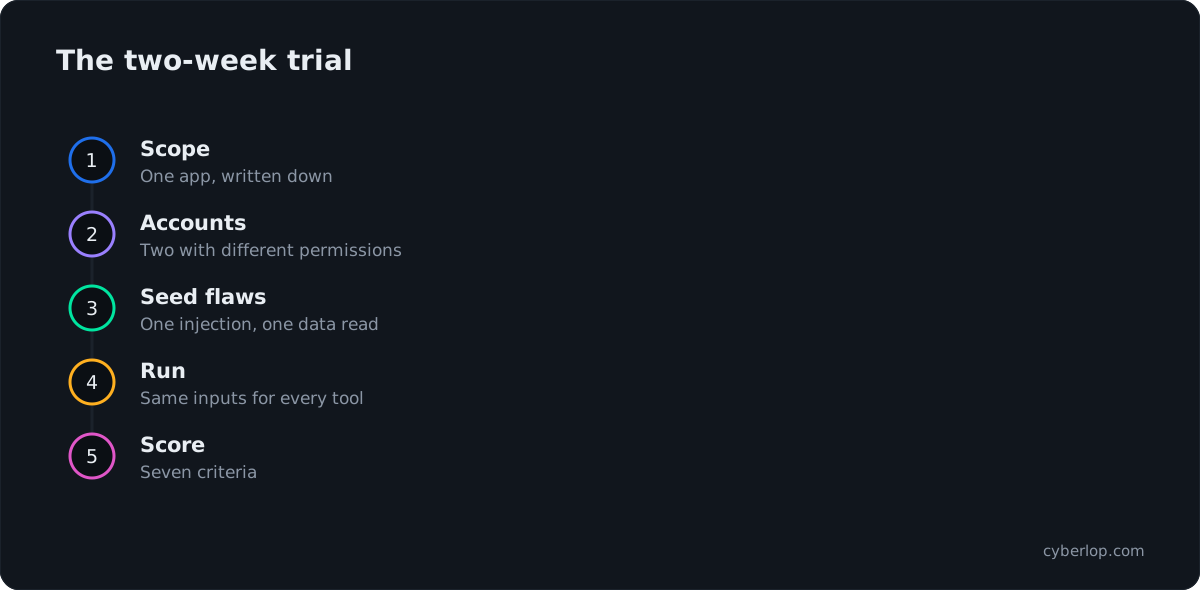
- Name the question. Write the one thing you cannot answer today.
- Pick two tools from different groups, using the tables above.
- Agree scope. One app, its APIs and the test windows.
- Create two accounts with different permissions.
- Seed two flaws: one injection and one account-to-account data read.
- Run and record proof, false positives and setup time.
- Score against the seven criteria, then name the gap you will cover another way.
What no single tool replaces
Automated and agentic testing do not replace judgement. Keep a person on scoping, on triage and on risk acceptance, and use the vulnerability management process you already have. Our honest page lists what we do not claim. For the wider picture read continuous penetration testing and DAST vs SAST vs IAST.
Questions people ask
Beagle security alternatives: FAQs
What is the best alternative to Beagle Security?
It depends on the gap. For a person to validate findings, Astra Security describes human expertise alongside scanning. For pipeline gates, StackHawk, Escape and Burp Suite DAST describe CI/CD use. For network and cloud scope, Intruder. For depth on logic and cross-account access, a pentest-style tool such as Cyberlop.
Is there a free alternative to Beagle Security?
ZAP calls itself "free and open source" and lists automation through Docker, GitHub Actions and an API. You supply the setup, tuning and triage. Beagle itself describes a 14-day free trial and a free plan; see each vendor's pricing page for terms.
Is Beagle Security a DAST tool or a pentest tool?
The vendor calls it an agentic pentesting platform and contrasts itself with traditional vulnerability scanners. Ask what each finding contains and whether it was exploited, because the label alone does not tell you.
Does Beagle Security test APIs and GraphQL?
Yes. The vendor lists web apps, APIs and GraphQL, with Postman and Swagger/OpenAPI formats and OAuth, JWT and API key authentication on its API page. API discovery is described for enterprise accounts.
Can Beagle Security test internal applications?
The vendor describes Cosmog, a private tunnel with a lightweight client on an internal machine and outbound-only connectivity. It lists internal apps, staging environments and internal APIs as uses.
Which tools run in CI/CD?
Beagle Security, Burp Suite DAST, StackHawk, Escape and ZAP describe pipeline or automation use on their own sites. Cyberlop can run on a schedule or in CI/CD and gate a build. Check the exact integrations you use.
Which tools find broken access control?
StackHawk lists BOLA, BFLA and broken access control. Escape lists access control and multi-tenant testing. A pentest-style tool checks cross-account access with signed-in accounts. Confirm with a seeded flaw in your own app.
How should I compare tools fairly?
Run the same two-week trial on one application with the same accounts and seeded flaws. Score proof, false positives, authentication, data handling, pipeline fit and fix verification.
Sources
Where the facts come from
- Beagle Security: home page
- Beagle Security: web application security testing
- Beagle Security: API security testing
- Beagle Security: Cosmog
- Beagle Security: DevSecOps tools
- Beagle Security: features
- Beagle Security: pricing
- Beagle Security: why Beagle
- Astra Security: home page
- PortSwigger: Burp Suite DAST
- Escape: home page
- Intruder: home page
- Invicti: home page
- Pentest-Tools.com: home page
- StackHawk: product
- ZAP: home page
- ZAP: automation
- Verizon: 2026 Data Breach Investigations Report
- IBM: Cost of a Data Breach Report 2026
- CISA: Known Exploited Vulnerabilities Catalog
- OWASP: Top 10:2021 A01 Broken Access Control
Keep reading
Related articles
Astra Security alternatives in 2026: nine options and how to choose
Astra Security alternatives compared from vendor sites: human-led PTaaS, AI pentesting, DAST in CI, attack surface tools and open source.
Best AI pentesting tools in 2026: ten compared, and how to choose
Ten AI pentesting tools compared from vendors' own sites, with a scoring sheet, a table by category and a plan for a fair trial on your own app.
Best DAST tools 2026: twelve compared and how to choose
Twelve DAST tools compared from vendor docs: authentication, APIs, CI/CD, proof and deployment, plus a decision table and a one-week bake-off.

Test what scanners cannot prove
Cyberlop finds vulnerabilities in web apps and their APIs with black-box, grey-box and white-box pentesting, and reports only what it exploited, with the request, response and line of code. Ask us to run it on one of your applications.
Or start with a $199 pilot on one application: thirty days, success criteria agreed before day one, credited against the annual if you convert.