
Home / Blog / Astra security alternatives
Compare
Astra Security alternatives in 2026: nine options and how to choose
Astra sells pentests, a DAST scanner, API and cloud scanning as one platform. This guide compares nine alternatives, using only what each vendor publishes.
Cyberlop Labs · Updated · 13 min read
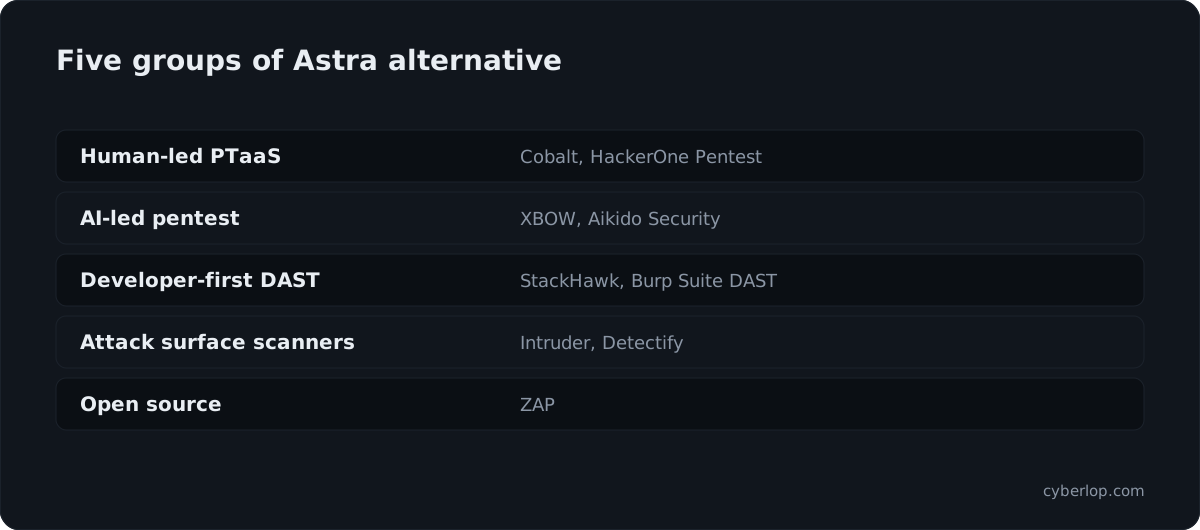
Astra Security is a platform offering pentest as a service, a DAST scanner, API security and cloud scanning. Alternatives fall into five groups: human-led PTaaS (Cobalt, HackerOne Pentest), AI-led pentesting (XBOW, Aikido), developer-first DAST (StackHawk, Burp Suite DAST), attack surface scanners (Intruder, Detectify) and open source (ZAP). Choose by report audience, authentication, proof and retest.
- Astra is a broad platform, so alternatives are either specialists or different models of the same job.
- Alternatives fall into five groups: human-led PTaaS, AI-led pentesting, developer-first DAST, attack surface scanners and open source.
- Decide who reads the output first: an auditor needs a report, a developer needs a pull-request result.
- Check authentication, proof of each finding and how fixes are retested before comparing anything else.
- Trial two or three tools on the same staging app with the same accounts and written authorisation.
Astra Security alternatives in 2026 fall into five groups: human-led penetration testing as a service, AI-led pentesting, developer-first DAST in CI, external attack surface scanners, and open-source tools. Which group suits you depends on whether you need a pentest report for an auditor, a scanner that runs on every pull request, or both. This guide compares nine alternatives, plus where Cyberlop fits, using only what each vendor publishes.
Astra Security is a security vendor whose site describes a pentest-as-a-service (PTaaS) platform, a DAST scanner, an API security platform and a cloud vulnerability scanner. Every vendor statement below was read on the vendor's own site, docs or GitHub page on 7 October 2026. No prices appear here: see each vendor's pricing page.
What is Astra Security, and how does its model work?
Astra Security sells security testing as a platform. Its home page lists four products: a PTaaS platform, a DAST scanner, an API security platform and a cloud vulnerability scanner. It describes the pentest model as human expertise combined with automation.
The products, in the vendor's words
Per the vendor's home page, the PTaaS platform "transforms pentests into an agile, incremental, and developer-friendly experience". The DAST scanner "scans for over 10,000 vulnerabilities, including OWASP Top 10 and CVEs". The API platform can "identify shadow, zombie, and undocumented APIs", and the cloud scanner "detects 400+ misconfigurations and risks across AWS, Azure, and GCP".
The pentest page pairs manual testing "by certified experts in OWASP, APTS, SANS, PTES standards" with autonomous AI-powered testing. It lists web applications, mobile apps, cloud, network, AI and MCP as scope, a "publicly verifiable pentest certificate", compliance views for SOC 2, ISO 27001, PCI DSS and HIPAA, and human re-scans after fixes. The number of re-scans depends on the plan, so read the plan details.
How the scanner and the pentests connect
On its DAST page Astra says scans reach "behind login forms, including TOTP-based MFA", that REST, SOAP and GraphQL APIs are covered, and that CI/CD integrations include GitHub Actions, GitLab CI, Jenkins and Bitbucket. It also says "every pentest our security engineers perform feeds back into our DAST vulnerability scanner". Users can mark false positives so they are skipped in later scans, and expert vetting of findings is offered.
Partners
Astra's partner page names compliance platforms, managed service providers, managed security service providers (MSSPs), insurance providers, individual auditors and venture capitalists as partner types. If you run an agency, ask any vendor in this guide, Astra included, whether reports and dashboards can carry your own brand, because the page text does not settle that.
Why do teams look for Astra Security alternatives?
Teams look for alternatives when the shape of the product stops matching the shape of the need. Astra is a broad platform; that breadth suits many teams and is a reason to look elsewhere for others. Five questions come up most often.
1. Do you want one specialist instead of a bundle?
A platform that covers pentests, a scanner, APIs and cloud is convenient. A team that already has a cloud posture tool and only wants proof-backed web and API findings may prefer a narrower product. The reverse also holds, and the bundle is the right answer for many small teams.
2. Is your pentest buyer an auditor or an engineer?
If an auditor or customer asks for a signed report, a human-led or hybrid service is the safer fit. If engineers want a result on the pull request, look at CI-first tools. The two groups of vendors below are built around different buyers.
3. Do you need network and external-perimeter coverage?
Astra's pentest page lists network testing. Some vendors in this guide, such as Intruder, centre their products on infrastructure and attack surface. If your estate is mostly servers and cloud accounts, that emphasis matters more than web-app depth.
4. Do you want to read the code that the test is about?
Most DAST tools test a running app from outside. Tools that also read your source can point a finding at a file and line. That is the white-box approach, and it changes how quickly a developer can fix what was found.
5. Do you want to run, tune and audit the tool yourself?
Open-source scanners cost engineer time instead of licence fees, and give full visibility into what they do. Some teams need exactly that.
How do the alternatives compare at a glance?
The nine alternatives sit in five groups, each answering a different buying question. The table below summarises what each vendor says its product is; the sections that follow give the detail and the limits.
Summary of the nine alternatives plus Cyberlop
| Option | Group | Who runs the test | Natural buyer | Web and API focus |
|---|---|---|---|---|
| Cobalt | Human-led PTaaS | Vetted testers plus AI | Security or compliance owner | Yes, web, API, AI/LLM |
| HackerOne Pentest | Human-led PTaaS | Vetted pentesters; agentic option | Security or compliance owner | Yes, matched to asset |
| XBOW | Autonomous pentest | AI platform | Security team | Yes, apps and APIs |
| Aikido Security | Developer platform | Automated, with AI pentest agents | Engineering lead | One part of a wider suite |
| StackHawk | Developer-first DAST | Scanner in the pipeline | Engineering lead | Yes, APIs incl. GraphQL, gRPC |
| Burp Suite DAST | Scanner at scale | Scanner | AppSec team | Yes, SPAs and APIs |
| Intruder | Infrastructure and surface | Scanner | IT or security owner | Web checks plus network |
| Detectify | Surface plus app scanning | Scanner plus research | Security owner | Yes, REST and GraphQL |
| ZAP | Open source | You | Engineer | Yes, web apps |
| Cyberlop | Proof-backed pentesting | Cyberlop engine | Product team, agency, MSSP | Yes, web apps and APIs |
Why does web and API testing still matter in 2026?
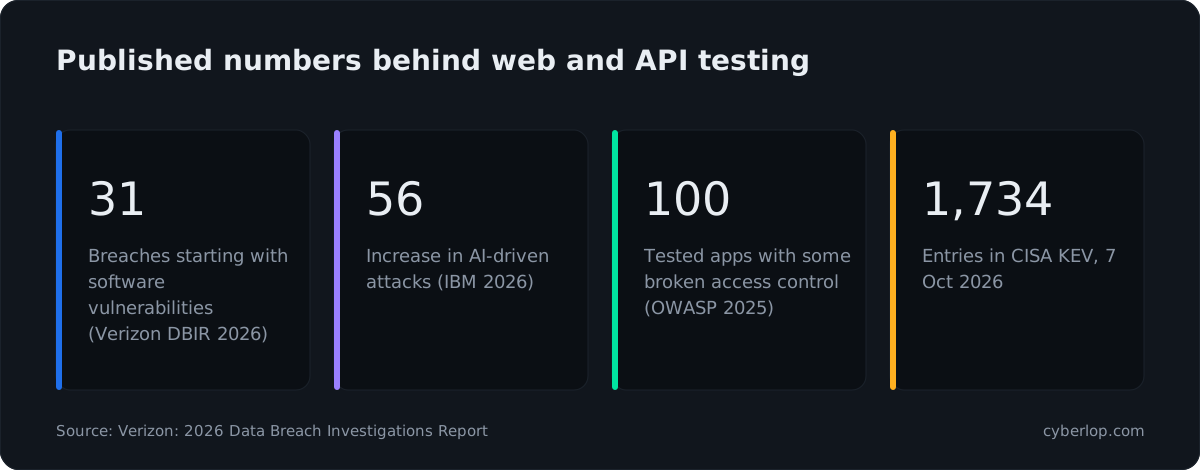
Published breach data keeps pointing at software flaws. The Verizon 2026 Data Breach Investigations Report reports that 31% of breaches now start with a software vulnerability, ahead of stolen passwords as the top way in.
The IBM Cost of a Data Breach Report 2026 puts the global average cost of a breach at $4.99 million, a 12% rise on the year before, and reports a 56% increase in AI-driven attacks. On the access-control side, the OWASP Top 10:2025 found some form of broken access control in 100% of the applications it tested. And the CISA Known Exploited Vulnerabilities catalogue listed 1,734 entries when read on 7 October 2026.
None of these numbers tells you which tool to buy. They do show why the test has to find real, exploitable flaws, including broken access control, which many scanners find hard to judge without knowing your accounts.
Which human-led PTaaS tools are alternatives to Astra?
Cobalt and HackerOne Pentest are the two human-led services in this guide. Both put vetted testers behind a platform, which suits teams that need a report a person has signed off. For the model in general, see pentest as a service.
Cobalt
What the vendor says
Cobalt's site describes "human-led, AI-powered pentesting that scales with your attack surface". The Cobalt Core is described as 500+ vetted security professionals. The platform promises you can "launch in hours, get real-time findings and direct access to testers", with 50+ integrations. Services include web, API, autonomous and AI/LLM application pentesting, network and cloud assessments, red teaming and secure code review.
Where it wins, and who it suits
Cobalt wins on breadth of human services: application, network, cloud and red team work from one vendor. Companies that run a regular programme and want direct contact with testers get the most from it. For scanning on every commit, pair it with a CI tool.
HackerOne Pentest
What the vendor says
HackerOne's pentest page describes H1 Pentest, "expert-driven, modern pentesting", and H1 Agentic Pentest, which combines "AI agents and human experts". Testers are "carefully matched to your asset type and technology stack". After fixes, testers "revisit the vulnerabilities and validate that all patches are successful". Reports include "proofs of concept and recommendations for fixes" and support standards such as SOC 2 and ISO 27001.
Where it wins, and who it suits
HackerOne is strongest if your team already works on its platform or wants pentests and other programmes in one place. Security owners who value human validation of fixes will like the retest step, but compare the retest terms in writing, as plans differ.
Which AI-led pentesting tools can replace or sit beside Astra?
XBOW and Aikido Security both put AI at the centre, but they are different products. XBOW is an autonomous pentester. Aikido is a developer security platform with AI pentest agents inside it. For the category as a whole, see best AI pentesting tools and XBOW alternatives.
XBOW
XBOW's site calls it an autonomous pentesting platform that validates exploitability. It says each finding includes the chained attack path, "the working exploit that proves it", a decision log and remediation advice. You define the scope, and actions are logged and auditable. The vendor lists alignment with SOC 2, ISO 27001, PCI DSS and NIS 2, and says you point it at a URL. Teams that want continuous, proof-first testing and can supply scope and context will get the most from it. If a human-signed report is the requirement, check whether the output meets your auditor's expectations.
Aikido Security
Aikido's site lists SAST, SCA, DAST, secrets detection, container and infrastructure-as-code scanning, cloud posture and AI-powered penetration testing agents. It stresses developer workflow, with automated fixes proposed as pull requests rather than tickets. A small engineering team that wants one tool for many scan types is the natural buyer. Web and API pentesting is one capability among many, so judge its depth on your own app.
Which DAST tools suit teams that test on every pull request?
StackHawk and Burp Suite DAST are the two scanner-first options here. Both run in a pipeline and test a running app. For how DAST differs from other test types, read DAST vs SAST vs IAST, and for tool lists see best DAST tools.
StackHawk
StackHawk's site positions it as DAST that runs in the developer loop, testing running applications to "surface exploitable vulnerabilities before pull requests are opened". It lists API testing with GraphQL and gRPC support, a find, fix and verify workflow, and integrations with coding agents including Claude Code, Cursor and GitHub Copilot. Engineering-led teams that want security as a pre-merge gate are its core audience. It is a scanner, so add a pentest if a customer wants a human-written report.
Burp Suite DAST
PortSwigger's Burp Suite DAST page describes a "browser-powered Chromium crawler that handles modern JavaScript SPAs", authenticated scanning, and API coverage for Postman Collections, OpenAPI, SOAP and GraphQL. CI integrations include Jenkins, GitHub Actions, GitLab CI, Azure DevOps and TeamCity, among others. Enterprise features include role-based access control, SAML SSO and audit trails, and deployment can be cloud, self-hosted or Kubernetes. AppSec teams scanning many sites are the target. See Burp Suite Enterprise alternatives for the wider field.
Which scanners cover the wider attack surface?
Intruder and Detectify start from the question "what is exposed?" and add application checks. They suit teams whose risk is as much unknown assets as known apps. See also Intruder alternatives and Detectify alternatives.
Intruder
Intruder's site lists external infrastructure, internal networks, web applications (DAST with "over 75 application checks"), APIs and agentless scanning across AWS, Azure and Google Cloud. It adds attack surface management, 15+ integrations and compliance support for SOC 2, ISO 27001, PCI DSS, HIPAA and DORA. Small IT and security teams that want network and web exposure in one place are the obvious fit.
Detectify
Detectify's site describes continuous discovery of external assets, authenticated application scanning, API scanning for REST and GraphQL, and research from a community of 400+ ethical hackers. It also lists internal scanning and PCI ASV scanning. Security owners who want a continuously updated view of what is exposed, with web checks behind it, are the target.
Is there an open-source alternative to Astra?
Yes. ZAP, the Zed Attack Proxy, is free and open-source. It does not replace a human pentest report, but it can replace a basic scanner if you have the time to run it.
ZAP
The ZAP repository describes it as "the world's most widely used web app scanner", free and open source under the Apache 2.0 licence, built to "automatically find security vulnerabilities in your web applications while you are developing and testing". It also serves manual testers, and the repository includes Docker support. You supply the setup, authentication scripts and triage, so budget engineer hours. See Burp Suite vs ZAP.
Where does Cyberlop fit?
Cyberlop is one option for teams that want findings with proof, not a list of suspicions. It finds vulnerabilities in web apps and their APIs with black-box, grey-box and white-box pentesting.
What it does
In white-box mode Cyberlop reads your code while testing the running app, so a finding can point to the file and line. It reports what it actually exploited: each finding carries the request, the response, a screenshot where a person can see it, and the line of code. Its rule is "if we did not break it, we do not report it". Severity and confidence are kept apart, and findings carry CWE and OWASP references.
It checks business-logic flaws and cross-account access, meaning one signed-in account reaching another's data or functions. A fix is proven by re-running the exact exploit against the new code, a closed-loop retest, not by a fresh scan. It can run inside your own network (private scanning), on a schedule or in CI/CD, and it can gate a build.
Who it suits, and who should pick something else
It suits product teams that want proof and a fix check, and agencies and MSSPs that run it under their own brand (partners, agencies). Pick a different option from this guide if your priority is a human-signed report from a named tester, network and cloud-infrastructure coverage, or a free tool you operate yourself. See the comparison page and our honest limits.
How do you choose an Astra Security alternative?
Choose by the output you must hand to someone else, then by where the test runs, then by proof. The criteria below turn that into a short review you can finish in a week.
Criteria that decide the choice
| Criterion | Question to ask the vendor | Lean towards |
|---|---|---|
| Audience for the report | Who reads the output: auditor, customer or developer? | Human-led PTaaS for auditors; CI tools for developers |
| Authentication | Can it test behind login, MFA and across two accounts? | Tools that document authenticated scanning |
| Proof | Does each finding show a working exploit, request and response? | Exploit-backed tools |
| Retest | Is a fix re-tested by a person, a re-scan or the same exploit? | Written retest terms |
| API coverage | Which definitions are read: OpenAPI, Postman, GraphQL? | Tools that list formats |
| CI fit | Can a failed check block a merge? | Pipeline-native tools |
| Data location | Does code or traffic leave your network? | Self-hosted or private options |
| Scope beyond the app | Network, cloud, mobile? | Platform or surface vendors |
Do you need both a scanner and a pentest?
A scanner runs often and catches known classes cheaply; a pentest, human or autonomous, looks for chained and logic flaws. The continuous penetration testing guide explains how to run both, and the web application pentest guide explains what a good one covers.
What do auditors expect?
Auditors for SOC 2, ISO 27001 and PCI DSS usually want a scoped test, a dated report and evidence of retest. Check the standard, not the vendor's badge. See SOC 2 penetration testing.
Questions to put to each vendor
- Which of these will I receive: a signed report, a scan export or a live dashboard?
- Is each finding confirmed by exploiting it, and how is that shown?
- How is a fix verified, and by whom?
- Can it test an app that has two or more roles, and compare what each account can reach?
- Where does my code and traffic go?
- Can reports carry my own brand, if I am an agency?
- What does the contract say about scope, retests and data deletion?
How do you trial the shortlist fairly?
Run every shortlisted tool against the same staging app, with the same accounts and the same written authorisation. Nine steps cover it.
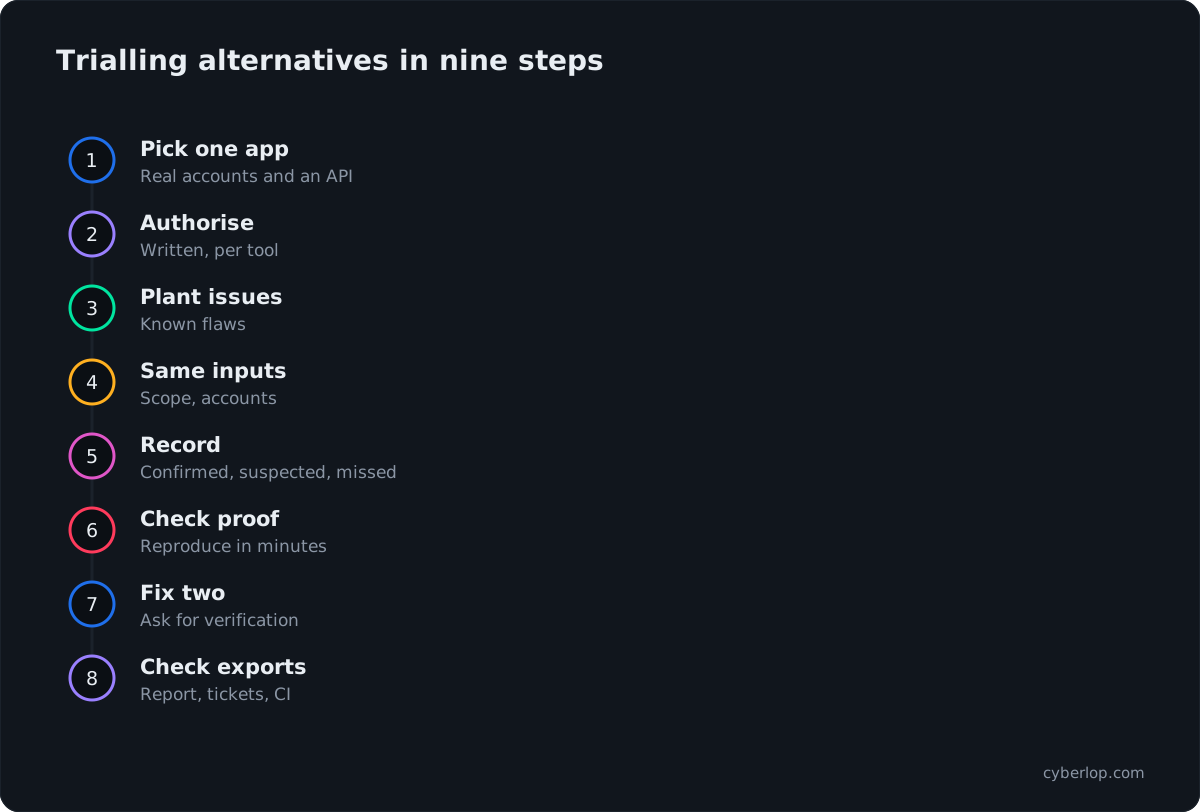
- Pick one application. Choose an app with real accounts and an API. A staging copy with test data is fine.
- Get written authorisation. Obtain written permission for each tool, open-source ones too.
- Plant known issues. Add a cross-account read, an injection point and a workflow flaw you already understand.
- Give every tool the same inputs. Same scope, accounts and API definition.
- Record findings. Count confirmed findings, suspected ones and misses.
- Check the proof. Can a developer reproduce each one in minutes?
- Fix two findings. Then ask each vendor to verify the fix.
- Check the exports. Look at the report, tickets, CI result and audit evidence.
- Decide with three people. Security, engineering and whoever signs the audit.
Mistakes that skew a trial
- Testing production without written scope.
- Giving one tool an API definition and another none.
- Counting raw finding totals instead of confirmed ones.
- Skipping the fix check, which is where tools differ most.
What each group still leaves for you
| Group | Strength | Gap you may still cover |
|---|---|---|
| Human-led PTaaS | Signed reports, human judgement | Between-test coverage: pair with CI |
| AI-led pentest | Proof of exploitability, continuous | Human-signed attestation, if needed |
| Developer-first DAST | Fast feedback in the pipeline | Chained and logic flaws; formal report |
| Surface scanners | Discovery of unknown assets | Depth inside authenticated apps |
| Open source | Visibility and control | Setup, tuning and triage time |
So which Astra alternative should you pick?
There is no universal winner, so match the group to the job. If an auditor will read the output, Cobalt and HackerOne Pentest are the natural starting points. If engineers need a pull-request gate, look at StackHawk or Burp Suite DAST. Unknown assets are the concern for Intruder and Detectify, and a zero licence budget points to ZAP. Where the priority is proof-backed web and API findings, XBOW, Aikido and Cyberlop belong on the shortlist. Whatever you pick, test two on the same app and compare the proof.
Questions people ask
Astra security alternatives: FAQs
What is Astra Security?
Astra Security is a security vendor whose site describes a pentest-as-a-service platform, a DAST scanner, an API security platform and a cloud vulnerability scanner. It says its pentests combine human expertise with automation.
What are the best Astra Security alternatives?
It depends on the job. Cobalt and HackerOne Pentest are human-led services. XBOW and Aikido put AI at the centre. StackHawk and Burp Suite DAST suit pipelines. Intruder and Detectify cover wider exposure. ZAP is open source. Cyberlop offers proof-backed web and API pentesting.
Is there a free alternative to Astra Security?
ZAP is free and open source under the Apache 2.0 licence, per its GitHub repository. It is a scanner you set up and tune yourself, so it does not give you a human-written pentest report.
Does Astra Security offer manual penetration testing?
Yes. Astra's pentest page lists manual pentesting by certified experts alongside autonomous AI-powered testing. Human re-scan counts depend on the plan, so confirm them before you buy.
Can a DAST scanner replace a penetration test?
Not on its own. A scanner runs often and finds known classes of flaw. A pentest looks for chained and business-logic flaws and produces a dated report. Many teams run both.
Which alternative is best for SOC 2 or ISO 27001 evidence?
Auditors usually want a scoped test, a dated report and proof that fixes were retested. Human-led services such as Cobalt and HackerOne Pentest describe reports for SOC 2 and ISO 27001 on their sites. Confirm with your auditor first.
Which alternatives work for agencies and MSSPs?
Astra lists MSSPs among its partner types. Cyberlop lets agencies and MSSPs run it under their own brand. Ask any vendor whether reports and dashboards can carry your brand.
How do I compare these tools fairly?
Run each against the same staging app with the same accounts and written authorisation, plant a few known flaws, and count confirmed findings and misses. Then fix two findings and ask each vendor to verify the fix.
Sources
Where the facts come from
- Astra Security: home page
- Astra Security: pentest
- Astra Security: DAST scanner
- Astra Security: partner page
- Cobalt: home page
- HackerOne: Pentest
- XBOW: home page
- Aikido Security: home page
- StackHawk: home page
- PortSwigger: Burp Suite DAST
- Intruder: home page
- Detectify: home page
- ZAP: GitHub repository
- Verizon: 2026 Data Breach Investigations Report
- IBM: Cost of a Data Breach Report 2026
- OWASP: Top 10:2025, A01 Broken Access Control
- CISA: Known Exploited Vulnerabilities catalog
Keep reading
Related articles
Best AI pentesting tools in 2026: ten compared, and how to choose
Ten AI pentesting tools compared from vendors' own sites, with a scoring sheet, a table by category and a plan for a fair trial on your own app.
Best DAST tools 2026: twelve compared and how to choose
Twelve DAST tools compared from vendor docs: authentication, APIs, CI/CD, proof and deployment, plus a decision table and a one-week bake-off.
Burp Suite Enterprise alternatives in 2026: Burp Suite DAST and seven tools compared
Burp Suite Enterprise Edition is now Burp Suite DAST. Seven alternatives compared from vendor sources, with a choice table and a two-week bake-off plan.

Test one app, compare the proof
Cyberlop finds vulnerabilities in web apps and APIs with black-box, grey-box and white-box pentesting, and reports only what it exploited, with request, response and the line of code. Ask us to run it on one of your applications.
Or start with a $199 pilot on one application: thirty days, success criteria agreed before day one, credited against the annual if you convert.