
Home / Blog / Best penetration testing companies in india
Compare
Best penetration testing companies in India (2026): nine providers and how to choose
Nine Indian penetration testing providers, described from their own sites and the CERT-In list of empanelled auditors, in alphabetical order, plus a scorecard to choose between them.
Cyberlop Labs · Updated · 13 min read

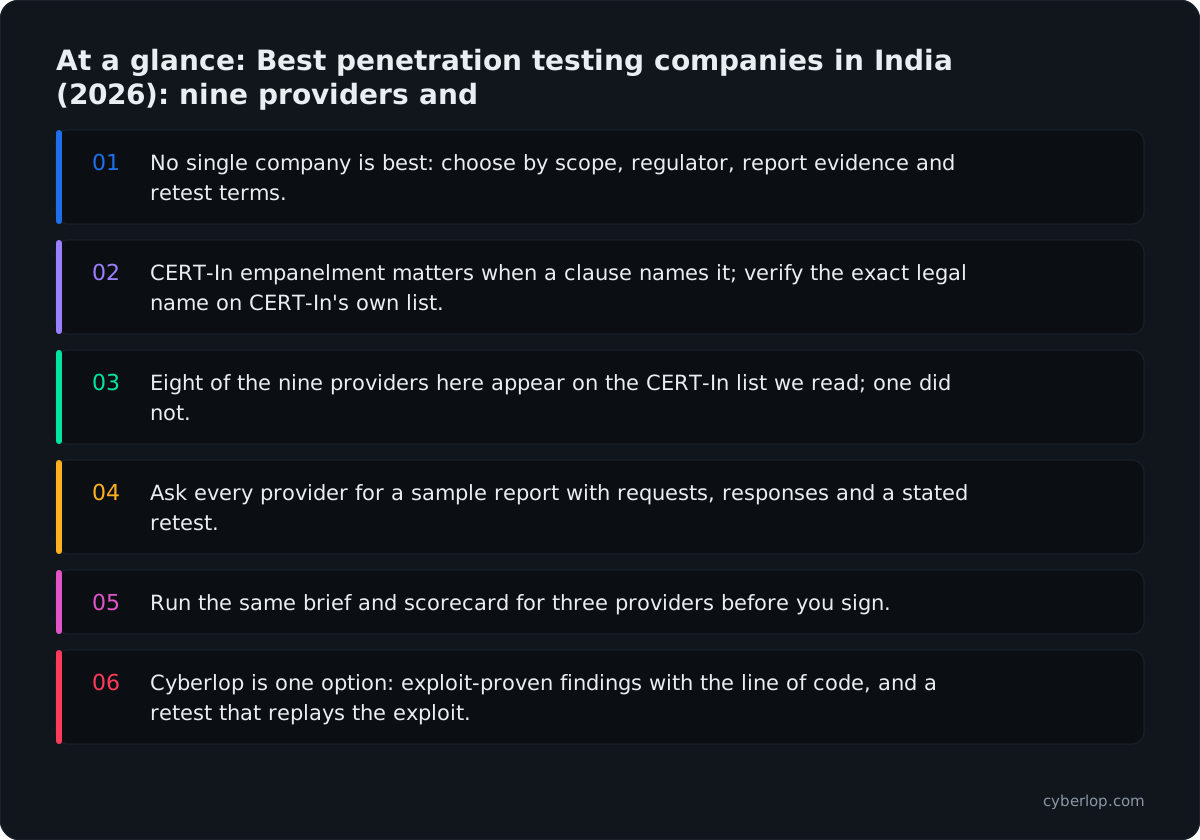
The best penetration testing company in India depends on your scope and your regulator. Shortlist providers such as Astra Security, Briskinfosec, Kratikal Tech, Payatu and Security Brigade, check the exact name on CERT-In's empanelled auditor list, then compare sample reports, evidence and retest terms before you sign.
- No single company is best: choose by scope, regulator, report evidence and retest terms.
- CERT-In empanelment matters when a clause names it; verify the exact legal name on CERT-In's own list.
- Eight of the nine providers here appear on the CERT-In list we read; one did not.
- Ask every provider for a sample report with requests, responses and a stated retest.
- Run the same brief and scorecard for three providers before you sign.
- Cyberlop is one option: exploit-proven findings with the line of code, and a retest that replays the exploit.
The best penetration testing companies in India for 2026 are the ones that match your scope, your regulator and your report needs, so there is no single winner. This guide covers nine providers, from Astra Security to Security Brigade, using each company's own site and the official CERT-In list of empanelled auditors, and it gives you a method to choose between them. A penetration testing company in India is an organisation that tests your software, infrastructure or cloud for exploitable weaknesses under written authorisation, then reports what it found with evidence and a fix path.
We list providers in alphabetical order inside each group, not by merit. Every vendor fact below comes from that vendor's own pages or from CERT-In, and nothing here is a ranking, a price or a promise of results.
What is CERT-In empanelment, and do you need it?
CERT-In empanelment means the Indian Computer Emergency Response Team lists an organisation as an approved information security auditor. CERT-In publishes the list itself and describes it as the "up-to-date valid list of CERT-In Empanelled Information Security Auditing Organisations" (CERT-In empanelled auditor list, read 7 October 2026). The copy we read numbers 236 entries.
Whether you need an empanelled auditor depends on who asks. A regulator, a government tender or an enterprise customer may name it in a contract. A startup preparing for a SOC 2 audit or an investor review usually cares more about report quality than about the list. Read the clause that asks for the test, then decide. For the longer explanation see CERT-In empanelled VAPT and the term CERT-In directions.
What does empanelment show, and what does it not?
It shows that CERT-In has accepted the organisation onto its published list, and each entry carries details the organisation supplied itself, with a date. For example, the Kratikal Tech Limited entry states it has carried out information security audits since 2013 and lists network, web application and wireless security audit among its capabilities (CERT-In empanelled auditor list).
It does not tell you how good the tester on your engagement is, how clear the report is, whether the team understands your business logic, or how fast a retest happens. Treat the list as a starting filter, then judge the work. For a neutral framework, see how to choose a penetration testing company and choosing a pentest provider.
What should you check on the CERT-In list itself?
- Exact legal name. Entries use the registered company name, which can differ from the brand. Astra Security appears as "Astra Security (Czar Securities Pvt. Ltd.)".
- Capabilities. Web application audit and network audit are listed separately in the entry forms.
- The date on the information. Entries state when the organisation supplied its details.
- Current status. The list is updated by CERT-In, so re-check it on the day you sign.
Why does penetration testing matter in 2026?
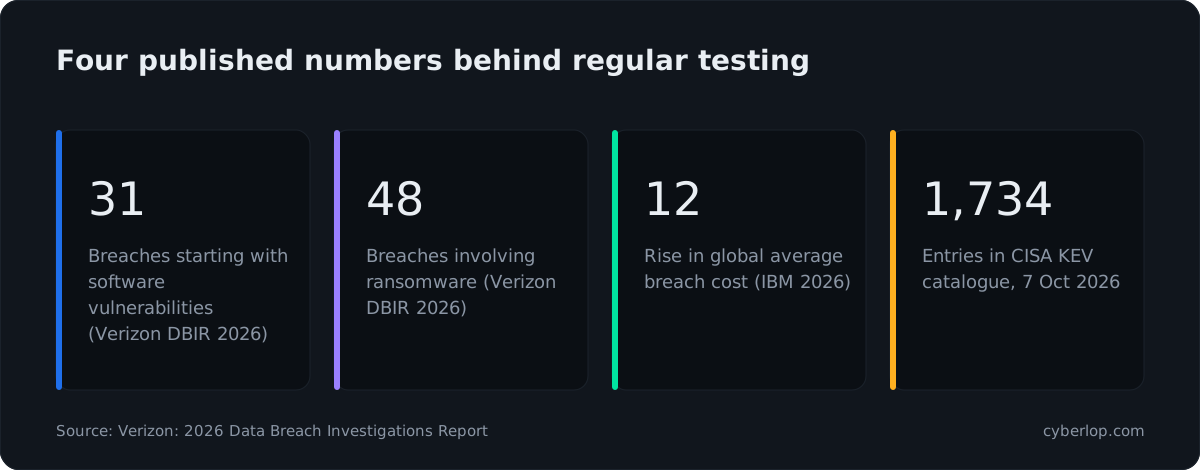
Attackers increasingly start with software flaws, and published figures show it. Verizon's 2026 Data Breach Investigations Report finds that software vulnerabilities start 31% of breaches, now ahead of stolen passwords, and that "48% of all breaches now involve ransomware" (Verizon DBIR, 2026). IBM's 2026 Cost of a Data Breach report puts the global average cost up 12% on the year, a record high (IBM Cost of a Data Breach, 2026).
The pressure to fix known flaws is also visible in public data. CISA's Known Exploited Vulnerabilities catalogue showed 1,734 entries when we read it on 7 October 2026 (CISA KEV catalogue). Each entry is a flaw that has been exploited in the wild, and the catalogue keeps growing.
India adds its own clock. CERT-In's 28 April 2022 directions require service providers, body corporates and government organisations to report listed cyber incidents "within 6 hours" of noticing them, and to keep logs of ICT systems for a rolling 180 days within Indian jurisdiction (CERT-In directions, 28 April 2022). See breach notification.
How do you choose a penetration testing company in India?
Choose by evidence and fit, not by a logo wall. Score each shortlisted provider against the same eight criteria below, using a sample report and a scoping call. The table also shows what a good answer looks like.
Eight criteria to score every provider
| Criterion | What to ask | A good answer |
|---|---|---|
| Empanelment and accreditation | Is the company on the CERT-In list, and does your contract require it? | Exact legal name on the list; other credentials named and checkable |
| Methodology | Which standard do testers follow, such as OWASP WSTG or PTES? | Named standard, with a written test plan for your app |
| Test depth | Do they test business logic and cross-account access, or only scan? | Examples of logic findings, not only injection and headers |
| Evidence | Does each finding include a request, a response and steps to reproduce? | A sample report you can replay |
| Report quality | Can a developer fix from the report without a call? | Severity, confidence, CWE and fix guidance kept distinct |
| Retest | How is a fix confirmed, and when? | The same exploit replayed against the fix, in a stated window |
| Data handling | Where do your code and credentials go? | Written answer on storage, access and deletion |
| Fit to your cadence | One annual test, or tests on every release? | Options for scheduled and CI-based testing |
Read the chosen sample report against how to read a penetration test report. Ask how scope is written, using pentest scope and rules of engagement as a guide. A pentest report that mixes severity with confidence is harder to triage, which is why severity vs confidence matters.
What are the red flags?
- No sample report, or only a redacted cover page.
- A scan export relabelled as a penetration test.
- Findings with no request, response or reproduction steps.
- No stated retest, or a retest that only re-runs a scanner.
- A quote that does not say which apps, APIs, roles and environments are in scope.
Cost is a real factor, but we do not quote figures here. Ask each vendor for its pricing page or a written quote against the same scope, and read penetration testing cost for what drives it.
Which penetration testing companies in India should you shortlist?
Nine providers are below, in alphabetical order. Eight appear on the CERT-In empanelled auditor list we read; one does not appear in that copy. Each profile is limited to what the vendor says about itself, so treat the numbers as the vendor's own claims. Product names are written as each vendor writes them.
Providers that appear on the CERT-In list
Astra Security
Astra titles its home page "AI Powered Continuous Pentest Platform" and lists four solutions: PTaaS ("Hacker-style pentesting (VAPT)"), a DAST scanner that "scans for over 10,000 vulnerabilities, including OWASP Top 10 and CVEs", an API security platform and a cloud vulnerability scanner (Astra home page). It lists Jira, Slack and CI/CD integrations and a Trust Center. On the CERT-In list it appears as "Astra Security (Czar Securities Pvt. Ltd.)" with a Chandigarh address. Suits: product teams that want a platform dashboard around the tests. See also Astra Security alternatives.
Briskinfosec
Briskinfosec says it works across offensive security (penetration testing, red team, API, cloud and IoT), managed services and compliance support, and says it is headquartered in Chennai with operations in Dubai (Briskinfosec home page). Its site states it holds CERT-In recognition as an authorised IT security auditor; it is also on the CERT-In list as Briskinfosec Technology and Consulting Pvt Ltd. A sensible pick if you want testing and compliance help from one firm.
Cyber Security Works
Cyber Security Works lists managed security services, vulnerability management and penetration testing, and says it helps organisations "reduce security debt and inherent vulnerabilities in an organization's infrastructure and code" (Cyber Security Works home page). Its CERT-In entry gives an address at IITM Research Park, Chennai. Suits: teams that want testing tied to a wider vulnerability management service.
Indusface
Indusface offers the AppTrana WAAP platform and "Indusface WAS", which it describes as "DAST scanning, vulnerability assessment, and penetration testing" (Indusface home page). Its site lists HITRUST CSF, SOC 2 Type II, PCI DSS and ISO 27001 certifications. It appears on the CERT-In list as Indusface Pvt. Ltd. The draw is scanning, testing and a web application firewall under one vendor.
Kratikal Tech
Kratikal describes AutoSecT as an "AI-Driven pentest and VM platform" covering web apps, mobile apps, APIs, cloud and networks, and names ISO 27001, SOC 2, RBI, SEBI and DPDP among the requirements it addresses (Kratikal home page). Its CERT-In entry gives a Noida address and states audits since 2013. Worth a look if an Indian business wants one partner across several compliance frameworks.
Network Intelligence
Network Intelligence uses the line "Cybersecurity – Powered by AI, Delivered by Humans" and lists offensive services such as vulnerability management, continuous red teaming, breach simulation and AI model testing, alongside strategic and defensive services (Network Intelligence home page). Its site names HITRUST, PCI QSA, CREST and SWIFT CSP among its accreditations, and it appears on the CERT-In list as Network Intelligence Pvt. Ltd. Suits: larger organisations that want testing alongside consulting and managed defence.
Payatu
Payatu describes "research-powered cybersecurity services" covering IoT, cloud, web and mobile application testing, red team exercises and code reviews. It says it is headquartered in Pune, runs the Nullcon and hardwear.io conferences, and calls itself "India's First ISO-17025 Certified Cybersecurity Lab" (Payatu home page). It appears on the CERT-In list as Payatu Security Consulting Private Limited. The natural call for teams with hardware, IoT or deep research needs.
Security Brigade
Security Brigade says it was founded in 2006 in Mumbai and lists web, network, API and mobile penetration testing, red team, cloud, secure code review and compliance audits. It describes two internal platforms: Lemon, for audit management, and B-52, an AI-powered pentesting platform (Security Brigade home page). It appears on the CERT-In list as Security Brigade InfoSec Pvt. Ltd. Suits: buyers who want a long-running Indian auditor with a structured review process.
A provider that did not appear in the copy we read
Qualysec
Qualysec says it is headquartered in Bhubaneswar and Bengaluru and offers penetration testing for web, mobile, API, cloud, IoT and networks, plus source code review. It states that it is CREST accredited, and its dashboard lets clients track vulnerabilities, assign developers, request retests and download reports (Qualysec home page). We did not find it in the CERT-In file we read on 7 October 2026, so check the live list if your contract names empanelment. Suits: product teams that want a dashboard and retest requests, and do not need an empanelled auditor.
Side-by-side: what each provider says about itself
The table compares only what each vendor and CERT-In publish. A blank on a vendor's own page is not a statement that it does not do something, so ask.
| Provider | On the CERT-In list read 7 Oct 2026 | Headline offer on its site | Platform or portal named |
|---|---|---|---|
| Astra Security | Yes, as Astra Security (Czar Securities Pvt. Ltd.) | PTaaS, DAST scanner, API and cloud scanning | |
| Briskinfosec | Yes | Offensive security, managed services, compliance support | |
| Cyber Security Works | Yes | Managed security, vulnerability management, penetration testing | |
| Indusface | Yes | AppTrana WAAP, Indusface WAS, API security | |
| Kratikal Tech | Yes | Penetration testing and vulnerability management | |
| Network Intelligence | Yes | Strategic, offensive and defensive services | |
| Payatu | Yes | Research-led testing for IoT, cloud, web and mobile | |
| Security Brigade | Yes | Pentesting, red team, code review, compliance audits | |
| Qualysec | Not found in the copy read | Pentesting across web, mobile, API, cloud, IoT and network |
What types of penetration testing company exist in India?
Providers fall into three broad models, and many mix them. Knowing the model tells you what to expect in speed, depth and report format.
Consultancy-led testing
Testers work to a scoped project, deliver a report and may retest within an agreed window. This model suits fixed compliance deadlines and one-off audits. See penetration test and what is VAPT.
Platform-led testing (PTaaS)
Findings arrive in a portal where developers comment and request retests. The model suits teams that ship often. Compare the category in best PTaaS platforms and the term pentest as a service.
Tool-led or automated testing
Software runs tests on a schedule or in CI. It suits regression checks between human-led tests, and works best when each finding comes with proof. Read continuous penetration testing and best AI pentesting tools.
Which testing mode should you ask for?
Ask which of black-box, grey-box and white-box testing is included. Black-box is outside-in. Grey-box adds signed-in test accounts. White-box adds source access, so a finding can point to the code. The three find different things, as set out in black box vs grey box vs white box testing.
Where does Cyberlop fit?
Cyberlop is one option, and it is a different kind of option from most firms above. It finds vulnerabilities in web apps and their APIs with black-box, grey-box and white-box pentesting. In white-box mode it reads your code while testing the running app, so a finding can point to the file and line.
It reports what it actually exploited: each finding carries the request, the response, a screenshot where a person can see it, and the line of code. "If we did not break it, we do not report it." Severity and confidence are kept apart, and findings carry CWE and OWASP references. A fix is proven by re-running the exact exploit against the new code, not by a fresh scan.
It also checks business-logic flaws and cross-account access (one signed-in account reaching another's data or functions), can run inside your own network so your code does not leave it, can run on a schedule or in CI/CD and gate a build, and lets agencies and MSSPs run it under their own brand. See how it works, sample evidence and private scanning. If your contract names a specific auditor, check that requirement first; the tests can still sit beside it, and our honest page says where we stop.
How do you shortlist and compare providers in a fair way?
Use the same brief, the same app and the same scoring sheet for every provider. A fair bake-off takes some planning, and it makes the choice far less subjective.
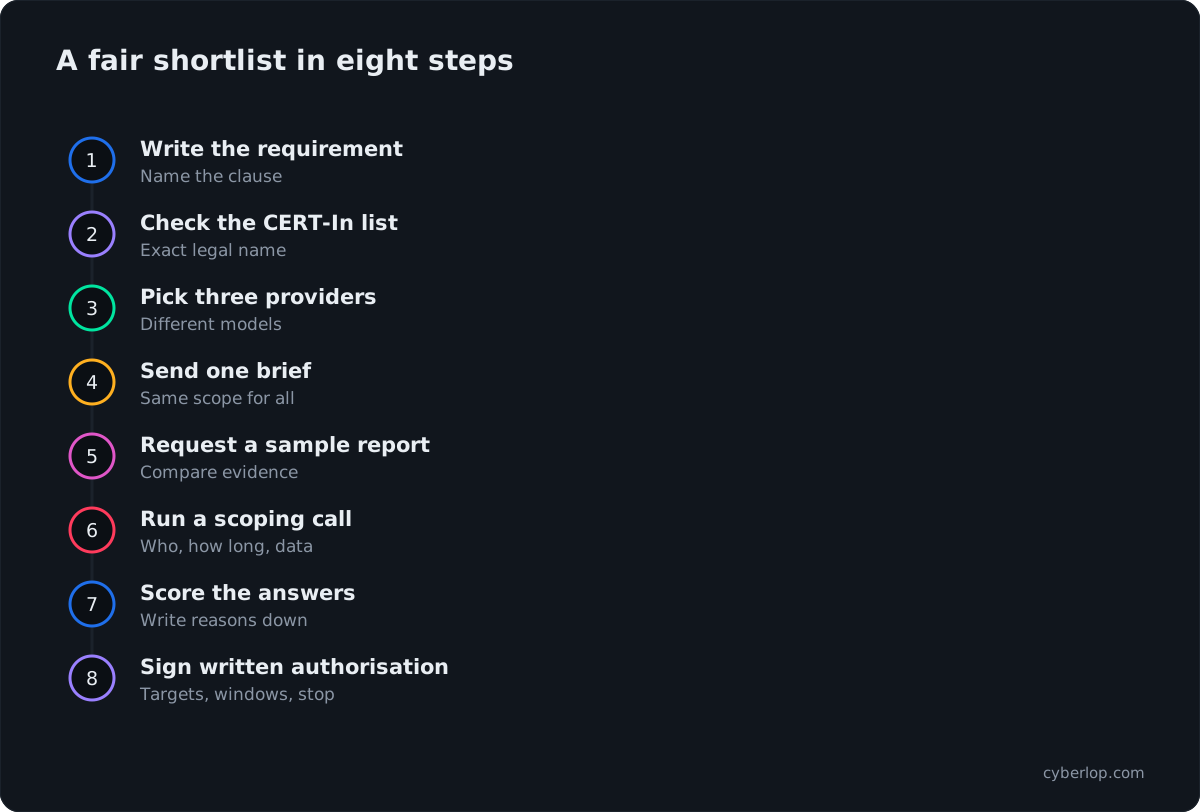
- Write the requirement. Does a regulator, customer or tender name an empanelled auditor? Write the clause down.
- Check the CERT-In list. Open the CERT-In list and confirm the exact legal name.
- Pick three providers. Choose different models: one consultancy-led, one platform-led, one tool-led if you can.
- Send one brief. Name the apps, APIs, environments, test accounts and dates. Say whether source access is available.
- Request a sample report. Compare structure, evidence and fix guidance.
- Run a scoping call. Ask who tests, how long, how retests work and where your data lives.
- Score the answers. Use the table below and write the reasons down.
- Sign a written authorisation. Name the targets, windows and stop conditions before any testing starts.
A scorecard you can copy
| Measure | How to score it (0 to 3) | Evidence to collect |
|---|---|---|
| Scope fit | Does the quote match your apps, APIs and roles? | Written scope, test accounts, exclusions |
| Report quality | Could a developer reproduce a finding alone? | Sample report with requests and responses |
| Logic depth | Does the sample show cross-account or workflow findings? | Two named examples |
| Retest | Is the retest window and method stated? | Written terms |
| Data handling | Where do code, keys and reports sit? | Written answer, and a deletion date |
| Regulatory fit | Is empanelment required, and met? | Exact name on the CERT-In list |
Use the VAPT checklist to prepare accounts, data and contacts before kick-off. Plan the result using the vulnerability remediation process, and ask about the retest in advance. A closed-loop retest replays the original exploit against the fix.
Which questions expose weak providers fastest?
- "Show me a finding where a signed-in account reached another account's data. How was it proven?"
- "Who writes the report, and who reviews it?"
- "What happens to my source code and credentials after the test?"
- "How do you handle a false positive that a developer disputes?"
- "What is in the retest, and by when?"
How do regulation and customers shape the choice?
Contracts and rules often decide this more than features do. Some vendors, for instance Kratikal Tech, name RBI and SEBI among the requirements they address, so ask any provider to state which frameworks it has delivered against, and ask for the clause rather than the claim.
For payments, the PCI DSS testing rules in requirement 11.4 shape scope and frequency; see PCI DSS 11.4. For personal data, see the DPDP Act. For a bank-facing app, read the RBI cybersecurity framework term. For a regulated product, see regulated teams.
Which penetration testing company is right for you?
Pick by your constraint, then confirm with a sample report. If a clause demands an empanelled auditor, start with the eight providers above that appear on the CERT-In list, and verify the name. If you ship weekly and want a portal, look at platform-led options such as Astra Security, Kratikal Tech or Qualysec. If your app includes hardware or firmware, look at Payatu. If you want one firm for testing plus compliance work, look at Briskinfosec, Kratikal Tech or Network Intelligence.
If you want proof-backed findings with code lines, and the ability to re-run the exact exploit after a fix, include Cyberlop in the trial. Whoever you pick, ask for a sample report, a stated retest, and a written answer on data handling. Agencies and MSSPs can read pentest platform for MSSP; the agencies page covers white-label use.
Questions people ask
Best penetration testing companies in india: FAQs
What are the best penetration testing companies in India?
There is no single best. Nine providers worth shortlisting are Astra Security, Briskinfosec, Cyber Security Works, Indusface, Kratikal Tech, Network Intelligence, Payatu, Security Brigade and Qualysec. Choose by scope, regulator, report quality and retest terms, and ask each for a sample report.
Is CERT-In empanelment mandatory for a penetration test?
Not by default. It matters when a regulator, a government tender or a customer contract names an empanelled auditor. Read the clause, then check the exact legal name on the CERT-In list. For startups without such a clause, report quality usually matters more.
How do I verify that a company is CERT-In empanelled?
Open CERT-In's published list of empanelled information security auditing organisations and search for the registered company name, not only the brand. The list says it is updated as changes occur, so check it again on the day you sign.
What should a penetration testing report include?
It should include scope, method, each finding with a request, a response and reproduction steps, severity and confidence, CWE and OWASP references, fix guidance and a retest status. See how to read a penetration test report for a buyer workflow.
How long does a penetration test take?
It depends on the number of apps, APIs, roles and environments in scope, and on whether source access is shared. Ask each provider for a written timeline against your own scope, including the report date and the retest window.
What is the difference between VAPT and a penetration test?
Vulnerability assessment lists likely weaknesses, often with a scanner. A penetration test goes further and tries to exploit them to prove impact. VAPT combines both. Ask the vendor which one you are buying and what evidence each finding carries.
Should I choose a consultancy, a PTaaS platform or an automated tool?
Choose a consultancy for fixed audits, a PTaaS platform for frequent releases and developer collaboration, and an automated tool for scheduled regression checks. Many teams combine a yearly human-led test with testing on each release.
Where does Cyberlop fit among Indian penetration testing providers?
Cyberlop finds vulnerabilities in web apps and their APIs with black-box, grey-box and white-box pentesting, and reports only what it exploited, with the request, the response and the line of code. Ask us to run it on one of your applications.
Sources
Where the facts come from
- CERT-In: Empanelled Information Security Auditing Organisations
- CERT-In: Directions under section 70B(6) of the IT Act, 28 April 2022
- Verizon: 2026 Data Breach Investigations Report
- IBM: Cost of a Data Breach Report 2026
- CISA: Known Exploited Vulnerabilities Catalog
- Astra Security: home page
- Briskinfosec: home page
- Cyber Security Works: home page
- Indusface: home page
- Kratikal: home page
- Network Intelligence: home page
- Payatu: home page
- Security Brigade: home page
- Qualysec: home page
Keep reading
Related articles
Astra Security alternatives in 2026: nine options and how to choose
Astra Security alternatives compared from vendor sites: human-led PTaaS, AI pentesting, DAST in CI, attack surface tools and open source.
Best AI pentesting tools in 2026: ten compared, and how to choose
Ten AI pentesting tools compared from vendors' own sites, with a scoring sheet, a table by category and a plan for a fair trial on your own app.
Best PTaaS Platforms in 2026: 9 Compared on Evidence, Retesting and Reporting
Nine PTaaS platforms compared on scope, evidence, retesting and reporting, from vendors' own sites, with six criteria to choose by.

Want proof on your own app?
Cyberlop finds vulnerabilities in web apps and their APIs and reports only what it exploited, with the request, the response and the line of code. Ask us to run it on one of your applications.
Or start with a $199 pilot on one application: thirty days, success criteria agreed before day one, credited against the annual if you convert.